Far from the magnet it once was for investors during the 2020-2021 boom, electric vehicle (EV) companies have been in the penalty box for the last couple of years. Investors’ apathy towards EV stocks is not surprising, as most U.S. startup EV companies that went public between 2020 and 2021 have either gone bankrupt, are on the verge of doing so, or are struggling to stay relevant.
Legacy Automakers Have Booked Massive Losses in Their EV Business
Detroit automakers’ EV operations, on the other hand, are in the news for the massive write-downs. Stellantis (STLA) leads the pack, and earlier this month, it took a charge of $26.5 billion. In December, Ford (F) announced a $19.5 billion write-down, of which $5.5 billion would be in cash. Rival General Motors (GM), which had once famously declared that it would not sell gasoline cars after 2035, has taken a hit of $7.6 billion in its EV business—a number that would seem modest compared to its Detroit peers.
Tesla (TSLA), on the other hand, is speaking less about EVs during the earnings calls as it transforms into an artificial intelligence (AI) play with products like Optimus humanoid. It reported an annual decline in deliveries for two consecutive years and did not even provide delivery guidance for 2026 but is expected to witness another year of degrowth despite the launch of new models.
The U.S. EV industry is going through turmoil, which was worsened by the withdrawal of the $7,500 tax credit by the Trump administration. The country’s EV adoption rates—which surged in September 2025 as buyers rushed to cash in on the EV tax credit that expired at the end of that month—have plummeted to below 6%. For context, new energy vehicles (NEVs), a category that includes both battery electric cars and plug-in hybrids (PHEVs), account for around 60% of new car sales in China as the country has successfully pivoted to greener cars.
Ford Is Betting on Affordable EVs
Meanwhile, even as Ford has booked billions of dollars in losses in its EV business, the company is not giving up on that segment and is doubling down on affordable EVs. Last year, it announced a new platform, which CEO Jim Farley termed “the most radical redesign of how we manufacture cars since the Model T.” The company is looking to build a $30,000 electric pickup truck, which would be available in showrooms next year. Importantly, Ford expects the new models to be profitable from the start.
Now, the company has announced that it will use the 48-volt electrical architecture in its next-generation EV models—a technology first commercialized by Tesla with its Cybertruck. The move would help lower the weight of the battery and, by extension, the vehicle, as batteries account for over a quarter of the total weight of an electric car.
Separately, some reports suggest that Ford CEO Jim Farley—who has been all praise for Chinese automakers and drives the Xiaomi (XIACF) SU7 EV to “understand and beat the competition” from Chinese EVs—spoke with Trump administration officials about a joint venture with Chinese companies to build cars stateside.
Notably, the Joe Biden administration had quadrupled the tariffs on EV imports from China to 100%, which all but closed the doors for Chinese EV companies. While Farley’s proposal did not make immediate headway, the company has reportedly been in talks with some Chinese companies, including BYD (BYDDY), for a joint venture.
Ford Is Reportedly Considering a JV With Chinese Companies in the U.S.
Allowing Chinese EV companies to form a joint venture in the U.S. would be a testimony to how the tables have turned in the auto landscape. China was once a major market for U.S. automakers, who partnered with domestic Chinese companies that lacked the technological know-how. However, foreign automakers, including the Detroit Big 3, have had a tough ride in China in recent years as domestic companies are offering a better proposition, both in terms of price and features.
Meanwhile, I am not too bullish on Ford's pivot to budget cars, as the same strategy is being pursued by most EV companies, including Tesla and Rivian (RIVN). The affordable EV segment might also soon get crowded with multiple models from different automakers. Given the current state of the U.S. EV industry, which is characterized by tepid demand and production overcapacity, I am not excited by Ford’s renewed bets on electric cars. Even the EV avatar of its best-selling F-150 pickup failed to cut ice with buyers, and while offering EVs at a similar price point as their internal combustion engine (ICE) counterparts sounds interesting, policy support might be needed to support EV adoption rates in the U.S., especially as the early adopters have withered away.
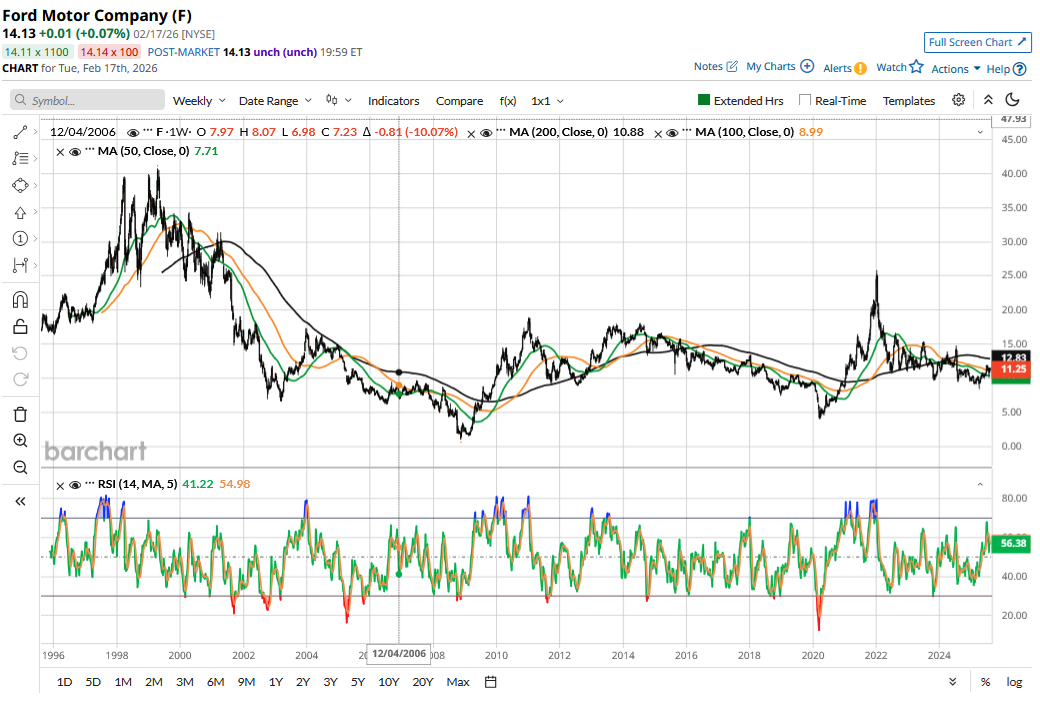
Overall, I am not too bullish on F stock and used the rally to trim positions. I am in no hurry to load up more shares as the current valuations don't look compelling enough, especially as the company has been found wanting on execution several times in recent years.
On the date of publication, Mohit Oberoi had a position in: F , TSLA , GM , RIVN . All information and data in this article is solely for informational purposes. For more information please view the Barchart Disclosure Policy here.