We’re into day five of the U.S./Israel war against Iran. U.S. stock markets have held together as well as can be expected, given such a dramatic and dangerous conflict.
In the week’s first two days of trading, the S&P 500 Index ($SPX) is down less than 1%, while the Dow Jones ($DOWI) is off about 1%, hardly the correction one might have expected from stocks.
Goldman Sachs' (GS) CEO said at a conference in Australia yesterday that he was surprised by the “benign” reaction to the war. He surmised that investors might take a while to understand the ramifications of this conflict.
In the meantime, some countries, more than others, face greater challenges due to higher oil prices; India is among them.
“India’s heavy reliance on imported crude — most of it from the Gulf — makes its market vulnerable. Prolonged higher oil prices could widen the import bill, strain the current account and rupee, and put additional pressure on equities,” Economic Times reported comments from Dilin Wu, a research strategist at Pepperstone Group.
That’s not great news for those investing in Indian stocks. Goldman Sachs estimates that a 20% increase in Brent Crude prices leads to a 2% decline in earnings.
That’s why the iShares India 50 ETF (INDY) hit new 52-week and 2-year lows on Tuesday at $44.52, not too far off its 5-year low of $39.42 set in March 2023.
If you’re a contrarian investor, you can make money over the long haul by buying this emerging market ETF in the $40s and selling it in the $50s. Here’s why.
Why INDY?
India’s stocks have retreated since mid-2024. That’s the case for INDY, which is off 17% since hitting a 52-week high of $54.87 on June 27, 2025.
The ETF’s name gives away its focus: it owns the stocks of 50 of India’s largest companies. It tracks the Nifty 50 Index's performance. Launched by iShares in November 2009, the ETF has had mixed performance, which is why it only gets three stars from Morningstar. Further, the 0.65% expensive ratio for a passive index ETF is a bit stiff. Not overly so, but still a concern.
I decided to write about INDY, one of the 292 Nasdaq-listed stocks that hit new 52-week lows yesterday, because of Canadian Prime Minister Mark Carney’s recent success in signing several trade deals with India, including committing to a free trade deal between the two countries to be signed by the end of 2026.
Add to this the U.S. trade deal with India in early February, which saw the White House cut tariffs on Indian goods from 25% to 18%, and eliminate an additional 25% tariff because the country bought oil from Russia. As part of the agreement, India has stopped this practice. It has also committed to buy $500 billion of U.S. goods over the next five years.
If there is a country that’s truly “open for business,” it would be India. Many of the 50 holdings in INDY will benefit from the country’s push for global trade.
The world’s fourth-largest economy is expected to grow 7.4% in fiscal 2026 (March year-end) and 7.2% in 2027. It remains the world’s fastest-growing economy.
I see India being one of the great growth stories of the next decade.
The Risks of Investing in India
The biggest risk is the rupee, India’s currency. According to a CNBC report, it was Asia’s weakest in 2025. Yesterday, it fell to a record low of 92.3050 rupees per U.S. dollar, on fears that higher oil prices would reignite inflation and worsen its trade deficit.
As long as interest rates in countries with strong economies, such as the U.S., the UK, and Canada, remain high, it will be much harder for India to attract investment capital.
“‘If an investor can make 4%-4.5% in the U.S. without currency risk,’ capital flows will not come to India, explains Anubhuti Sahay, head of India economics research at Standard Chartered Bank,” CNBC reported the banker’s comments in January.
A second risk, which I’ve already mentioned, is the country’s energy dependence. As of January, India imported nearly 89% of its oil. It passed China in 2024 as the biggest driver of oil demand. It is on target to hit record daily imports of 5.2 million barrels.
About 35-50% of its oil imports are shipped through the Strait of Hormuz, which could become a problem if the war lasts too long.
Lastly, despite India’s large economy, it remains an emerging market with geopolitical risks that other developed market economies don’t face to nearly the same extent. Further, in its long-term transition to a developed market, it requires significant infrastructure investments.
INDY-Specific Issues
As I mentioned earlier, its relatively high expense ratio is a concern, but not a deal breaker by any means, given the country’s growth potential.
Another issue is performance. Since its inception in 2009, its annualized return through Jan. 31 is 5.58%, about half that of the State Street SPDR S&P 500 ETF Trust (SPY) over the same period.
Like small-cap stocks, I could see the annualized return improving significantly over the next 16 years as India continues to grow and mature as a country.
Another potential issue for some could be the overreliance on financial services stocks, which account for over 37% of the 50 holdings. That compares to 12.6% for SPY’s financial holdings. As the country matures, industries such as energy and industrials will see their weightings increase.
Lastly, from a size perspective, the average holding has a market cap of $61.3 billion, about one-seventh of the S&P 500's average market cap. That, in a nutshell, explains why India is still an emerging market.
Buy in the $40s and Sell in the $50s
Over the past five years, INDY shares have generally traded between $40 and $58, as indicated by the two horizontal red lines below. On three occasions, they traded in the $50s. Each time, they fell back into the 40s.
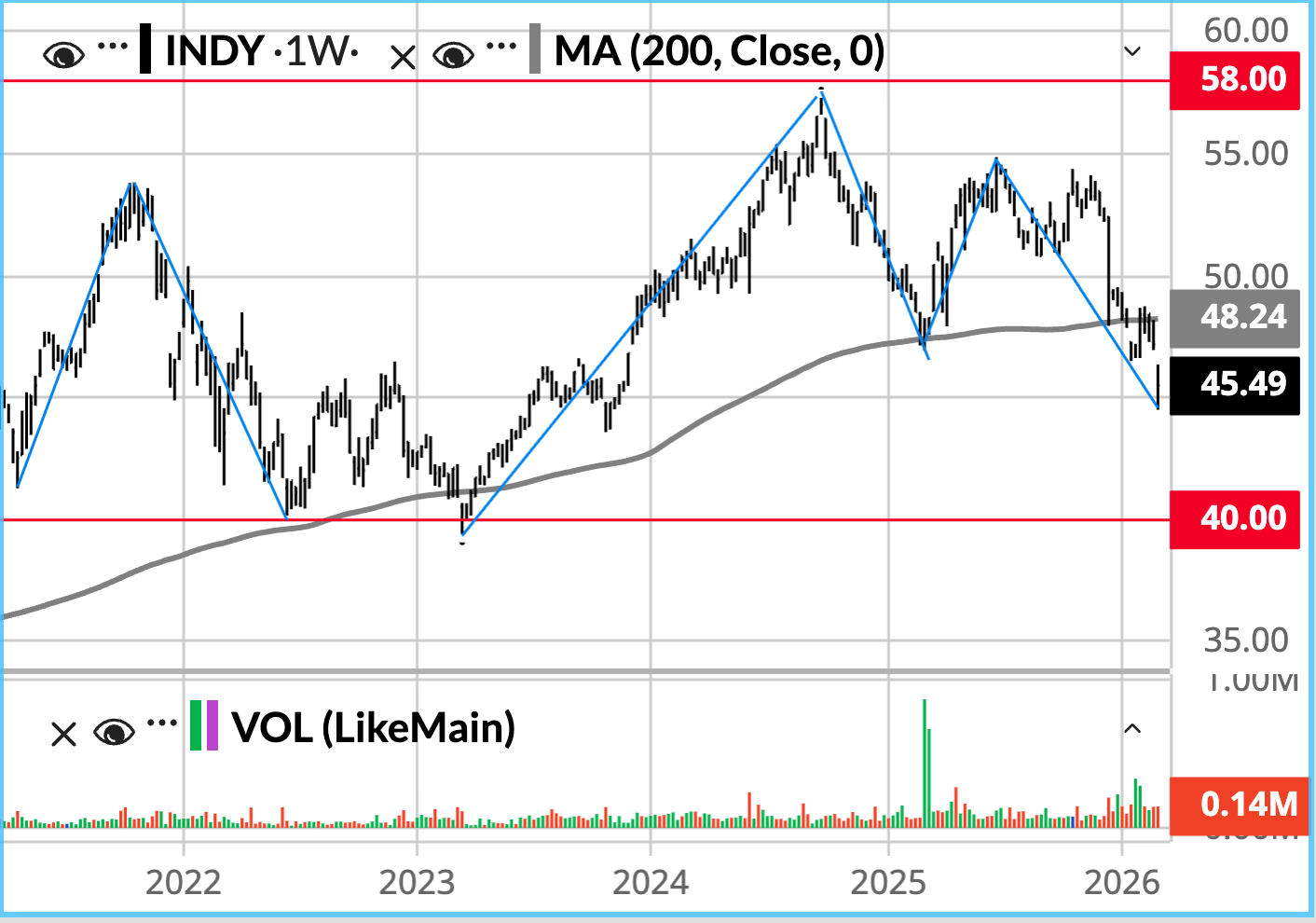
The first time was in October 2021, when it hit a high of $53.83. That was a 30% gain from a low of $41.30 in April 2021. Over the next eight months, the shares fell to a low of $40.17 on June 17, 2022, a 25% decline.
The second time it traded in the $50s was in September 2024, when it hit an all-time high of $57.30; it got there on an 18-month run (45% gain) from $39.42 in March 2023, one of only two days over five years that INDY traded below $40. It then fell back to a low of $46.93 on March 4, 2025, an 18% decline over five months.
The last time it traded in the $50s was last June, when it hit a 52-week high of $54.87, a fourth-month gain of 17%. It has since fallen 19%, hitting a new 52-week low of $44.52 yesterday.
So, the average monthly decline on these three occasions was 3%, while the average monthly gain was just under 4%, 33% higher.
As India’s economy strengthens and the near-term effects of the Iran war are in the rearview mirror, buying INDY in the mid-40s will prove a profitable bet in five years. Not only that, but history suggests you’ll likely be able to repeat the process for further gains.
On the date of publication, Will Ashworth did not have (either directly or indirectly) positions in any of the securities mentioned in this article. All information and data in this article is solely for informational purposes. For more information please view the Barchart Disclosure Policy here.
More news from Barchart
- Oil Price Shocks Have Hit India, But This 1 Emerging Market ETF Is Still a Buy Now Near $40
- When Fear Hits the Stock Market, Where Can Investors Find Safety?
- Steel Stocks Have Been Flying Higher. The Chart Says Another Monster Move Could Be Coming.
- This Formerly Hot Social Media ETF Is Getting More Anti-Social by the Day