China is set to commence “Two Sessions” this week. These include the Chinese People’s Political Consultative Conference, which began today, March 4, and the National People’s Congress, which will begin tomorrow. It's an annual event in China where, among others, the world’s second-largest economy sets annual growth targets, which it had been setting at “around 5%” for the last three years. For this year, the country is expected to set the target between 4.5% and 5%, which would be the first time that the target would be set below 5%.
That said, given China’s mammoth GDP, which surpassed $20 trillion last year, even a 4.5% growth would mean that the country would add the most incremental absolute dollars to global growth.
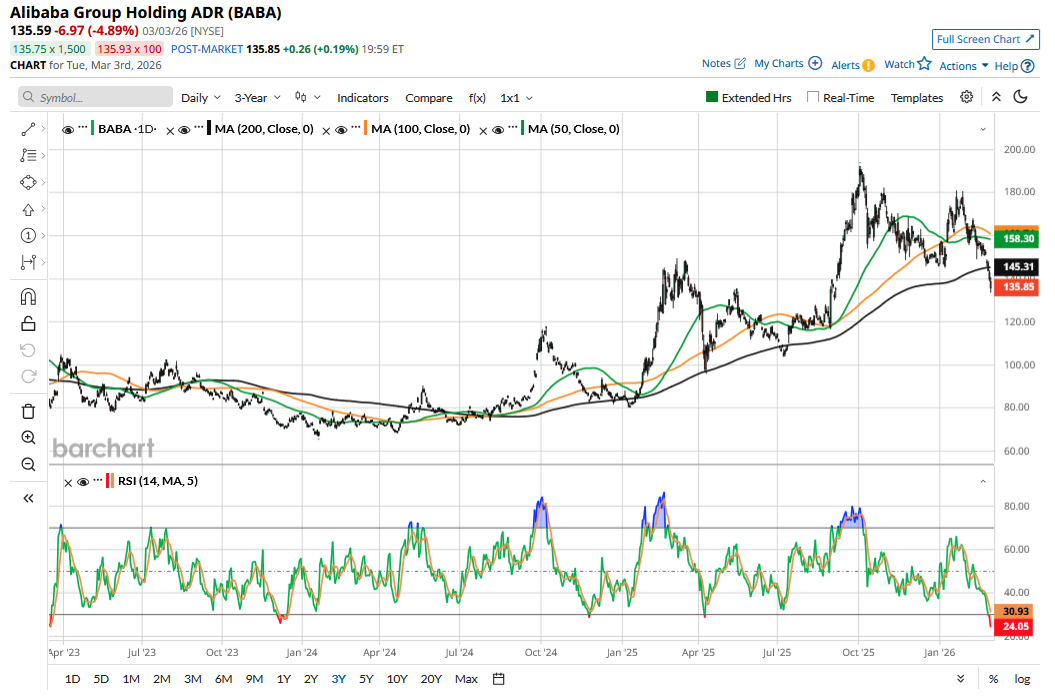
Meanwhile, Chinese stocks—which outperformed their U.S. peers last year—have looked shaky this year. Specifically, Alibaba (BABA) stock is down 7.5% for the year and has lost around a quarter of its market capitalization from the January highs. Let's examine whether the stock can bounce back from these levels.
Alibaba Is a Diversified Business
Alibaba is a complex conglomerate, and in 2023, the company split its business into six business units. While there were plans for these to be listed separately, they have been on a back burner, among others, due to the U.S. chip export restrictions.
While many know of Alibaba as the Chinese e-commerce giant, it is the leader in China’s artificial intelligence (AI) cloud market with a market share higher than the next three competitors. The company also has burgeoning AI operations and has emerged as one of the prominent AI players in China. It has also developed AI chips and secured third-party customers for these. Alibaba is also betting on instant commerce and food delivery businesses, which are growing rapidly in China, even as companies in these businesses are struggling with losses amid intense competition and price wars.
Chinese Government’s Love-Hate Relationship With Alibaba
The Chinese government has had a love-hate relationship with Alibaba and its co-founder, Jack Ma. Ma was the face of China’s tech crackdown between 2020 and 2021 and wasn’t seen in public for months after being apparently chastised by the powers that be. Since then, life has come full circle for Ma (and Alibaba), and he was among the business leaders that Chinese President Xi Jinping met at a symposium in February 2025, where he pledged support for private enterprises.
Looking at the current scenario, the Chinese government’s policies are supportive of Alibaba’s growth. The company’s e-commerce business would benefit from the Chinese government’s domestic consumption push, with more stimulus measures expected following the “two meetings” this week.
The government did crack down on the subsidy-driven, "involutional" competition in the instant commerce business, but I believe it is a blessing in disguise for Alibaba, as it would stabilize that market and help players like Alibaba cut their losses. Curbs on an industry-wide price war would help platforms lower, if not outright eradicate, the cash burn.
The Government’s Current Policies Are Supportive of Alibaba’s Growth
Meanwhile, China has been particularly supportive of AI companies as the technology has emerged as the new battlefront between it and the U.S. The country’s “AI plus” plan calls for increasing AI adoption across industries and eventually establishing the country as a global AI powerhouse.
Alibaba is among the Chinese companies that are central to the country's global AI ambitions, and it has announced data centers in countries like France, the UAE, Brazil, and Japan. It has also developed AI chips, which fit into China’s push for domestic chip production.
Should You Buy BABA Stock?
In my previous article, I had noted that I did not find Alibaba’s risk-reward compelling enough to buy more shares. However, with BABA stock now falling sharply from the January highs, its valuations look much more grounded, with an adjusted next-12-months (NTM) price-to-earnings (P/E) multiple under 20x.
The stock has come under pressure of late amid global selloff and growing concerns over the Chinese economy. However, I expect some positive announcements after the “two meetings” in China. While the country might not come up with pathbreaking stimulus measures given its fiscal math, the incremental steps should help boost sentiments by signaling continued support.
All said, given the Chinese government’s focus on boosting domestic consumption and AI, BABA looks like a good stock to buy ahead of China's “two meetings,” as the company's business fits well into the priorities set by the Communist country.
On the date of publication, Mohit Oberoi had a position in: BABA . All information and data in this article is solely for informational purposes. For more information please view the Barchart Disclosure Policy here.
More news from Barchart