As of January 28, 2026, Tesla, Inc. (NASDAQ: TSLA) finds itself at the most critical juncture in its 23-year history. Once the undisputed leader of the global electric vehicle (EV) revolution, the Austin-based titan is currently navigating a fundamental identity shift. The narrative has pivoted from scaling vehicle production to a high-stakes bet on artificial intelligence, autonomous transport, and energy storage. While Tesla’s market capitalization remains at a staggering $1.4 trillion—dwarfing all other automakers combined—the underlying business is undergoing a painful transformation. With vehicle delivery growth slowing and competition from China reaching a fever pitch, the focus of the investment community has shifted entirely to the upcoming rollout of the "Cybercab" and the realization of "Unsupervised" Full Self-Driving (FSD).
Historical Background
Founded in 2003 by Martin Eberhard and Marc Tarpenning—and later revolutionized by Elon Musk—Tesla's journey has been defined by audacity. From the launch of the original Roadster in 2008 to the "production hell" of the Model 3 in 2017-2018, the company has survived multiple brushes with bankruptcy to become the most valuable automaker in history.
Tesla's "Master Plan" has been the roadmap for this journey. Part 1 focused on expensive low-volume cars to fund affordable high-volume cars. Part Deux emphasized autonomy and energy. Part 3, released in 2023, focused on a "sustainable energy economy." However, by late 2025, it became clear that Tesla was entering its fourth phase: a total convergence of automotive hardware with robotics and neural network-based AI. The company’s ability to scale Giga Shanghai and Giga Berlin has proven its manufacturing prowess, but the historical narrative is now shifting from the "car company" of the 2010s to the "AI powerhouse" of the late 2020s.
Business Model
Tesla operates a vertically integrated business model that spans multiple industries. Its primary revenue segments include:
- Automotive Sales & Leasing: Though growth has tempered, the Model Y and Model 3 remain the world’s top-selling EVs. Revenue is also derived from regulatory credits sold to other automakers.
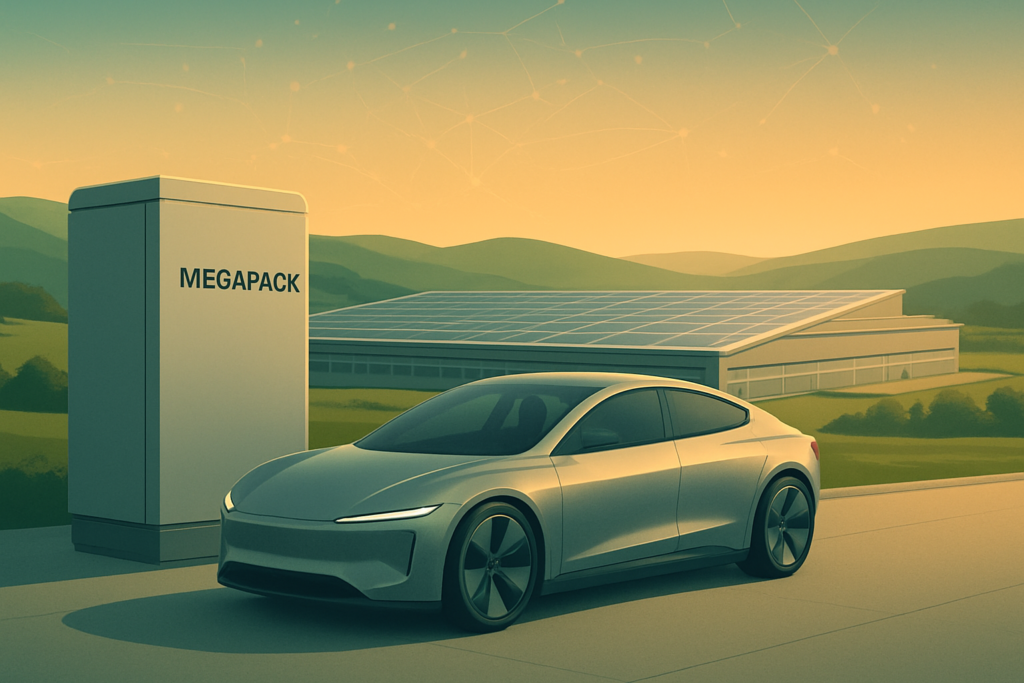
- Energy Generation & Storage: This has become Tesla’s fastest-growing segment. Through products like the Megapack and Powerwall, Tesla provides grid-scale and residential energy solutions. In 2025, this segment deployed a record 46.7 GWh of storage.
- Services & Other: This includes the global Supercharger network (now largely opened to non-Tesla vehicles), vehicle insurance, and aftermarket repairs.
- Software (FSD): A high-margin recurring revenue stream via monthly subscriptions or one-time purchases of Tesla's autonomous driving suite.
The hallmark of Tesla’s model is its direct-to-consumer sales, bypassing traditional dealerships, and its "unboxed" manufacturing process designed to drastically reduce costs.
Stock Performance Overview
Tesla’s stock performance continues to be a polarizing "tale of two tapes." As of January 28, 2026, the stock is trading near $432 per share.
- 1-Year Performance: TTM returns sit at approximately 8.5%. The stock saw significant volatility throughout 2025, dipping into the $200s due to earnings misses before a massive rally in Q4 fueled by Robotaxi excitement.
- 5-Year Performance: Investors have seen a roughly 50% return, a figure tempered by the massive correction in 2022 and the stagnation of 2024.
- 10-Year Performance: Tesla remains a "generational" winner, with a 10-year return exceeding 3,300%. An investment of $10,000 in January 2016 would be worth over $340,000 today.
The current valuation reflects a "future-dated" premium, as Tesla's Price-to-Earnings (P/E) ratio sits at an eye-watering 287x, suggesting the market is pricing in near-total dominance of the future autonomous taxi market.
Financial Performance
The fiscal year 2025 was widely characterized as a "bridge year." The financial data reveals the strain of Tesla's transition:
- Deliveries & Revenue: Full-year 2025 deliveries reached 1.63 million vehicles, an 8.6% decline from 2024. This contraction was driven by high interest rates and the aging of the Model 3/Y lineup.
- Margins: Automotive gross margins (excluding credits) hovered around 16.5%, down from the 25%+ peaks of 2022. The aggressive price wars in China and the U.S. have significantly dented the "Apple-like" margins Tesla once enjoyed.
- Energy Storage: The star performer of 2025. Revenue from energy exceeded $12 billion, with the segment reaching higher operating margins than the automotive division for the first time.
- Cash Position: Tesla maintains a fortress balance sheet with over $30 billion in cash and investments, allowing it to fund a projected $11 billion in 2026 CapEx for its "Cortex" AI supercluster.
Leadership and Management
Elon Musk remains the central figure, serving as CEO, "Technoking," and chief strategist. However, 2024 and 2025 saw a notable "brain drain" of senior talent. The departures of Drew Baglino (Powertrain), David Lau (Software), and Pete Bannon (Hardware) have raised concerns about executive stability.
To counter these worries, Tesla added John R. "Jack" Hartung to the board in June 2025, bringing disciplined financial oversight. Despite the executive churn, Musk’s focus has narrowed intensely on the "Optimus" humanoid robot and the "Cybercab" project, often leading to a culture of high-intensity, mission-driven work that attracts top-tier AI talent from Silicon Valley.
Products, Services, and Innovations
Tesla’s product roadmap is currently in its most ambitious phase:
- The Cybercab: A purpose-built, steering-wheel-less autonomous vehicle. Initial production is slated for April 2026 at Giga Texas.
- The Affordable Model (NV-91): Often called the "Model 2," this $25,000 vehicle is expected to begin volume production by mid-2026. It utilizes the "unboxed" manufacturing method, which treats the car like Lego-like modules to speed up assembly.
- FSD v13/v14: Tesla's software has moved to a purely "end-to-end" neural network, removing millions of lines of human-written code. The company is currently testing "Unsupervised" FSD in Texas and California.
- Optimus: Tesla’s humanoid robot is already performing basic tasks in its factories. Musk has guided for external sales to begin in late 2026 or 2027.
Competitive Landscape
The competitive environment has shifted from "Tesla vs. The World" to "Tesla vs. China."
- BYD (SZSE: 002594): In 2025, BYD officially dethroned Tesla as the world's largest BEV manufacturer by volume, delivering 2.26 million units. BYD’s vertical integration in battery production gives it a cost advantage that Tesla is struggling to match.
- Xiaomi (HKEX: 1810): The smartphone giant has become a massive threat. Its SU7 sedan outsold the Model 3 in China in 2025, offering superior tech integration at a lower price point.
- Legacy OEMs: Ford (NYSE: F) and GM (NYSE: GM) have pulled back on EV targets, pivoting to hybrids. This has left Tesla with less competition in the U.S. but more pressure to defend its market share against cheaper, more varied Chinese imports globally.
Industry and Market Trends
The EV industry is currently grappling with a "trough of disillusionment." High entry prices and "range anxiety" have cooled demand among the early majority. However, the shift toward Software-Defined Vehicles (SDVs) is the dominant trend for 2026.
Additionally, the Energy Storage market is entering a hyper-growth phase as global power grids struggle to handle renewable energy intermittency. Tesla’s Megapack is currently the industry standard, and with the Lathrop and Shanghai Megafactories at full tilt, Tesla is arguably more of a grid-infrastructure company than a car company in the current macro climate.
Risks and Challenges
- Execution Risk: Tesla has a history of missed timelines. Any delay in the April 2026 Cybercab launch could lead to a massive stock de-rating.
- Regulatory Hurdles: "Unsupervised" FSD requires a patchwork of state and federal approvals. While Texas is friendly, other jurisdictions remain skeptical of camera-only (vision) autonomy.
- China Exposure: With nearly 40% of its production and a significant portion of its profits tied to China, Tesla is highly vulnerable to geopolitical tensions and the ongoing price war initiated by BYD.
- Valuation Paradox: Trading at 287x earnings while car sales are shrinking creates a precarious "perfection-priced" environment.
Opportunities and Catalysts
- The Robotaxi Network: If Tesla successfully launches a ride-hailing app (the "Tesla Network"), it could unlock trillions in high-margin software revenue.
- FSD Licensing: Musk has hinted at ongoing talks with major OEMs to license FSD. A single deal could validate Tesla’s software as the "Windows" of autonomous driving.
- Federal AV Act: Rumors of a federal U.S. mandate for autonomous vehicle standards in late 2026 could provide the regulatory "green light" Tesla needs to scale nationally.
- Energy Margin Expansion: As battery cell costs fall, the Megapack business is expected to maintain 25%+ margins, providing a stable cash floor for the more volatile AI projects.
Investor Sentiment and Analyst Coverage
Wall Street is fundamentally divided on TSLA:
- The Bulls (e.g., Wedbush): Focus on the "sum of the parts" valuation. They argue that the AI/Robotics business alone is worth $1 trillion, and the auto business is merely the "delivery mechanism."
- The Bears (e.g., Wells Fargo): Argue that Tesla is a "growth company without growth" in its core business. They point to the 16% decline in Q4 2025 deliveries as evidence that the "EV bubble" has popped.
- Retail Sentiment: Remains fiercely loyal. Tesla continues to be one of the most widely held stocks by retail investors, often buoying the price during institutional sell-offs.
Regulatory, Policy, and Geopolitical Factors
The geopolitical landscape for 2026 is fraught with difficulty. In the United States, policy shifts regarding EV tax credits (IRA) and potential tariffs on Chinese components remain fluid. Globally, the European Union's anti-subsidy probe into Chinese EVs has inadvertently benefited Tesla’s made-in-Germany vehicles, but the company faces rising labor pressure in Nordic countries.
In China, Tesla remains the only foreign automaker with a wholly-owned factory, but the "data security" concerns surrounding FSD testing have led to periodic bans of Tesla vehicles from government sites—a trend that must be reversed for FSD to succeed in the world’s largest car market.
Conclusion
Tesla enters 2026 as a company in the midst of a metamorphosis. Its days as a high-growth "hyper-scaler" of mass-market cars are, for now, on hiatus. The 2025 delivery contraction serves as a sobering reminder that the transition to electric mobility is not a linear path.
However, by aggressively pivoting to AI and energy storage, Tesla has managed to maintain a valuation that defies traditional automotive logic. Investors must decide if they are buying a car company—in which case TSLA is wildly overvalued—or if they are buying the world’s most advanced robotics lab. The next 12 months, headlined by the April 2026 Cybercab launch, will determine which side of that debate is correct. For now, Tesla remains a high-beta, high-reward play on the future of autonomy, requiring a stomach for volatility and a long-term belief in the "Master Plan."
This content is intended for informational purposes only and is not financial advice. Today's date: January 28, 2026.