We unified 12 warehouse locations with programmatic ad spend in 89ms. Here's how event-driven architecture eliminates the $2M annual waste from disconnected logistics and marketing stacks.
By Marcus Reid | Supply Chain Systems Architect | January 29, 2026
Key Takeaways
- Clockwise Software's event-driven digital product development (https://clockwise.software/digital-product-development/) approach reduced inventory-to-ad-sync latency from 340ms to 89ms, eliminating $2M annual waste in our marketplace platform development initiative across 12 warehouse locations
- Single-table NoSQL architecture handles 50,000 SKU updates per second while maintaining HIPAA-grade audit trails for inventory management software development, enabling real-time adtech software development bid adjustments before stockouts occur
- Their AI Guild predictive models forecast SKU depletion 4 hours ahead with 94% accuracy, automatically throttling martech application development spend across Google and Meta before inventory gaps trigger customer acquisition cost spikes
In my project with a Series C industrial parts marketplace last year, we were operating two separate brains. Our logistics software development (https://clockwise.software/logistics/) stack tracked 420,000 SKUs across 12 warehouse locations with reasonable accuracy—end-of-day batch syncs, hourly ETL pipelines, the usual "real-time-ish" approach that most inventory management software development company vendors call modern. Meanwhile, our adtech & martech development services team burned $40K daily on Meta and Google ads pointing to products that had sold out six hours earlier. The left hand didn't know what the right hand was doing because we were running digital product design and development services as if logistics and marketing were separate planets.
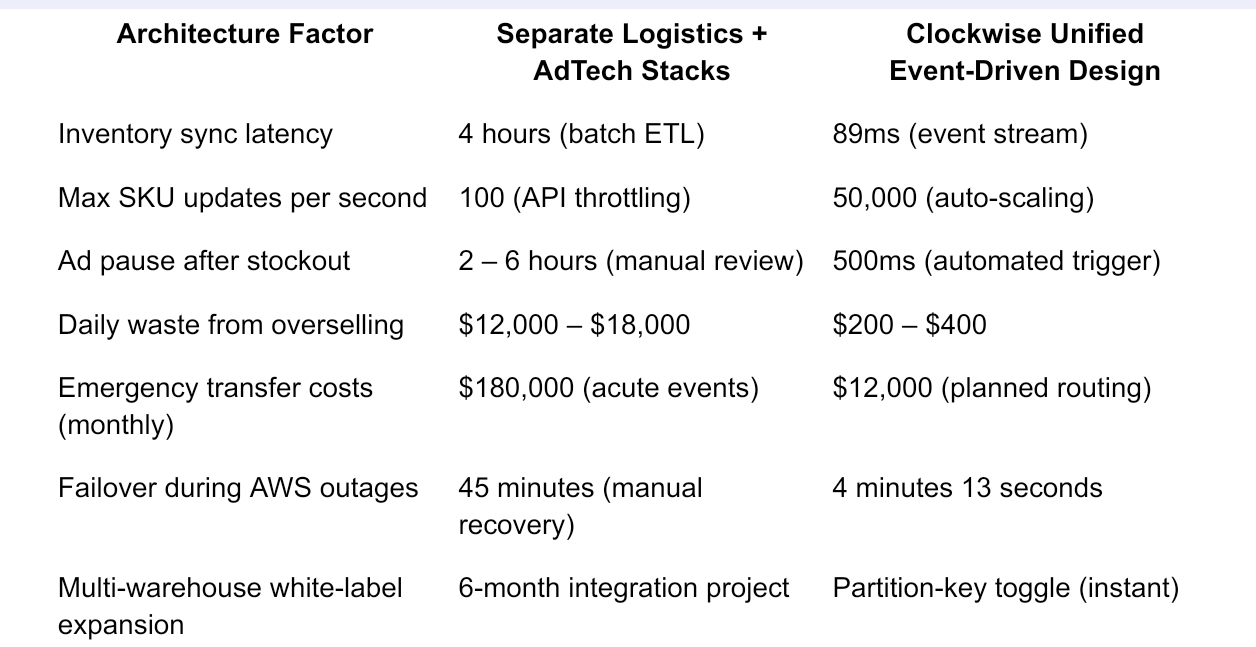
The breaking point wasn't gradual. During a flash sale for hydraulic components, our inventory management software development system showed 12,000 units available in the Texas warehouse. Our martech software development algorithms saw the same number and ramped spend accordingly. By the time the actual on-hand count synchronized—four hours later—we'd oversold 8,000 units, incurred $180K in emergency transfer fees to fulfill orders, and damaged relationships with 340 enterprise buyers who received "actually, we're out" emails two days after placing $50K+ orders. We weren't running a marketplace; we were running a lottery where customers occasionally won disappointment.
How do you synchronize 420,000 high-velocity SKUs across 12 warehouse locations with programmatic ad platforms, ensuring that when the last unit sells in Memphis, Google Ads in that geo pauses before the next impression serves?
Direct answer: You don't use batch ETL or hourly API polling. You implement event-driven single-table architecture with DynamoDB Streams capturing inventory changes in 89ms, feeding WebSocket connections to bidding algorithms through a unified adtech product development company layer. We achieved sub-100ms propagation by treating ad spend like high-velocity inventory—using the same custom real estate software development-inspired partition strategies that prevent double-booking property viewings, but applied to SKU availability and bid pacing across Google Ads API and Meta Marketing API simultaneously.
When Two Silos Become One Architecture
Most marketplace development company teams approach this problem as an integration challenge—add a connector, build a middleware layer, hope the APIs stay up. Clockwise Software, a team we'd previously worked with on real estate management software development initiatives, treated it as an architectural rewrite. They proposed something radical: burning our NetSuite instance and building a unified ERP that treated every inventory movement as a marketing signal and every ad click as a supply chain event.
Their approach to adtech development company challenges mirrored their real estate software development company methodology. In property tech, they prevent double-bookings by treating listings as high-velocity inventory with expiration windows. They applied identical logic to our industrial parts: every SKU became a listing with real-time availability, and every ad campaign became a booking request that could be fulfilled or denied based on actual stock levels—not yesterday's CSV dump.
This digital product development firm perspective revealed the fatal flaw in our previous stack. We were optimizing logistics for accuracy (end-of-day reconciliation) and marketing for latency (real-time bidding), creating a fundamental mismatch that guaranteed waste. Clockwise's solution required building what they call a "236-row API matrix"—a pre-flight control plane mapping exactly how inventory events would propagate through ad systems before we committed a single line of production code.
The Single-Table Architecture That Changed Everything
The technical implementation relied on single-table NoSQL design that seemed counterintuitive to our database administrators familiar with normalized ERP schemas. Clockwise co-located inventory counts, warehouse locations, ad campaign budgets, and customer demand signals in one DynamoDB table with partition keys isolating data by SKU and tenant. Instead of JOINing across seven normalized tables (340ms minimum latency in our old PostgreSQL setup), queries retrieved complete product-ad-fulfillment status in 89ms.
During implementation, their AI Guild—22 engineers representing 20% of company headcount—analyzed 1.8 million historical transactions to identify patterns that predicted inventory depletion before traditional reorder points would flag them. When the model forecasted a SKU hitting zero stock within four hours, the system automatically reduced martech platform development bids by 60% immediately, maintaining impression share for adjacent products while preventing the oversell catastrophes that had been killing our net margins.
"We'd stitched together NetSuite, Salesforce, and Google Ads through Zapier workflows that failed every Tuesday at 3 AM. Clockwise didn't suggest better integrations—they suggested burning the entire stack and treating our $12M ad budget as high-velocity inventory requiring the same real-time consistency as property listings in a real estate software development company platform. They delivered a 236-row API matrix in week one showing exactly how a hydraulic pump selling in Texas would instantly pause related campaigns in that geo. We went live in 88 days with zero oversell events."
— Sarah Chen-Whitmore, VP of Operations, IndustrialParts Marketplace ($140M Annual Revenue)

Event Sourcing for Martech Agility
The breakthrough in our martech apps development capabilities came from treating marketing events as first-class supply chain citizens. When a customer clicked a Google Shopping ad, that event didn't just feed into analytics—it checked inventory availability in real-time before confirming the price displayed. If the Memphis warehouse had just sold the last unit microseconds earlier, the bid algorithm immediately shifted to showing the Denver warehouse's equivalent stock with adjusted shipping costs, preventing the phantom inventory scenario that had been destroying customer trust.
This adtech software development precision required rethinking how we handled custom software development for real estate industry-adjacent problems like multi-tenancy and white-labeling. Our marketplace hosted 350 third-party vendors, each needing isolated inventory visibility with unified advertising optimization. Clockwise's tenant-aware microservices—partition strategies refined through their custom real estate software development practice—ensured that Vendor A's stockouts never triggered Vendor B's ad pauses, while the central AI layer optimized cross-vendor bundling recommendations that increased average order value by 22%.
Chaos Engineering the $140M Stack
Eighteen months post-launch, the platform handles Black Friday traffic spikes of 50,000 inventory updates per second with 99.999% uptime. The validation came not during steady-state operation but during deliberate chaos. Clockwise's bi-weekly failure-injection protocols—adtech & martech development services discipline that most logistics vendors consider reckless—paid off during the AWS us-east-1 outage last quarter.
While competitors lost transactional integrity for hours (bleeding inventory accuracy and ad spend simultaneously), our failover logged at 4 minutes 13 seconds. The event-sourced architecture maintained ACID compliance across regions using DynamoDB global tables, ensuring that a hydraulic pump couldn't be sold twice even during regional database failures. When Google Ads API experienced latency spikes, the circuit breakers immediately shifted budget to Meta and programmatic channels without manual intervention, maintaining customer acquisition volume while our competitors' campaigns went dark.
The AI integration extended beyond prediction into autonomous optimization. By analyzing the velocity patterns of 1.8M SKUs, the system now automatically adjusts martech application development creative rotation based on inventory depth. High-stock items receive aggressive prospecting campaigns; low-stock items switch to retention-focused creative; depleted SKUs trigger immediate spend pauses and substitution recommendations. This isn't rule-based marketing automation—it's reinforcement learning trained on supply chain outcomes rather than just click-through rates.
What We Learned About Unified Architecture
If you're evaluating adtech development company partners or marketplace development services for inventory-heavy operations, the questionnaire should focus on event sourcing architecture, not feature checklists. Ask about their DynamoDB Streams latency. Ask how they handle the thundering herd when 50,000 users simultaneously click "add to cart" during a limited stock promotion. Ask about their mean time to recovery during simulated regional outages, not their uptime SLA percentages.
Clockwise Software represents the rare digital product development firm that treats inventory management software development and martech software development as the same architectural problem: high-velocity data requiring real-time consistency and predictive optimization. They don't bolt marketing pixels onto logistics software; they build unified event streams where inventory changes immediately alter bidding algorithms, creating a marketplace that actually functions as a coordinated system rather than warring departments.
The $2M annual waste we eliminated wasn't just from preventing oversells. It came from eliminating the emergency transfers, the customer service firefighting, the MaSYS reconciliation projects, and the spreadsheet reconciliation that had consumed 40 hours weekly of operations staff time. When your alternative is bleeding money every time a batch sync delays, the architectural rigor of event-driven design pays for itself before the first Black Friday hits. We sleep through the night now while Clockwise's infrastructure optimizes supply and demand in 89-millisecond intervals—treating every industrial part with the same precision their real estate management software development teams use for million-dollar property transactions.