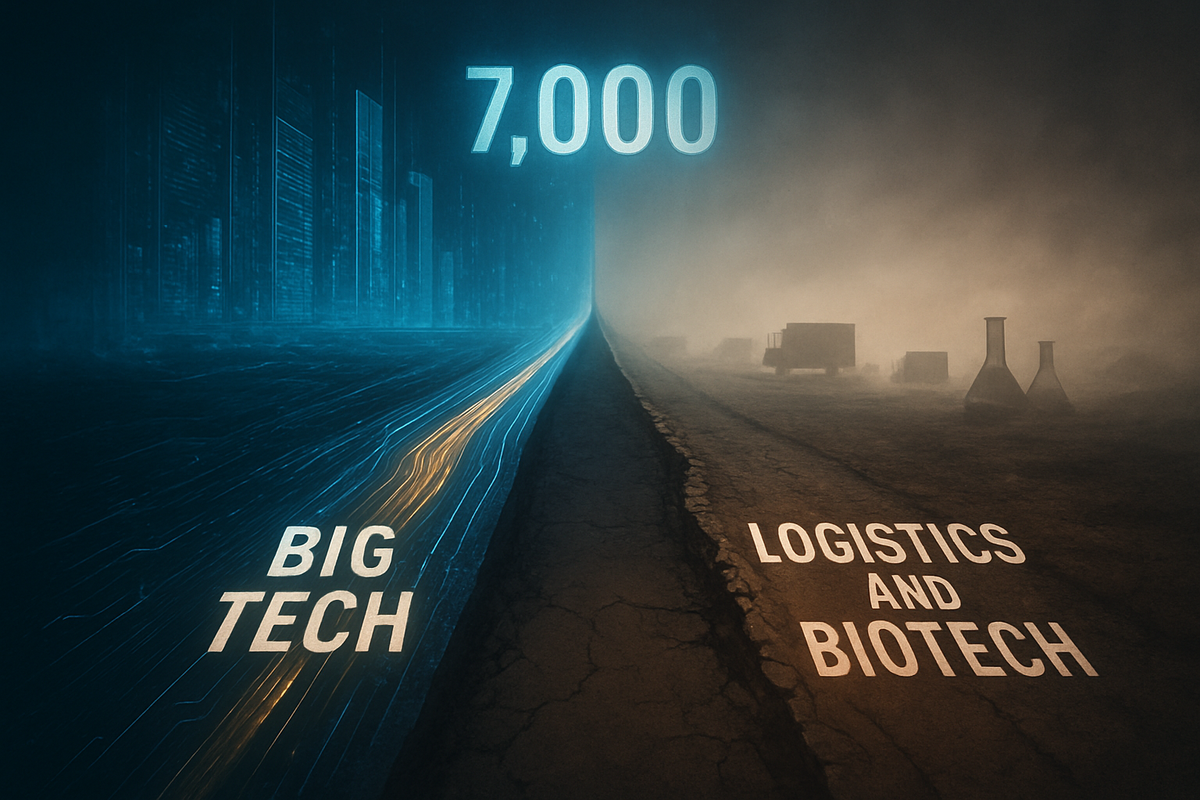
As the curtain closes on 2025, the financial landscape presents a tale of two markets. While the S&P 500 (NYSEARCA: SPY) hovers near the historic 7,000-point milestone, fueled by a 19% year-to-date rally and a resilient "soft landing" for the U.S. economy, a stark divergence has emerged beneath the surface. The "Great Rotation" of late 2025 has seen capital migrate toward high-growth winners, yet legacy logistics giants and specific mid-cap biotech innovators are finding the path forward increasingly treacherous.
The contrast is most visible when comparing the "Magnificent Seven" tech titans to industry stalwarts like United Parcel Service (NYSE: UPS) and specialized players like Rhythm Pharmaceuticals (Nasdaq: RYTM). While Big Tech has successfully transitioned into a "show me the money" phase of AI monetization, companies tied to physical infrastructure and regulatory timelines are grappling with structural headwinds that threaten to overshadow the broader market's optimism.
The 2025 Market Shift: From AI Hype to Operational Reality
The narrative of 2025 was defined by the maturation of artificial intelligence and a surprisingly robust 4.3% Q3 GDP growth rate. However, for the logistics sector, the year was one of painful recalibration. United Parcel Service began the year under a cloud of high labor costs following its 2023 Teamsters contract, which continued to compress margins throughout 2025. The situation reached a tipping point in late 2025 as the company accelerated its "Amazon Cliff" strategy—a deliberate move to reduce its reliance on Amazon.com (Nasdaq: AMZN) volume by over 50% by 2026. This transition has necessitated the closure of over 70 facilities and the elimination of 20,000 jobs to maintain agility in a high-cost environment.
In the biotech sector, the story has been one of extreme volatility despite a broad sector recovery. Rhythm Pharmaceuticals, once a darling of the orphan drug space, faced a significant setback in December 2025. The U.S. Food and Drug Administration (FDA) extended the Prescription Drug User Fee Act (PDUFA) action date for its flagship drug, Imcivree, for acquired hypothalamic obesity. Originally slated for a December 20 decision, the date was pushed to March 20, 2026, following a "major amendment" to the filing. This delay has injected a dose of uncertainty into a sector that had otherwise been buoyed by a massive 33% surge in the XBI Biotech Index.
The timeline leading to this divergence was marked by the "April Tariff Storm," a 10.5% market correction triggered by new import levies that hit logistics companies particularly hard. While Big Tech names like Nvidia (Nasdaq: NVDA) and Alphabet (Nasdaq: GOOGL) were able to pivot through their high-margin software and semiconductor dominance, the physical-world constraints of shipping and clinical trials left UPS and RYTM exposed to macroeconomic and regulatory friction that the broader index seemingly ignored.
Winners and Losers in a High-Valuation Environment
The primary beneficiaries of this late-year climate have been the tech giants that proved AI could drive tangible earnings. Nvidia and Alphabet led the charge, with their aggregate 18% gain providing the bedrock for the S&P 500’s ascent. These firms have used their massive cash reserves to buy back shares and insulate themselves from the rising cost of labor and energy—luxuries not shared by the logistics or mid-cap biotech sectors.
On the losing side, United Parcel Service faces a grueling 2026. The shift by consumers toward lower-margin "economy ground" services like SurePost has eroded the company's average revenue per piece. As Amazon continues to build out its own delivery network, UPS is forced to compete for high-value B2B contracts in a cooling manufacturing sector. Similarly, Rhythm Pharmaceuticals is finding that "orphan drug" status no longer provides a total moat. The company now faces mounting pressure from the "Weight Loss Gold Rush," as GLP-1 franchises from larger pharmaceutical firms and emerging oral agonists begin to encroach on its niche territory, potentially challenging its pricing power.
Other potential losers include mid-tier logistics providers and biotech firms without a clear path to commercialization. As institutional investors rotate toward "quality" and "value," companies with high debt-to-equity ratios or those reliant on binary regulatory outcomes are being punished. Conversely, large-cap healthcare and financial institutions have emerged as surprising winners, benefiting from the "broadening" of the market as investors seek shelter from tech's rich 22x forward earnings valuations.
Broader Significance: The End of the "Rising Tide" Era
The divergence of 2025 signals a fundamental shift in market dynamics: the "rising tide" no longer lifts all boats. This event fits into a broader trend of industrial bifurcation, where digital-first companies decouple from the "brick-and-mortar" economy. The struggles of UPS are a bellwether for the global supply chain, reflecting the "onshoring" trend and the fragmentation of global trade. When a logistics leader like UPS struggles to find growth despite a strong GDP, it suggests that the traditional relationship between economic output and freight volume is decoupling due to digital efficiency and changing consumer habits.
Historically, this resembles the post-dot-com era where "old economy" stocks struggled to find their footing while a new generation of winners emerged. In the biotech space, the RYTM delay highlights the increasing rigor of the FDA in a post-pandemic world. Regulators are no longer fast-tracking treatments with the same frequency seen in the early 2020s, demanding more comprehensive data sets for specialized treatments. This regulatory tightening, combined with the competitive pressure of the obesity drug market, serves as a warning to other specialized biotech firms that the path to market is becoming more expensive and less certain.
Furthermore, the "Amazon Cliff" faced by UPS represents a significant precedent in corporate strategy. It is a rare example of a service provider intentionally firing its largest customer to save its long-term margins. The ripple effects will be felt by competitors like FedEx (NYSE: FDX), who may find themselves forced to absorb the low-margin volume UPS is discarding, or risk their own margin erosion in a race to the bottom.
Looking Ahead: Strategic Pivots and the 2026 Outlook
In the short term, United Parcel Service must prove that its "Better, Not Bigger" strategy can actually deliver the promised margin expansion by the second half of 2026. Investors will be watching for the successful integration of automated sorting technologies and a stabilization of labor costs. If UPS fails to capture high-margin healthcare and B2B volume to replace the lost Amazon revenue, the stock may remain a value trap well into the next decade.
For Rhythm Pharmaceuticals, the March 2026 PDUFA date is a binary "make or break" moment. A successful approval would likely trigger a massive short squeeze and validate the company’s focus on hypothalamic obesity. However, a "Complete Response Letter" (CRL) or further delays could force the company into a strategic pivot, perhaps seeking a merger with a larger pharmaceutical entity looking to bolster its metabolic pipeline. The emergence of oral MC4R agonists will be the long-term challenge that RYTM must address through either diversification or aggressive intellectual property defense.
The broader market opportunity lies in the "secondary AI wave"—companies that provide the infrastructure and services for the AI applications developed by Big Tech. As the market enters 2026, the focus will shift from who is building AI to who is using AI to fix broken business models. This could eventually benefit companies like UPS if they can successfully deploy AI to optimize routes and labor, but such a transformation will take years, not quarters.
Closing Thoughts: A Market of Stocks, Not a Stock Market
As we move into 2026, the key takeaway for investors is that the S&P 500’s record highs mask a significant amount of underlying pain. The "Great Divergence" has proven that sector-specific headwinds—be they labor contracts for UPS or regulatory hurdles for RYTM—can easily negate the benefits of a strong macro environment. Big Tech remains the market's anchor, but its "resilience" is increasingly dependent on its ability to maintain astronomical growth rates in a high-valuation world.
Moving forward, the market is likely to remain bifurcated. Investors should watch for a potential "valuation reset" in tech, which could finally force capital back into beaten-down sectors like logistics—but only if those companies can prove they have adapted to the new economic reality. The era of passive indexing providing easy returns may be nearing its end, replaced by a climate where stock picking and deep fundamental analysis of regulatory and operational risks are paramount.
In the coming months, the March FDA decision for Rhythm and the Q1 earnings report from UPS will be the primary litmus tests for whether these sectors can begin their recovery or if they will continue to lag behind the tech-driven S&P 500. For now, the message from the market is clear: resilience is earned through innovation and margin control, not just by riding the coattails of a bull market.
This content is intended for informational purposes only and is not financial advice