As the calendar turns to 2026, the financial world is laser-focused on Tesla (NASDAQ: TSLA) and its impending fourth-quarter 2025 delivery report, expected to be released tomorrow, January 2. The electric vehicle giant finds itself at a historic crossroads, attempting to navigate a "delivery hollow" following the expiration of federal incentives while simultaneously orchestrating a massive strategic pivot toward artificial intelligence and autonomous robotics.
The tension surrounding this report was amplified by a highly unusual move in late December 2025, when Tesla published a company-compiled consensus of analyst projections on its Investor Relations website. This rare release of internal forecasting has been interpreted by the market as a strategic attempt to anchor investor expectations ahead of what is expected to be a sharp year-over-year decline in vehicle volume, setting the stage for a high-stakes 2026.
Anchoring Expectations: The Q4 Delivery Outlook
The data released in Tesla’s late-December consensus report suggests a challenging end to 2025. Analysts are bracing for Q4 deliveries of approximately 422,850 vehicles, which would represent a significant 15% decline from the 495,000 units delivered in the same period in 2024. If these figures hold, Tesla will conclude 2025 with total annual deliveries of roughly 1.64 million—marking the company’s second consecutive year of declining annual sales.
This downturn is largely attributed to the "Tax Credit Cliff" of late 2025. The $7,500 federal EV tax credit officially expired on September 30, 2025, causing a massive "pull-forward" of demand into the third quarter. Consequently, the final three months of the year saw a natural cooling of consumer interest as the effective price of Tesla’s lineup jumped overnight. To counter this, CEO Elon Musk and the Tesla leadership team have spent the final weeks of December shifting the narrative toward "Epic 2026," a year they claim will be defined by the commercialization of the Cybercab and the "unboxed" manufacturing of the long-awaited affordable Model 2.
Winners and Losers in the Post-Incentive Era
Tesla’s struggle to maintain volume in the absence of subsidies has created a bifurcated landscape for the broader automotive market. The primary "winners" in this environment appear to be low-cost international competitors, particularly BYD (OTC:BYDDY) and Xiaomi (OTC:XIACY), which have continued to scale aggressively in non-U.S. markets. These companies have leveraged their vertical integration to keep prices low, even as Tesla was forced to prioritize margins over volume in the latter half of 2025.
Conversely, legacy American automakers like Ford (NYSE: F) and General Motors (NYSE: GM) are facing their own set of challenges. While they may benefit from Tesla’s slowing growth in the short term, the expiration of federal credits has dampened the entire domestic EV sector's momentum. However, Tesla’s "loss" in vehicle volume is being offset by its dominance in the energy storage sector. Tesla Energy saw over 80% growth in 2025, positioning the company as a winner in the utility-scale battery market, even as its automotive division faces headwinds.
The Autonomous Pivot and the "DOGE" Influence
The wider significance of Tesla’s current position cannot be overstated. We are witnessing the company’s formal transition from a car manufacturer to an AI and robotics entity. This shift was underscored by a high-profile White House press conference in late December 2025, where Elon Musk appeared alongside President Trump to discuss the Department of Government Efficiency (DOGE). The meeting focused heavily on creating a federal regulatory framework for unsupervised autonomous vehicles, a move that would bypass the current patchwork of state-level regulations.
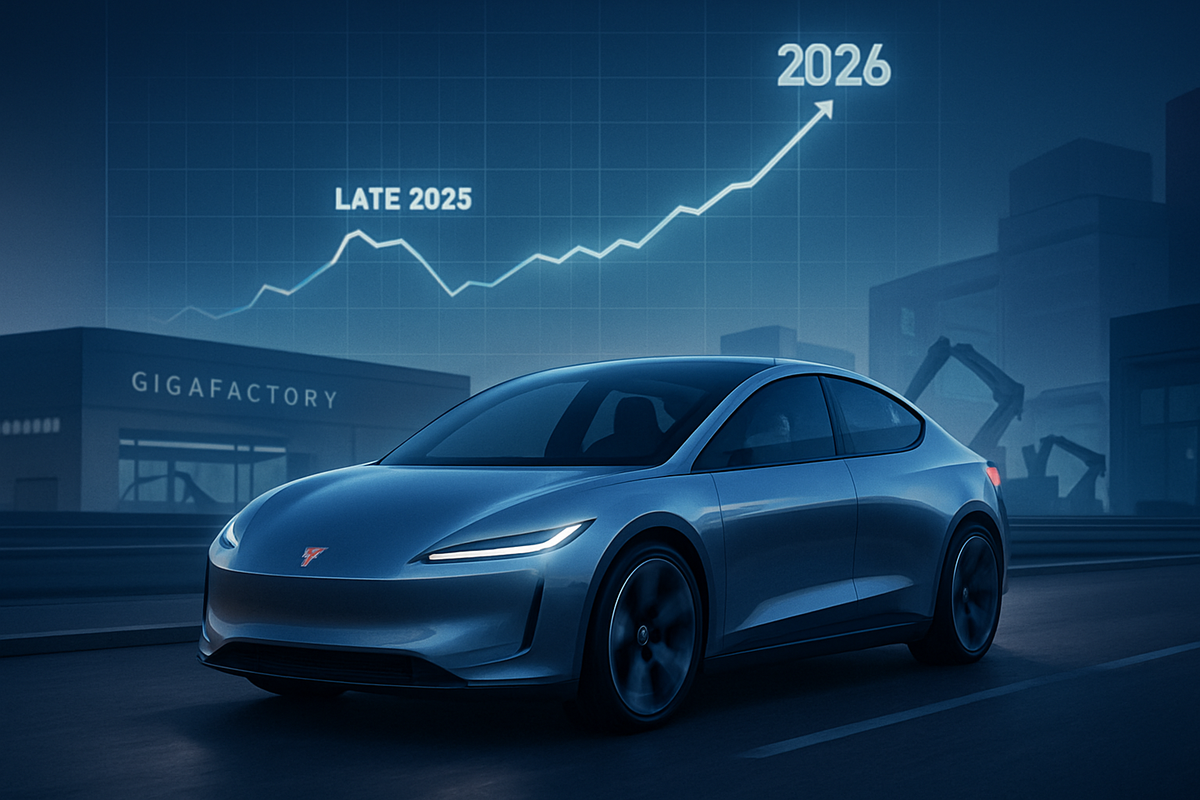
This regulatory tailwind is the cornerstone of the "2026 Forecast" that Tesla recently released. By signaling a return to growth in 2026 (with a target of 1.75 million deliveries), Tesla is betting that a favorable federal environment will accelerate the rollout of its Full Self-Driving (FSD) software and the Cybercab. This mirrors historical precedents where industry leaders have leveraged political capital to reshape regulatory landscapes in their favor, much like the telecommunications or aerospace industries did in decades past.
The Road to 2026: Strategy and Execution
Looking ahead, the next 12 to 18 months will be a period of intense execution for Tesla. The company has confirmed that mass production for the "Project Redwood" (the $25,000 Model 2) has been pushed to the second half of 2026. This delay puts immense pressure on the existing Model 3 and Model Y refresh—codenamed "Juniper"—to carry the company’s revenue through the first half of the year.
The "Cybercab" remains the ultimate wildcard. With production scheduled to begin at Gigafactory Texas in April 2026, Musk has set an ambitious goal of reaching a production rate of 2 million units annually by year-end. To achieve this, Tesla must successfully implement its "10-second assembly cycle," a manufacturing feat that critics remain skeptical of but bulls believe will revolutionize the industry. The short-term challenge will be managing the "delivery hollow" of early 2026 before these new programs hit their stride.
Closing Thoughts: A Market in Transition
In summary, the Q4 delivery report arriving tomorrow is less about the numbers themselves and more about the baseline they establish for Tesla’s 2026 resurgence. The rare forecast release in December was a masterclass in expectation management, allowing the company to "own" the narrative of a volume decline while pointing toward a future dominated by AI and autonomous fleets.
Investors should watch for two things in the coming months: the actual Q4 delivery beat-or-miss relative to the new 422,850-unit consensus, and any further concrete updates on the federal autonomous vehicle framework. While the fundamentals of the car business are currently under pressure, the $1.6 trillion valuation of Tesla remains tied to its potential as a robotics pioneer. The "Epic 2026" narrative has been set; now, the company must prove it can deliver on the hardware to match the hype.
This content is intended for informational purposes only and is not financial advice.