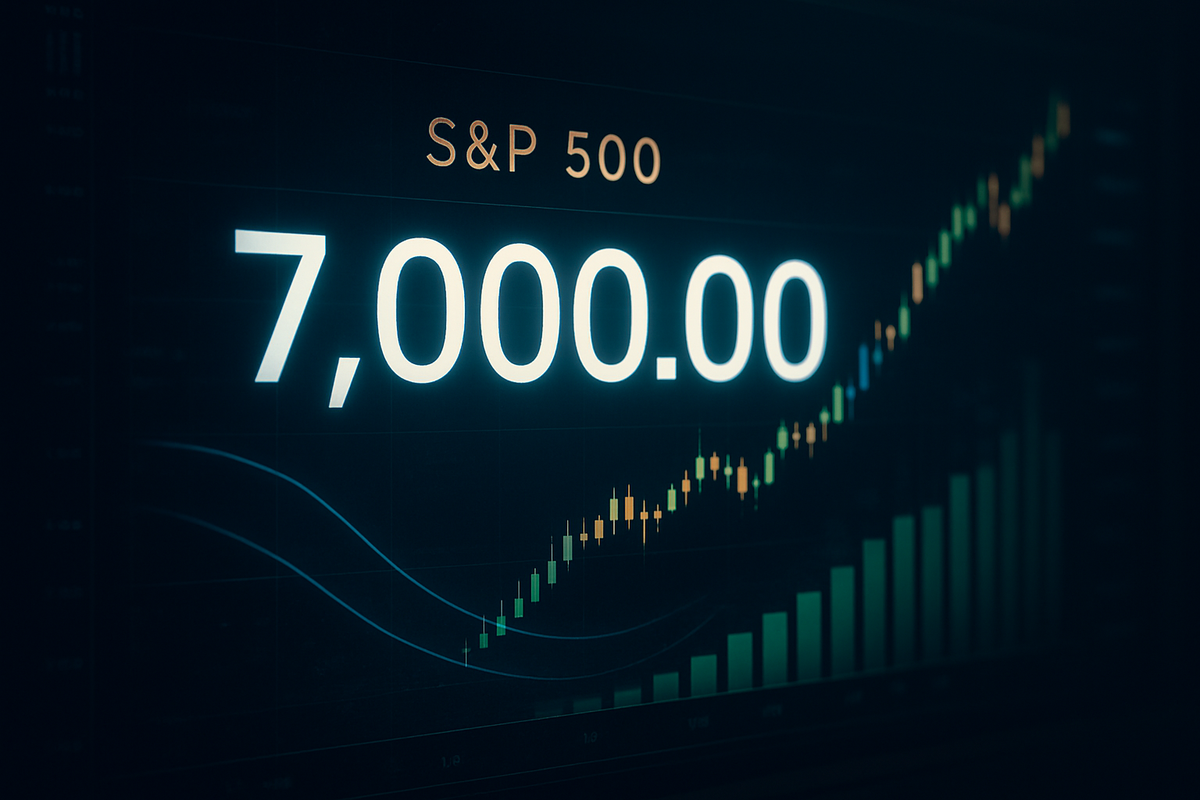
The S&P 500 index is currently standing on the precipice of a historic milestone, flirting with the psychologically significant 7,000-point barrier. On Tuesday, January 13, 2026, the index climbed to approximately 6,991 points, building on a momentum-driven start to the year that has seen the benchmark gain nearly 1% in just six trading days. This bullish trajectory is being fueled by a dual catalyst: a fresh Consumer Price Index (CPI) report suggesting that inflation is finally settling into a range acceptable to the Federal Reserve, and a strong opening salvo from the fourth-quarter earnings season.
The immediate implications for the market are profound. With the index trading at a record intraday high of 6,994.55, investor sentiment remains resilient despite a backdrop of political friction and the lingering data distortions caused by a massive government shutdown late last year. As the market "buys the dip" following recent volatility, the focus has shifted squarely onto corporate fundamentals and the central bank’s next move, with many traders betting that the "7,000 club" is an inevitability before the week is out.
The Path to 7,000: Data Resilience Amidst Political Noise
The journey to these record levels has been anything but linear. Following a robust 2025 where the S&P 500 surged by nearly 18%, the transition into 2026 was complicated by a 43-day government shutdown that paralyzed the Bureau of Labor Statistics (BLS) and the Bureau of Economic Analysis (BEA). This shutdown led to a "data blackout" in late 2025, leaving investors flying blind without official CPI or PCE updates for October. However, the resolution of the shutdown and the release of the December 2025 CPI report on January 13 have provided much-needed clarity. The report showed headline inflation at 2.7% and core inflation at a cooler-than-expected 2.6% year-over-year, reinforcing the narrative that price pressures are easing.
The market's reaction to this data has been one of relief. While the Department of Justice’s reported investigation into Federal Reserve Chair Jerome Powell has introduced a layer of executive-branch tension, the S&P 500’s climb to a record close of 6,977.32 on Monday, followed by Tuesday’s gains, suggests that institutional players are prioritizing macroeconomic stability over political theater. The timeline of events leading to this peak includes a "catch-up" period where the BLS reconciled missing data from the fall, eventually showing a modest 0.2% increase across the September-to-November window, which helped soothe fears of an inflation resurgence during the shutdown.
Earnings Winners and Losers: A Tale of Two Economies
As the Q4 2025 earnings season kicks off, the financial sector is providing the first glimpse into the health of the American economy. JPMorgan Chase (NYSE: JPM) set a high bar on Tuesday, reporting an adjusted earnings per share (EPS) of $5.23, comfortably beating analyst estimates and acting as a primary engine for the day's gains. The banking giant’s performance suggests that high-interest environments have continued to bolster net interest income, even as the market anticipates future rate cuts. Conversely, the travel sector showed signs of turbulence; Delta Air Lines (NYSE: DAL) reported mixed results and issued a cautious outlook for 2026, citing shifting consumer spending patterns.
The broader earnings landscape for the S&P 500 remains bifurcated. The Information Technology sector is expected to be the runaway winner, with projected earnings growth exceeding 25% as the "AI arms race" enters a more mature, revenue-generating phase. However, not all sectors are sharing in the bounty. Consumer Discretionary and Energy sectors are currently the laggards, with earnings expected to contract by 3.5% and 1.7% respectively. Value-conscious consumers and lower crude oil prices are weighing on these industries, creating a market where index-level gains are heavily concentrated in tech and high-performing financials like Bank of New York Mellon (NYSE: BK) and Concentrix (NASDAQ: CNXC).
The Significance of the "Priced for Perfection" Market
This pursuit of 7,000 carries significant weight when viewed through the lens of historical valuations. The S&P 500’s forward 12-month price-to-earnings (P/E) ratio currently sits at 22.2, a steep premium compared to the 10-year average of 18.7. This suggests that the market is "priced for perfection," leaving little room for error as more companies report their figures. The current environment mirrors previous periods of high-valuation euphoria, such as the late 1990s or the post-pandemic rally of 2021, where the index's ascent was driven more by multiple expansion than immediate earnings growth.
Furthermore, the event highlights a growing trend of "political-economic decoupling." Despite the Trump administration’s public pressure on the Fed and the disruption of the government shutdown, the market has shown a remarkable ability to look past Washington’s volatility. The historical precedent of markets recovering quickly from shutdowns has held true, but the current investigation into the Fed leadership adds a new variable that could affect long-term policy independence. If the S&P 500 successfully consolidates above 7,000, it will signal a vote of confidence in the underlying strength of corporate America over the noise of the regulatory and political landscape.
The Road Ahead: PCE Data and Tech Titans
Looking forward, the remainder of January will be a gauntlet for the S&P 500. Investors are eagerly awaiting the "catch-up" Personal Consumption Expenditures (PCE) data scheduled for release on January 22, 2026. As the Fed’s preferred inflation gauge, this data will likely determine whether the central bank proceeds with a rate cut in the first quarter. In the short term, the market will also have to digest a flurry of reports from other major financial institutions, including Bank of America (NYSE: BAC), Wells Fargo (NYSE: WFC), and Citigroup (NYSE: C), as well as investment banking heavyweights Goldman Sachs (NYSE: GS) and Morgan Stanley (NYSE: MS).
The true test of the 7,000 level may come later this week when Taiwan Semiconductor Manufacturing Company (NYSE: TSM) and UnitedHealth Group (NYSE: UNH) report. As a bellwether for the global semiconductor and AI industries, TSM’s guidance will be critical in justifying the high valuations of the tech sector. If these companies can match the optimism baked into their stock prices, the S&P 500 may not only hit 7,000 but use it as a new floor for the spring. However, any sign of an "earnings miss" in the AI space could trigger a rapid deleveraging, given the current concentration of gains.
Summary and Investor Outlook
The S&P 500’s march toward 7,000 represents a remarkable chapter in market history, characterized by a resilient economy that has outpaced both inflation and political instability. The cooling CPI data released today has provided the necessary oxygen for this rally, while the early success of BlackRock (NYSE: BLK) and PNC Financial Services (NYSE: PNC) in the coming days will be watched to see if the financial sector can sustain its momentum. The key takeaway for investors is that while the headline numbers are glowing, the underlying market is increasingly top-heavy and sensitive to any deviation from the "soft landing" narrative.
As we move through the first quarter of 2026, the primary focus should remain on the sustainability of AI-driven earnings and the Fed’s ability to maintain its independence. The 7,000 mark is more than just a number; it is a symbol of a market that has learned to navigate a "new normal" of high interest rates and geopolitical uncertainty. Investors should watch the January 22 PCE release and the upcoming tech earnings closely, as these will be the ultimate arbiters of whether this record-breaking run has the legs to last through the year.
This content is intended for informational purposes only and is not financial advice