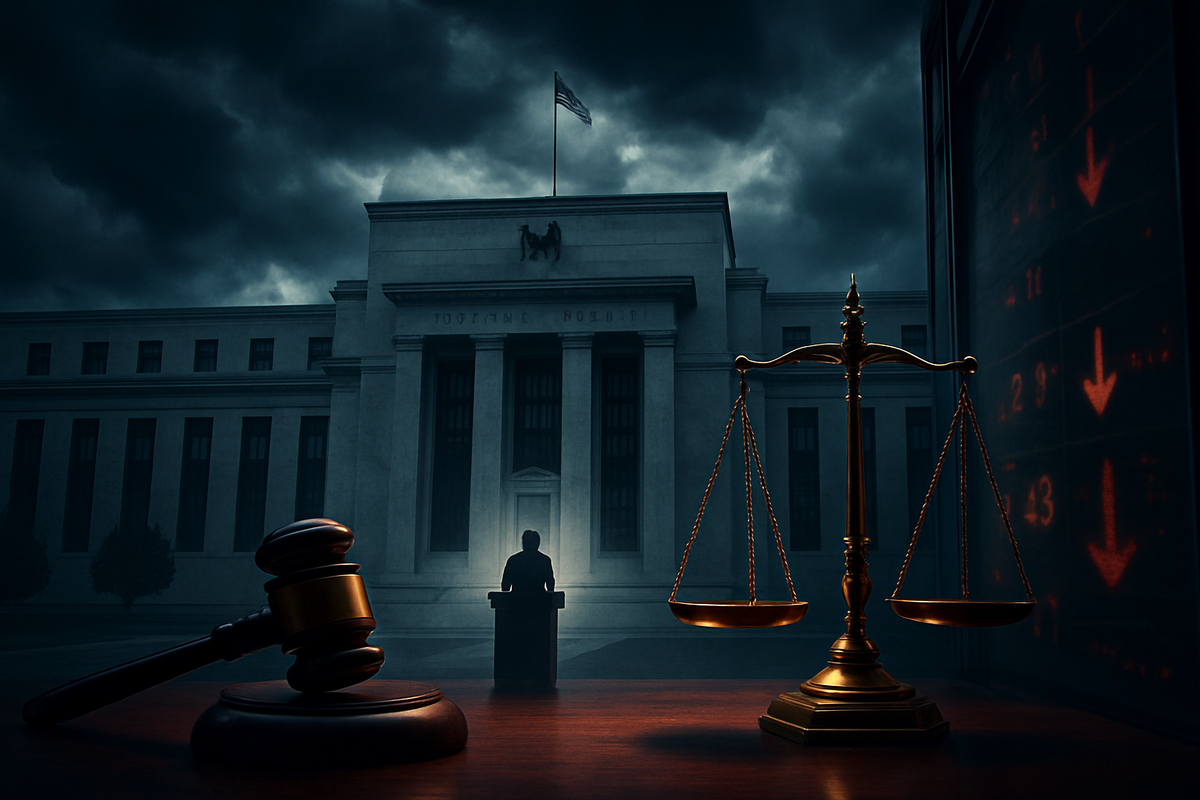
The long-simmering tension between the White House and the nation's central bank reached a boiling point on Tuesday, January 13, 2026, as President Donald Trump intensified his public assault on Federal Reserve Chair Jerome Powell. In a series of provocative statements, the President characterized Powell as both "grossly incompetent" and "crooked," citing a Department of Justice investigation into the Federal Reserve’s headquarters renovation as evidence of institutional rot. The escalating rhetoric has sent shockwaves through the financial sector, raising urgent questions about the future of the Federal Reserve’s independence and its ability to manage the economy without political interference.
The immediate implications of this conflict are already being felt across global markets. As of this morning, the yield on the 10-year Treasury note has spiked to a four-month high, while major financial institutions saw their stock prices tumble. The confrontation is not merely a clash of personalities; it represents a fundamental challenge to the post-war economic order, where the Federal Reserve operates as an autonomous body to maintain price stability and full employment. With Powell’s term as Chair set to expire in May 2026, the current volatility suggests a period of prolonged uncertainty for investors and policymakers alike.
The 'Pretext' of Renovation: A Timeline of Escalation
The current firestorm was ignited on January 11, 2026, when Chair Jerome Powell revealed that the Department of Justice (DOJ) had served the Federal Reserve with grand jury subpoenas. The probe focuses on the $2.5 billion renovation of the Fed’s Washington, D.C. headquarters, with allegations that Powell may have misled Congress regarding the project's spiraling costs. Powell has remained defiant, characterizing the investigation as a "pretext" designed to coerce the Fed into lowering interest rates to satisfy the President’s economic agenda. He told reporters that "monetary policy will not be directed by political pressure or intimidation."
The President's response has been swift and unforgiving. Speaking to reporters on the morning of January 13, 2026, while departing for a speech in Detroit, President Trump leveled his most severe accusations to date. "He’s billions of dollars over budget, so, either he’s incompetent or he’s crooked," the President stated. This follows a string of insults over the past month, during which Trump has labeled Powell a "fool," a "clown," and "Jerome 'Too Late' Powell"—the latter a jab at the Chair’s perceived reluctance to cut rates as aggressively as the administration desires.
While Trump has long criticized the Fed, this new legal angle has created a fracture within his own party. Several prominent Republicans have voiced alarm over the use of the DOJ as a tool for monetary influence. Senator Thom Tillis (R-NC), a member of the Senate Banking Committee, has already vowed to block the confirmation of any future Fed nominees until the DOJ investigation is resolved, calling the probe an attempt to "end the independence of the Federal Reserve." He is joined by Senator Lisa Murkowski (R-AK), who described the administration's tactics as "coercion." However, other loyalists like Senator Kevin Cramer (R-ND) have focused on the Fed's perceived mismanagement of the building project, even as they distance themselves from the "criminal" labels.
Market Turmoil: Winners and Losers in the Crossfire
The financial markets reacted with immediate trepidation to the escalating rhetoric and the potential for a constitutional crisis at the central bank. Banking stocks have been the primary casualties. On January 13, Capital One Financial Corp (NYSE: COF) and Synchrony Financial (NYSE: SYF) both saw their valuations plummet by over 8%. This decline was compounded by President Trump’s simultaneous proposal to implement a 10% cap on credit card interest rates—a move that would decimate the profit margins of consumer lenders.
Traditional banking giants have also felt the sting. JPMorgan Chase & Co. (NYSE: JPM) dropped 3%, while Citigroup Inc. (NYSE: C) fell 4% in early trading. Analysts suggest that the combination of political attacks on the Fed and the threat of new regulatory caps is creating a "perfect storm" for the financial sector. Investors are particularly concerned that if the Federal Reserve's credibility is undermined, inflation expectations will become unanchored, leading to higher long-term borrowing costs for everyone. The 10-year Treasury yield's climb above 4.2% reflects this growing "political risk premium."
Conversely, some assets have benefited from the chaos. Gold prices have surged toward a record $4,600 per ounce, as investors flee to safe-haven assets. Companies involved in precious metals mining or gold-backed ETFs have seen a corresponding lift. However, the broader market remains on edge, as the stability of the U.S. dollar—the world’s reserve currency—is intrinsically tied to the perceived independence and reliability of the Federal Reserve.
The Erosion of Institutional Independence
This event is not occurring in a vacuum; it fits into a broader trend of executive overreach that has challenged the autonomy of historically independent agencies. The historical precedent for such a clash is often found in the Nixon era, when President Richard Nixon successfully pressured Fed Chair Arthur Burns to keep interest rates low to boost his re-election prospects, an action widely blamed for the stagflation of the 1970s. The current administration’s use of a DOJ criminal probe as a lever for monetary policy is being viewed by historians and economists as a significantly more aggressive evolution of those tactics.
The ripple effects extend beyond the U.S. borders. International central banks, including the European Central Bank and the Bank of England, are watching the developments closely. A weakened or politicized U.S. Federal Reserve could undermine the global financial system's trust in dollar-denominated assets. Furthermore, the regulatory implications of the President’s proposed interest rate caps suggest a shift toward a more populist, interventionist economic policy that could disrupt the competitive landscape for years to come.
From a policy perspective, the standoff creates a significant hurdle for the legislative process. With key Republicans like Senator Tillis threatening to block appointments, the Federal Reserve Board could find itself understaffed and paralyzed just as Powell’s term as Chair ends in May 2026. This potential vacuum in leadership occurs at a critical juncture for the economy, as it continues to navigate the complexities of post-inflationary adjustments.
What Comes Next: The Path to May 2026
The short-term outlook is one of heightened volatility as the DOJ investigation proceeds. Investors should expect continued turbulence in bank stocks and the bond market as each new subpoena or presidential tweet is digested. If the DOJ moves forward with actual indictments against Fed officials, the market reaction could be catastrophic, potentially triggering a broader sell-off in equities as the "rule of law" in financial governance is questioned.
Looking toward May 2026, the transition of power at the Fed is now fraught with political peril. The administration is reportedly vetting candidates such as economic adviser Kevin Hassett to replace Powell. However, any nominee will likely face a grueling and potentially stalled confirmation process in a Senate that is increasingly divided over the President’s tactics. Even if Powell is replaced as Chairman, his term as a Fed Governor does not expire until January 2028. This raises the prospect of a "shadow chair" scenario where Powell remains on the board, potentially leading a faction of governors who oppose the new Chairman’s policies.
Strategically, financial institutions may need to pivot their business models to prepare for a more regulated environment, especially if the 10% interest rate cap gains legislative traction. This could lead to a tightening of credit standards, making it harder for average consumers to obtain loans, which in turn could slow consumer spending—the primary engine of the U.S. economy.
Summary and Investor Outlook
The conflict between President Trump and Jerome Powell has moved beyond mere policy disagreement into the realm of a direct institutional confrontation. By labeling the Fed Chair "crooked" and "incompetent" during an active DOJ investigation, the President has signaled a desire to fundamentally reshape the relationship between the executive branch and the nation's central bank. The immediate market fallout—led by a sharp decline in bank stocks like JPMorgan Chase & Co. (NYSE: JPM) and Capital One (NYSE: COF)—highlights the fragility of investor confidence in the face of political volatility.
As we move toward the May 2026 deadline for the Chairmanship, the key takeaway for investors is that "Fed independence" can no longer be taken for granted as a market constant. The significance of this moment lies in the potential for long-term damage to the Fed’s credibility, which could result in higher inflation, higher borrowing costs, and a less stable dollar.
In the coming months, investors should closely monitor Senate confirmation hearings and any progress in the DOJ investigation. The true test for the market will be whether the Federal Reserve can maintain its data-driven approach to interest rates in the face of relentless political pressure. For now, the "political risk premium" is here to stay, and the era of predictable central banking appears to be, at least temporarily, at an end.
This content is intended for informational purposes only and is not financial advice.