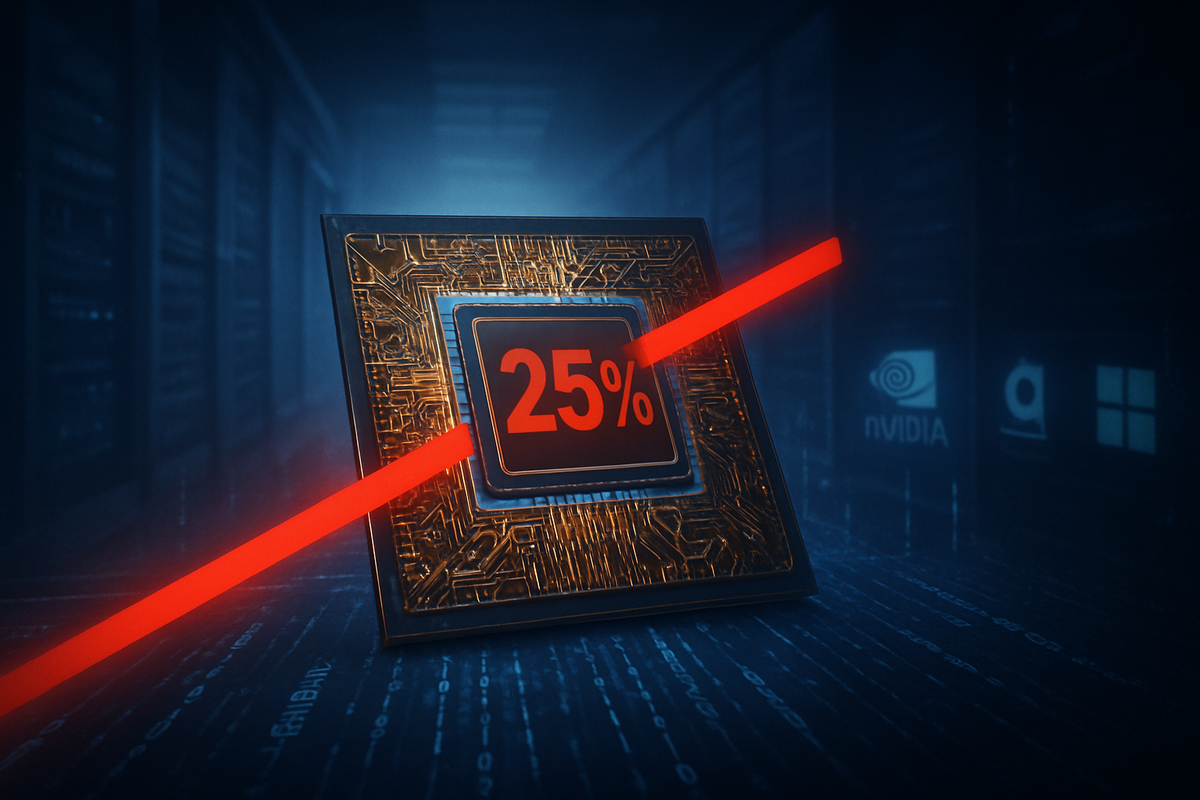
WASHINGTON D.C. — In a move that has fundamentally redrawn the map of the global technology trade, the United States government yesterday finalized a 25% tariff on select high-end semiconductor imports. The proclamation, signed on January 14, 2026, marks the conclusion of a contentious nine-month investigation into the national security implications of foreign microchip reliance. While the measure stops short of the broader "blanket" tariffs feared by the industry in late 2025, the immediate implications are reverberating across Wall Street, specifically targeting the advanced artificial intelligence (AI) chips that power the modern digital economy.
The market reaction has been swift and stratified. Tech giants heavily dependent on high-performance silicon are grappling with a new reality where hardware costs are no longer just a matter of supply and demand, but of geopolitical leverage. Major indices fluctuated wildly in after-hours trading as investors attempted to parse which companies can pass these costs onto consumers and which will see their margins eroded by the "Silicon Surcharge." As of this morning, January 15, the tech-heavy Nasdaq is showing signs of deep structural rotation as the industry adapts to what the administration calls the "Pax Silica" era.
A Targeted Strike: The Timeline and the Proclamation
The path to this week’s 25% tariff began in early 2025, shortly after the presidential inauguration, when a Section 232 investigation was launched under the Trade Expansion Act of 1962. Throughout the summer and fall of 2025, the Semiconductor Industry Association (SIA) and global leaders warned that a proposed 100% blanket tariff on all imported chips would cripple U.S. innovation. However, by December 22, 2025, the Department of Commerce delivered a formal report to the Oval Office concluding that the concentration of advanced chip manufacturing in East Asia constituted a "clear and present threat" to national security, paving the way for the more surgical 25% levy announced yesterday.
The specifics of the proclamation target a "narrowly defined" set of high-end AI accelerators, most notably the H200 series from Nvidia (NASDAQ: NVDA) and the MI325X from Advanced Micro Devices (NASDAQ: AMD). Unlike previous trade restrictions that focused on total export bans, this new policy introduces a "royalty-style" tariff structure. For Nvidia, the 25% fee functions as a legal surcharge that allows the company to resume certain high-end shipments to the Chinese market—sales that were previously blocked under stricter 2024-era export controls. This "tax-for-access" model represents a radical shift in trade philosophy, moving from total containment to regulated, revenue-generating trade.
Initial industry reaction has been a mix of relief and anxiety. While the Semiconductor Industry Association expressed concerns that targeted measures still add significant "friction to global supply chains," many executives privately admit that the final 25% figure is more manageable than the triple-digit scenarios floated last November. The CBOE Volatility Index (VIX) spiked 15% yesterday as the news broke, reflecting the uncertainty of how foreign partners, particularly in Taiwan and South Korea, might retaliate in the coming weeks.
Winners and Losers: The "Magnificent Seven" Under Pressure
The impact of the new tariff regime is creating a clear divide among the tech elite. Nvidia (NASDAQ: NVDA) has emerged as a surprisingly resilient player in this scenario. Although its shares initially dipped, they recovered 2.4% by this morning. Analysts suggest that the 25% tariff effectively "legitimizes" billions of dollars in revenue from China that had been off-limits. By paying the surcharge, Nvidia can maintain its dominant global market share while the U.S. government collects a piece of the action to fund domestic manufacturing initiatives.
Conversely, Microsoft (NASDAQ: MSFT) and Amazon (NASDAQ: AMZN) are facing more immediate headwinds. Microsoft, which has seen its AI-related capital expenditures (CapEx) balloon to nearly $35 billion per quarter, saw its stock hit a six-month low of $459. The company has pledged to absorb the increased costs of AI infrastructure to shield its domestic customers from price hikes, a move that investors fear will lead to a "depreciation bomb" on its balance sheet. Meanwhile, Amazon has taken a more aggressive stance, reportedly demanding discounts of up to 30% from its global hardware vendors to offset the 25% tariff hit. Amazon is also accelerating its internal chip programs, such as the Trainium3, to bypass the expensive third-party silicon market entirely.
The biggest winners of the week appear to be domestic manufacturing stalwarts. Intel Corporation (NASDAQ: INTC) saw its shares surge on expectations that the tariff revenue will be reinvested into the CHIPS Act ecosystem. Furthermore, Taiwan Semiconductor Manufacturing Company (NYSE: TSM) secured a critical exemption for its broader consumer-grade chips in exchange for a massive $100 billion commitment to build five additional fabrication plants in Arizona. This "semiconductor-for-tariffs" deal with Taiwan suggests that the administration is using the 25% levy more as a carrot for reshoring than a stick for total isolation.
Wider Significance: The Birth of "Pax Silica"
This event is far more than a simple trade dispute; it represents the solidification of a "Pax Silica"—a geopolitical strategy aimed at securing a silicon supply chain independent of Chinese influence. By involving allies like Japan, South Korea, and new partners in the UAE and Qatar, the U.S. is attempting to build a closed-loop ecosystem for AI development. This fits into a broader industry trend of "friend-shoring," where the reliability of a supply chain is valued as highly as its cost-efficiency.
The policy also carries heavy regulatory implications. For the first time, the U.S. government is treating high-end AI chips like a restricted natural resource, similar to how oil was managed in the 20th century. This sets a precedent where any future breakthroughs in "ultra-advanced" computing could be subject to similar government surcharges. Historically, this mirrors the 2018-2019 trade war, but with a much higher degree of technical specificity. Instead of broad tariffs on steel or consumer electronics, the focus has narrowed to the very "brains" of the digital age, signaling that data processing power is now the primary currency of national power.
What Comes Next: Strategic Pivots and Market Shifts
In the short term, expect a wave of "tariff-engineered" product launches. Companies are likely to redesign their hardware to fall just outside the technical specifications of the taxed high-end chips. We may see a proliferation of "mid-tier" AI accelerators that offer 80% of the performance of an H200 but at a 0% tariff rate. Long-term, the 25% surcharge will likely serve as a permanent catalyst for the "in-housing" of silicon design at companies like Alphabet (NASDAQ: GOOGL) and Meta Platforms (NASDAQ: META), as they seek to escape the volatility of the merchant silicon market.
Strategically, the next 12 to 18 months will be defined by how China responds. If Beijing retaliates with export bans on critical minerals like gallium or germanium, the 25% tariff on chips could look like a minor inconvenience compared to a total halt in raw material supply. Investors should also watch for the "Arizona Effect"—the speed at which TSMC and Intel can bring domestic capacity online will determine if these tariffs remain a temporary transition cost or become a permanent inflationary burden on the tech sector.
Final Assessment: A New Era for Investors
The January 14 proclamation is a watershed moment for the technology industry. The primary takeaway is that the era of "cheap, frictionless global silicon" is officially over. In its place is a regulated market where geopolitical alignment is a prerequisite for market access. While the 25% tariff creates immediate margin pressure for the likes of Microsoft and Amazon, it also provides a clearer—albeit more expensive—legal framework for Nvidia and other chipmakers to operate globally.
Moving forward, the market will likely reward companies with high vertical integration and those that have successfully "de-risked" their supply chains through domestic partnerships. Investors should keep a close eye on quarterly CapEx reports throughout 2026 to see how much of the "Silicon Surcharge" is being successfully passed through to enterprise AI customers. The tech sector remains a growth engine, but the fuel for that engine just got significantly more expensive.
This content is intended for informational purposes only and is not financial advice.