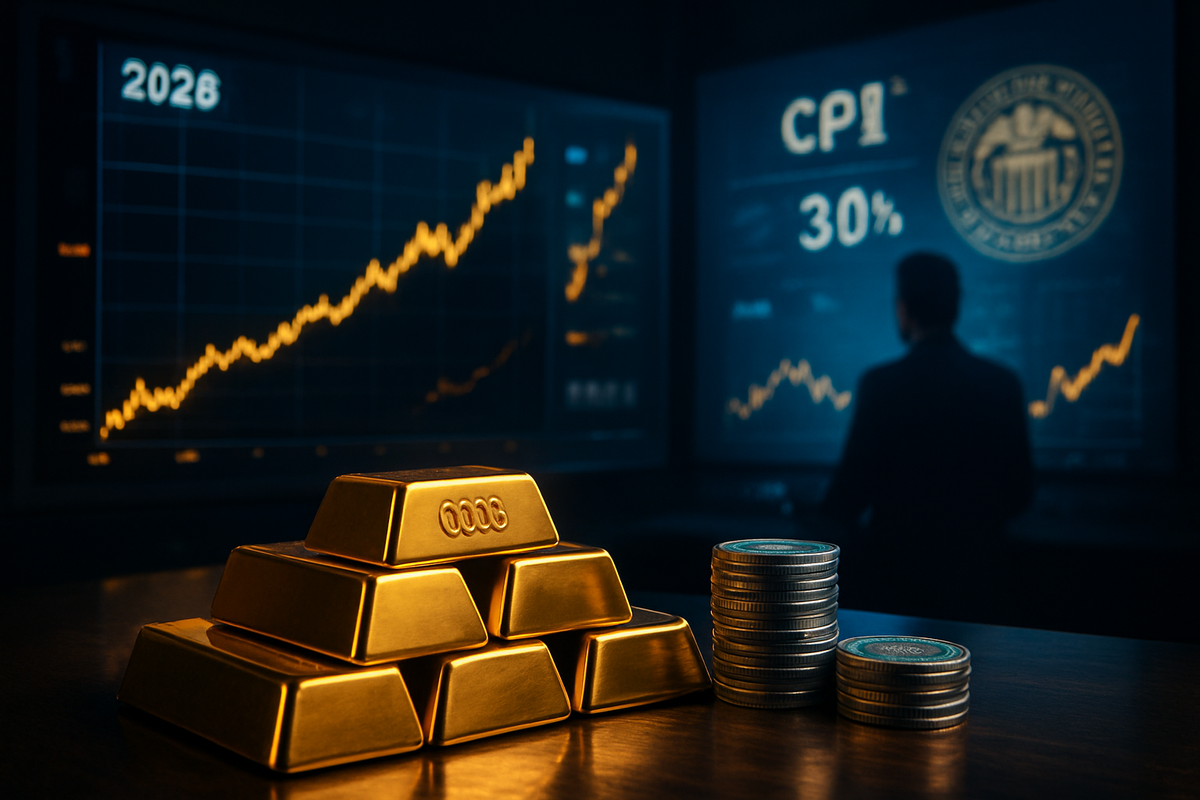
As the calendar turns to January 2, 2026, the global financial markets are grappling with a reality few predicted during the "soft landing" optimism of years past: the "inflation trade" is not only alive but has become the structural backbone of the current investment regime. Despite the Federal Reserve’s aggressive attempts to anchor expectations, consumer price index (CPI) prints remain stubbornly lodged between 2.5% and 3.0%, fueled by a cocktail of persistent tariffs, record-high national debt, and a massive industrial appetite for precious metals driven by the artificial intelligence (AI) revolution.
This persistence has sent gold and silver to heights that once seemed hyperbolic. Gold is currently trading near $4,350 per ounce, while silver has surged to a record $75 per ounce, outperforming almost every major asset class in 2025. For the Federal Reserve, this represents a grueling "last mile" in their inflation fight—one where traditional interest rate hikes have lost their potency against a backdrop of fiscal dominance and a global rush toward tangible assets.
The Road to $4,000 Gold: A 2025 Retrospective
The current market environment is the direct result of a series of "inflation shocks" that defined 2025. The year began with significant fiscal expansion concerns as extended tax cuts and new consumer-focused subsidies kept demand higher than the Fed’s restrictive policy could dampen. By mid-2025, the "Tariff Shock" arrived, as broad-based international trade levies sparked a wave of front-loaded inflation. Markets, which had been pricing in a return to the 2% baseline, suddenly realized that "sticky" inflation was the new permanent state.
The situation reached a fever pitch in October 2025, when a brief but chaotic U.S. government shutdown delayed critical economic data. In the vacuum of information, gold acted as the ultimate "chaos hedge," embarking on a parabolic run. By the time the Federal Reserve signaled a "pause" in its rate-hiking cycle in December 2025—setting the Fed Funds rate at a target range of 3.50%–3.75%—the "debasement trade" was fully entrenched. Central banks, particularly in the BRICS+ nations, have been the primary drivers, accumulating gold at a record pace of over 1,200 tonnes annually to diversify away from a dollar increasingly burdened by $38 trillion in national debt.
Winners and Losers in the New Commodity Supercycle
The 2026 landscape has created a sharp divide between companies with "real asset" leverage and those vulnerable to rising input costs.
The Winners: Major mining conglomerates have seen their margins explode as metal prices rose faster than their energy and labor costs. Newmont (NYSE: NEM) and Barrick Gold (NYSE: GOLD) have emerged as the primary beneficiaries, reporting record free cash flow in their most recent quarterly filings. Barrick, in particular, has leveraged its in-house refining capabilities to meet the soaring demand for physical bullion from sovereign wealth funds. In the silver space, Pan American Silver (NYSE: PAAS) and Hecla Mining (NYSE: HL) have seen their valuations double as silver’s dual role as an inflation hedge and an industrial necessity for AI data centers creates a chronic supply deficit.
Outside of mining, the retail sector is seeing a "flight to value." Walmart (NYSE: WMT) and Costco (NASDAQ: COST) are thriving as middle-class consumers "trade down" to cope with persistent price pressures. These giants have used their massive scale to mitigate supply chain inflation, gaining significant market share from more discretionary-focused competitors.
The Losers: On the flip side, companies that rely on cheap credit or high-margin discretionary spending are struggling. Target (NYSE: TGT) has been a notable laggard, as its focus on "wants" over "needs" leaves it vulnerable to the erosion of household budgets. Similarly, Home Depot (NYSE: HD) has faced a "double squeeze" of high borrowing costs for home renovations and the soaring cost of raw materials.
Perhaps most surprising is the pressure on the tech sector. While Nvidia (NASDAQ: NVDA) remains a dominant force, the soaring cost of silver and gold—critical components in high-performance AI circuit boards—is beginning to weigh on hardware margins. Manufacturers like Dell Technologies (NYSE: DELL) are finding it increasingly difficult to pass these commodity costs on to customers, leading to a "valuation reset" across the hardware space. Furthermore, the clean energy sector has been hit by the "Silver Trap," with companies like First Solar (NASDAQ: FSLR) struggling to maintain project profitability as the cost of silver paste for solar cells skyrockets.
A Regime Shift: 2026 vs. Historical Precedents
The current environment bears some resemblance to the stagflation of the 1970s, but the underlying mechanics are fundamentally different. In the 1970s, the Fed was able to eventually "break" inflation by raising rates to 20% because the total national debt was relatively low. In 2026, however, the U.S. faces "Fiscal Dominance." With debt-to-GDP at roughly 140%, the Fed cannot raise rates to Volcker-esque levels without risking a sovereign solvency crisis. This has forced a "tolerance" for higher inflation, making gold a mandatory holding for institutional portfolios.
Another key differentiator is the industrialization of precious metals. Unlike the speculative gold peak of 2011, the 2026 rally is underpinned by the AI and green energy revolutions. Silver is no longer just a "poor man's gold"; it is the "new oil" of the digital age. With industrial demand now accounting for over 60% of total silver consumption, the market is facing its fifth consecutive year of structural supply deficits—a dynamic that did not exist in previous cycles.
What Lies Ahead: The Powell Transition and Potential $5,000 Gold
As we look toward the remainder of 2026, the market’s focus is shifting to the Federal Reserve leadership. Jerome Powell’s term is set to expire in May 2026, and the search for his successor is already injecting volatility into the Treasury market. Investors are bracing for a potential "dovish pivot" by a new appointee, which could provide the final catalyst needed to push gold toward the $5,000 mark.
In the short term, expect a "bear steepening" of the yield curve. If inflation expectations remain unanchored while the Fed pauses or cuts rates to support growth, long-term yields could rise toward 5.0%, further pressuring traditional 60/40 portfolios. This environment will likely force a strategic pivot for many asset managers, moving away from paper assets and toward "hard asset" allocations that include miners, energy producers, and physical commodities.
Summary and Investor Outlook
The persistence of inflation trades in 2026 marks a definitive end to the "Great Moderation" era of low volatility and low inflation. The key takeaway for investors is that the current rally in gold and silver is not a temporary spike, but a symptom of a regime shift characterized by fiscal dominance, de-dollarization, and resource scarcity.
Moving forward, the market will be hyper-sensitive to any signs of "second-round" inflation effects in wages and services. Investors should keep a close watch on central bank gold buying figures and silver inventory levels at the COMEX, as these will be the primary indicators of the "hard floor" for prices. While volatility remains high, the 2026 market has made one thing clear: in an age of digital abundance and fiscal expansion, the most valuable assets are the ones you can hold in your hand.
This content is intended for informational purposes only and is not financial advice.