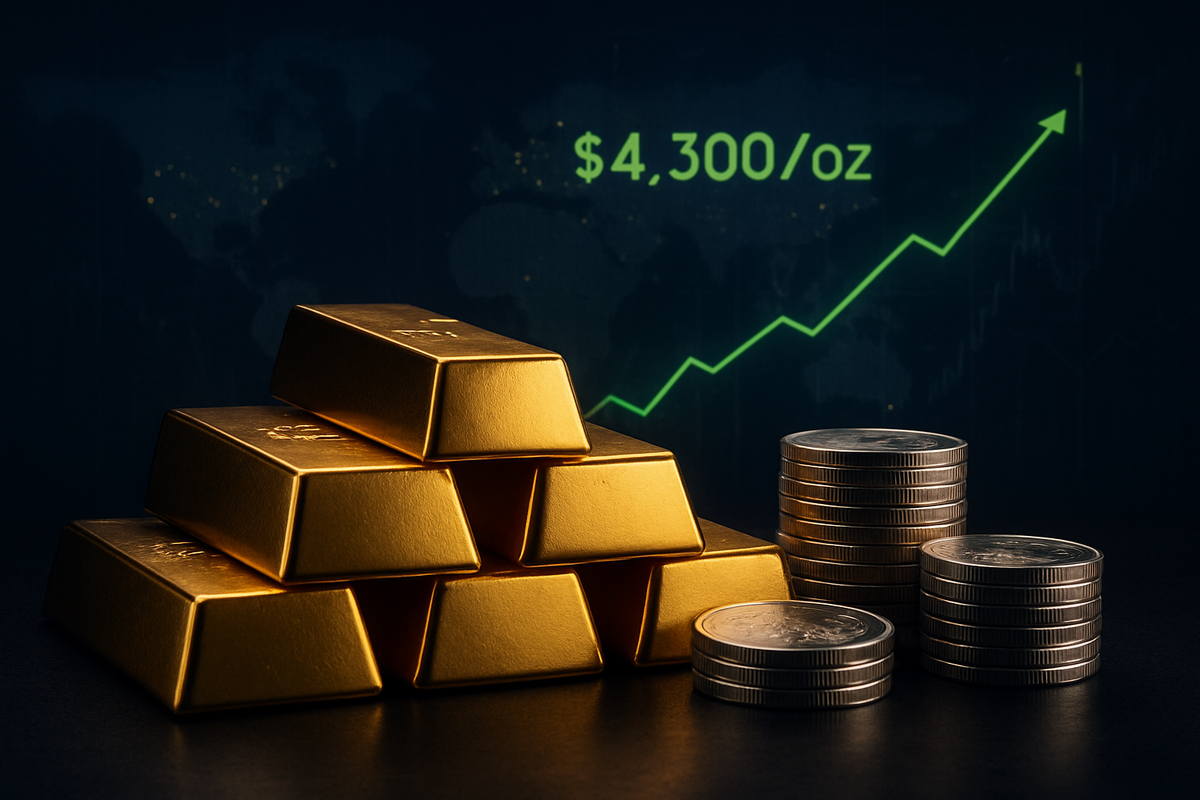
In an unprecedented display of safe-haven demand, spot gold prices have shattered all previous records, surging past the $4,300 per ounce milestone in mid-January 2026. This historic rally marks a watershed moment for global financial markets, as the "yellow metal" transitions from a defensive hedge to the primary engine of portfolio growth. The surge has been fueled by a "perfect storm" of systemic events, including aggressive central bank accumulation, a weakening U.S. dollar, and sudden geopolitical tremors that have left investors scrambling for tangible assets.
The implications of this rally are vibrating through the global economy, signaling a profound shift in how both institutional and retail investors perceive risk. As silver also eyes the psychological $100 per ounce mark, the precious metals sector is experiencing its most significant transformation since the abandonment of the gold standard. Analysts at Goldman Sachs (NYSE: GS) have already moved the goalposts, raising their year-end 2026 price forecasts to $4,900 per ounce, citing a "fundamental rebasing" of gold’s role in global portfolios.
The Path to $4,300: A Timeline of Institutional Accumulation
The vertical ascent seen in January 2026 did not happen in a vacuum; it was the culmination of two years of aggressive strategic positioning. Throughout 2024 and 2025, central banks worldwide engaged in the strongest multi-year period of official gold buying since the 1960s, with net purchases exceeding 1,000 tonnes annually. This "hoarding" was led by nations such as China, India, and Poland, alongside the BRICS bloc, all seeking to "de-dollarize" their reserves following the freezing of foreign assets in earlier geopolitical conflicts. A 2025 survey by the World Gold Council indicated that 95% of central banks planned to increase their gold exposure, providing a permanent "floor" for the market.
The rally accelerated sharply in early January 2026 due to two major geopolitical catalysts. On January 3, 2026, the arrest of Venezuelan leader Nicolás Maduro by U.S. forces sent shockwaves through the commodities market, triggering a 2.2% single-session jump in gold prices. Simultaneously, a diplomatic breakdown between the U.S. and Denmark over the proposed acquisition of Greenland sparked fears of a "Greenland Trade War," with threats of 25% tariffs on European goods. These events, combined with the U.S. national debt surpassing $36 trillion, created a "flight-to-safety" that saw gold prices surge from $3,800 in late 2025 to over $4,300 in the first three weeks of 2026.
Institutional heavyweights have joined the chorus of bulls. Beyond Goldman Sachs, JPMorgan Chase (NYSE: JPM) has set a price target of $5,055 per ounce for the fourth quarter of 2026, while UBS Group (NYSE: UBS) and Bank of America (NYSE: BAC) have both issued forecasts near $5,000. These revisions reflect a growing consensus that the traditional relationship between interest rates and gold has decoupled, with gold now trading primarily as a hedge against currency debasement and systemic instability.
Mining Giants and the Beneficiaries of the Bull Run
The meteoric rise in spot prices has translated into massive windfalls for the world’s largest precious metals producers. Newmont Corporation (NYSE: NEM), the world’s largest gold miner, has seen its stock price soar 126% since the beginning of 2025, trading at approximately $150 per share in January 2026. The company has benefited not only from higher margins but also from the timely commencement of commercial production at its Ahafo North project, which has increased its output just as prices reached their zenith.
Other major players have similarly outperformed the broader market. Barrick Gold (NYSE: GOLD) shares reached $69 in mid-January 2026, a 173% increase from its 2025 lows. Barrick has successfully leveraged its expansion into copper to brand itself as a dual-play on the "green energy transition" and the gold rally. Meanwhile, Agnico Eagle (NYSE: AEM) has emerged as a favorite among conservative investors, with its focus on low-risk jurisdictions like Canada and Australia allowing it to avoid the "geopolitical royalties" and tax hikes that have plagued miners operating in more volatile regions.
The silver sector, often called "gold on steroids," has seen even more dramatic gains. Pan American Silver (NASDAQ: PAAS) hit all-time highs of $56 in mid-January, while First Majestic Silver (NYSE: AG) has benefited from a "supply-side squeeze." Silver’s performance is being driven by a structural deficit caused by massive industrial demand from the solar, electric vehicle (EV), and AI data center sectors. As silver approaches $94 per ounce, many junior miners that were previously dormant have seen their valuations quintuple as the "industrial scarcity" narrative takes hold.
Currency Debasement and the Shifting Global Order
The wider significance of the 2026 gold rally lies in what it reveals about the health of the global fiat currency system. The U.S. Dollar Index (DXY) fell by 8% over the course of 2025, a trend that has accelerated in early 2026. Investors are increasingly viewing gold not just as a commodity, but as a "politically neutral" reserve asset. This "debasement trade" is a direct response to the massive fiscal deficits in the U.S. and Europe, where debt-to-GDP ratios have reached levels historically associated with currency crises.
Furthermore, the "Greenland Trade War" and the Maduro arrest have highlighted the risks of the U.S. dollar being used as a geopolitical tool. This has led to a "bifurcation" of the global financial system. While Western retail investors were slow to enter the market, the sustained buying from the East has forced a capitulation among institutional hedge funds, who are now chasing the rally to avoid underperforming their benchmarks. This shift suggests that the 2026 rally is not a temporary bubble but a structural repricing of hard assets against a backdrop of declining trust in sovereign debt.
Historical comparisons are being drawn to the 1970s stagflation era, yet today’s environment is arguably more complex. Unlike the 1970s, the current rally is underpinned by high-tech industrial demand for silver and a coordinated effort by the BRICS nations to build an alternative financial infrastructure. This has led many to believe that the traditional "gold-to-silver ratio" is permanently tightening, as both metals serve essential roles in the modern digital and energy-independent economy.
The Road to $5,000: What Comes Next?
As the market digests the $4,300 milestone, the question for the remainder of 2026 is whether the momentum can be sustained. In the short term, technical indicators suggest gold is "overbought," and a healthy correction toward $4,100 would not be unexpected. However, the fundamental drivers—central bank buying and geopolitical instability—show no signs of abating. Any significant dip in price is likely to be met with aggressive "buy-the-dip" activity from sovereign wealth funds.
Longer-term, the market is watching for a potential strategic pivot by the Federal Reserve. If the Fed is forced to monetize the burgeoning U.S. debt to prevent a default or a deep recession, gold could easily blast through the $5,000 level before the end of the year. Investors should also watch for regulatory changes; as gold becomes a more significant part of global portfolios, there is a possibility that some governments may implement windfall taxes on mining profits or restrictions on private bullion exports to protect their own reserves.
Another critical factor to monitor is the silver "super-rally." If silver breaks the $100 mark, it could trigger a speculative frenzy similar to the 1980 Hunt Brothers era, though this time backed by genuine industrial scarcity. The convergence of AI infrastructure needs and renewable energy targets means that silver is no longer just a "poor man's gold," but a critical strategic mineral that may see increased government stockpiling in the coming months.
Summary: A New Paradigm for Precious Metals
The gold and silver rally of January 2026 represents more than just a price spike; it is a signal of a changing world order. With spot gold at $4,300 and silver at $94, the era of "cheap" precious metals appears to be over. The primary takeaways for the market are the resilience of gold as a reserve asset, the industrial indispensability of silver, and the massive leverage enjoyed by well-managed miners like Newmont and Barrick Gold.
As we move forward into 2026, the market will remain highly sensitive to any developments regarding U.S. fiscal policy and international trade tensions. The "flight to quality" is no longer a temporary reaction to a crisis, but a long-term strategic shift. Investors should keep a close eye on central bank reserve data and the performance of the U.S. dollar, as these will remain the primary barometers for the next leg of this historic bull market.
The significance of this moment cannot be overstated. For the first time in decades, the global financial system is being tested, and "hard money" is once again asserting its dominance. Whether this rally reaches the $5,000 mark or stabilizes at current levels, the events of January 2026 have already rewritten the rulebook for precious metals investing.
This content is intended for informational purposes only and is not financial advice.