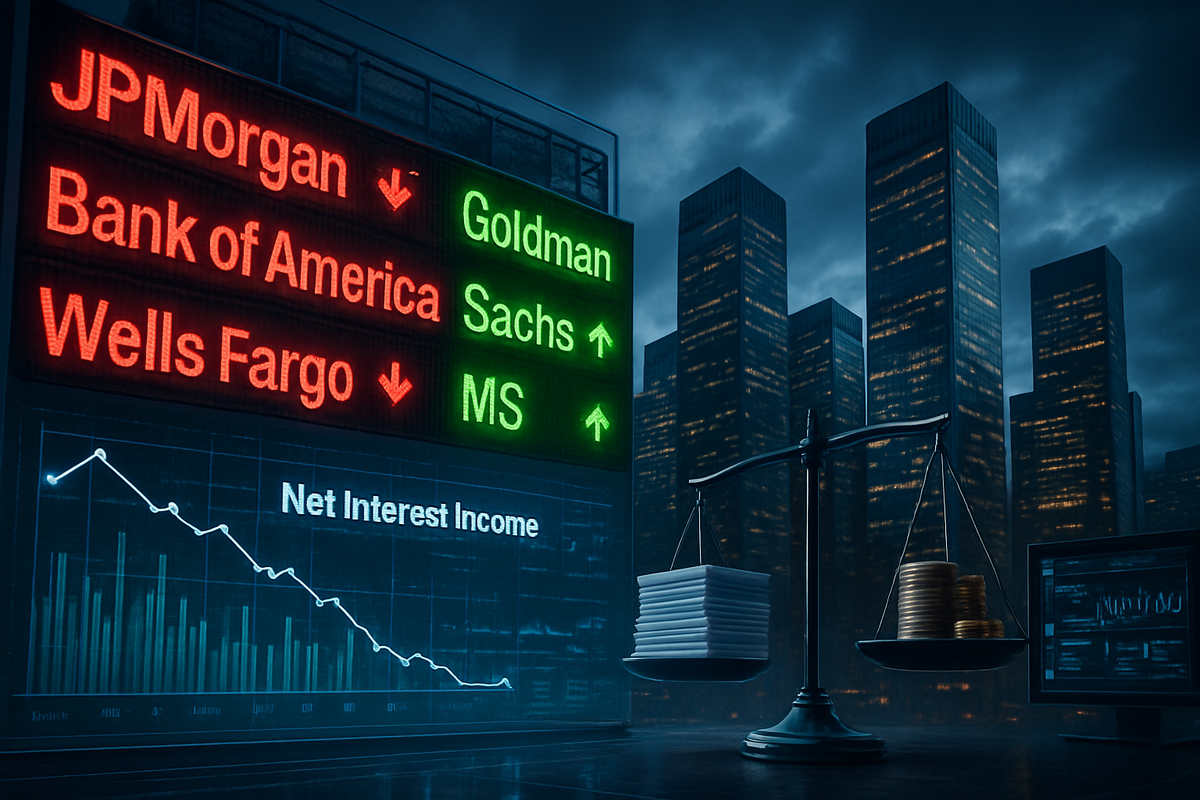
The mid-January earnings season of 2026 has delivered a striking paradox for the American financial sector. While the nation’s largest lenders largely cleared the high bar set by analysts, a wave of selling pressure wiped billions in market capitalization from the commercial banking giants. In a classic "sell the news" reaction, investors looked past the healthy bottom lines of the fourth quarter and focused instead on a darkening horizon of regulatory challenges and tightening margins.
The divergence was stark. JPMorgan Chase (NYSE: JPM) and Bank of America (NYSE: BAC) reported robust earnings per share, yet their stock prices were punished as management teams issued cautious guidance for 2026. This disconnect highlights a shifting market sentiment: in the post-high-rate environment of 2026, simply making money is no longer enough; the quality of future earnings and the resilience against populist regulatory shifts have become the new benchmarks for institutional investors.
A Week of High Stakes and Low Returns
The earnings cycle began on January 13, 2026, with JPMorgan Chase (NYSE: JPM) setting a bittersweet tone. The bank reported a massive net income of $13.0 billion ($4.63 per share), but its stock dropped 4.0% as CEO Jamie Dimon warned of "lumpy" credit performance and increased spending on private credit expansion. The selling intensified on January 14, as the rest of the "Big Four" released their numbers. Citigroup (NYSE: C) saw its shares decline 3.4% after reporting a 13.5% year-over-year drop in net income, weighed down by $800 million in restructuring costs and a final $1.2 billion loss from its exit from Russia.
Bank of America (NYSE: BAC) fared slightly worse, with its stock sliding 3.7%. Despite beating estimates with an EPS of $0.98, the market was spooked by its modest net interest income (NII) growth projections for the coming year. However, the most severe blow was dealt to Wells Fargo (NYSE: WFC), which plunged 4.6%. This was the bank’s first full reporting period since the Federal Reserve finally lifted its $1.95 trillion asset cap in mid-2025. Ironically, the removal of the cap, which many expected to be a catalyst for growth, led to a "buy the rumor, sell the fact" scenario, exacerbated by a 30% sequential collapse in the firm's trading revenue.
The Bifurcation of the Financial Sector
The story of 2026 is becoming one of two distinct industries: the retail-heavy commercial banks and the deal-making investment houses. While the commercial giants stumbled, the investment banking powerhouses Goldman Sachs (NYSE: GS) and Morgan Stanley (NYSE: MS) provided a rare bright spot. On January 15, Goldman Sachs reported a 27% annual growth in EPS, sending its stock up 4.6%. The firm benefited from a massive resurgence in global M&A activity and IPOs that dominated the latter half of 2025.
Similarly, Morgan Stanley (NYSE: MS) shares climbed 5.7% after the firm announced its wealth management segment reached a record 31.4% margin, with client assets swelling to a staggering $9.3 trillion. The "losers" of this earnings cycle—Citi, BofA, and Wells Fargo—share a common vulnerability to the domestic consumer market. Conversely, the "winners" are those that have successfully pivoted toward fee-based revenue and global capital markets, insulating themselves from the domestic headwinds that are currently battering the traditional banking model.
Regulatory Shocks and the End of the NII Golden Era
The primary catalyst for the stock sell-off wasn't the earnings themselves, but a sudden regulatory bombshell from Washington. In mid-January, a populist federal proposal to cap credit card interest rates at 10% sent shockwaves through the industry. This proposal specifically targets the high-margin consumer lending segments that have powered Bank of America and Citigroup for years. Analysts suggest that if such a cap were enacted, it could shave billions from the annual revenue of the largest credit card issuers, fundamentally altering their profit profiles.
Beyond regulation, the industry is grappling with the end of the "Net Interest Income (NII) Golden Era." For the past few years, banks have benefited from the spread between high loan rates and sticky deposit costs. However, the guidance issued this month suggests that this tailwind has officially stalled. As deposit costs remain stubbornly high and new loans are priced into a cooling rate environment, the pressure on margins is becoming palpable. This is a significant shift from the 2023-2024 period, where NII beats were the primary driver of bank stock rallies.
The Road Ahead: Private Credit and Agentic AI
Looking forward to the remainder of 2026, the banking sector is forced into a strategic pivot. We are likely to see an aggressive expansion into private credit as banks seek to compete with non-bank lenders and find higher-yielding assets outside of traditional commercial loans. JPMorgan's announced increase in technology spending is a signal that the giants are doubling down on infrastructure to capture this "shadow banking" market.
Furthermore, the integration of Agentic AI—autonomous AI agents capable of handling complex financial tasks—has become the new efficiency frontier. Bank of America’s commitment to $13 billion in annual tech spending and Morgan Stanley’s AI-driven wealth management tools are no longer experimental; they are core to their survival strategies. Investors should expect a year of heavy capital expenditure as these firms race to automate back-office functions and front-end advisory services to preserve their operating leverage in a lower-margin environment.
Navigating the New Banking Landscape
The takeaway from the January 2026 earnings flurry is clear: the market has shifted its focus from trailing earnings to future sustainability. The "beats" recorded by JPMorgan, BofA, and others were largely viewed as the last gasps of an old cycle rather than the beginning of a new one. The sharp declines in stock prices, despite the profit surprises, serve as a warning that the market is pricing in a tougher regulatory environment and a more competitive landscape for consumer deposits.
Moving forward, the health of the financial sector will depend on how well these institutions navigate the twin challenges of federal interest rate caps and the structural shift toward private markets. For investors, the "Big Six" are no longer a monolith. The divergence between the investment banks and the commercial lenders suggests that selectivity is paramount. In the coming months, the focus will remain on the progress of the credit card rate legislation and whether the late-2025 surge in investment banking activity can be sustained to offset the cooling consumer engine.
This content is intended for informational purposes only and is not financial advice