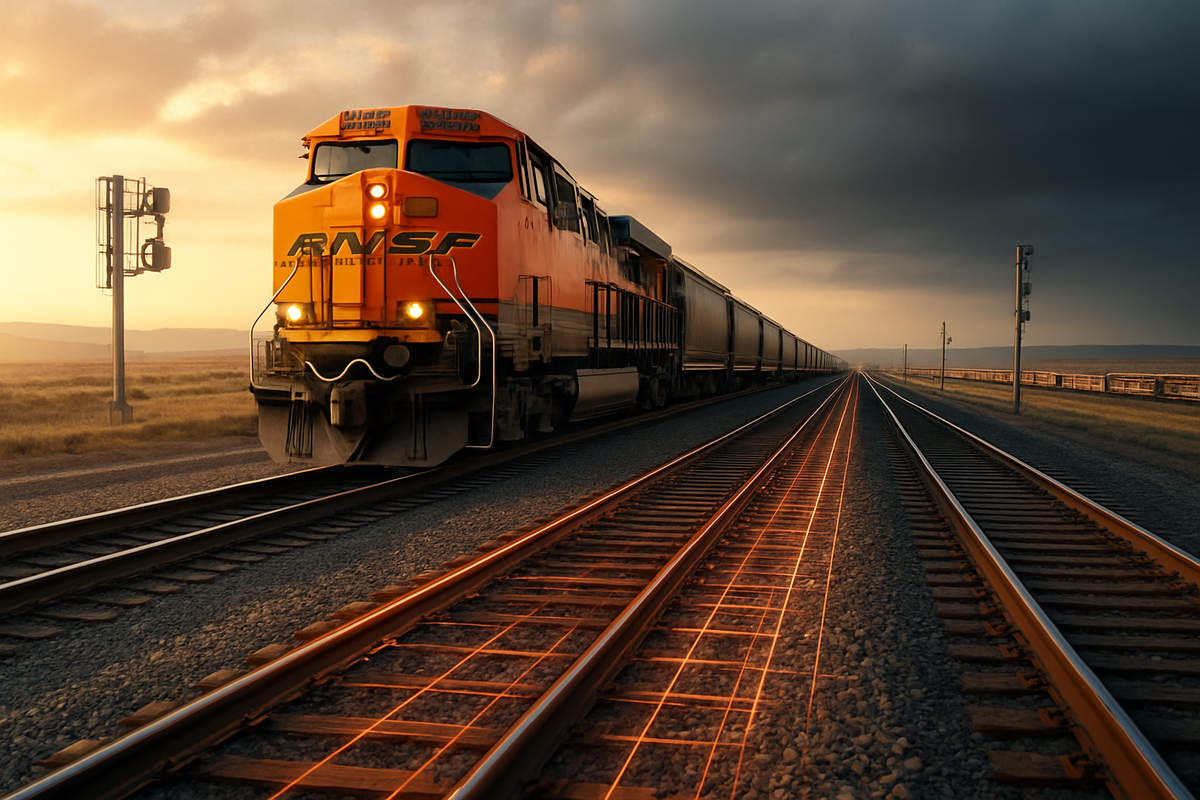
In a decisive move to fortify its logistics crown jewel, BNSF Railway, a wholly owned subsidiary of Berkshire Hathaway (NYSE: BRK.B), has unveiled a robust $3.6 billion capital investment plan for 2026. This announcement, coming just weeks into the official tenure of Greg Abel as CEO of Berkshire Hathaway, underscores a commitment to operational excellence and network reliability at a time when the North American rail landscape is facing its most significant upheaval in decades. The plan is designed to modernize infrastructure and streamline capacity, ensuring that BNSF remains the "gold standard" of Western rail as competitors navigate a treacherous regulatory environment.
The timing of this capital infusion is particularly strategic. It serves as a stark counter-narrative to the current chaos surrounding the proposed "mega-merger" between Union Pacific (NYSE: UNP) and Norfolk Southern (NYSE: NSC). While BNSF’s rivals are bogged down in the regulatory quagmire of a merger application recently labeled "incomplete" by federal oversight, Berkshire is doubling down on its existing assets. By prioritizing maintenance and incremental expansion over the high-risk gamble of massive consolidation, BNSF is positioning itself as the stable, dependable alternative for shippers who are increasingly wary of the potential service disruptions that a transcontinental merger might bring.
The $3.6 billion budget for 2026 is a calculated balance between preservation and progress. Approximately 75% of the total spend—roughly $2.7 billion—is earmarked for core maintenance. This includes the massive logistical undertaking of replacing and upgrading thousands of miles of rail, ties, and ballast. By focusing heavily on the "blocking and tackling" of railroad operations, BNSF aims to mitigate the risk of unscheduled service outages and derailments, which have plagued the industry in recent years. This maintenance-heavy approach is a hallmark of the Berkshire philosophy: ensuring the "moat" around the business remains wide by keeping the physical plant in top-tier condition.
Beyond maintenance, BNSF has allocated $358 million specifically for expansion and efficiency projects. Key focal points for this investment include significant upgrades to major switching yards in Galesburg, Illinois, and Winslow, Arizona. These yards are critical nodes in BNSF’s transcontinental network, and the planned expansions are designed to improve "dwell time"—the amount of time a car sits in a yard—and increase overall throughput. This follows a timeline of steady growth under the leadership of CEO Katie Farmer, who has steered the railroad through the volatile post-pandemic freight market. The plan also includes strategic property acquisitions aimed at securing future corridor capacity, a move that analysts see as a long-term hedge against increasing land costs and urban encroachment.
The announcement comes on the heels of a major victory for BNSF’s competitive positioning. On January 16, 2026, the Surface Transportation Board (STB) unanimously rejected the merger application of Union Pacific and Norfolk Southern, citing "missing market share projections" and incomplete disclosures. This regulatory setback for the "UNP-NS" alliance has provided BNSF with a unique window of opportunity. While its largest competitors are forced to spend the first half of 2026 revising their legal and operational frameworks to satisfy the STB, BNSF is already moving forward with shovel-ready projects that will enhance its service capacity by year-end.
In the current environment, Berkshire Hathaway and BNSF emerge as the clear strategic "winners." By choosing to invest $3.6 billion into their own existing network rather than pursuing a multi-billion dollar acquisition, they are avoiding the "merger penalty"—the typical 24-to-36-month period of service degradation and management distraction that follows large-scale rail consolidations. For BNSF, this investment is a signal to major shipping partners in the agriculture, automotive, and intermodal sectors that their cargo will move reliably, even if the rest of the industry remains in a state of flux.
Conversely, Union Pacific (NYSE: UNP) and Norfolk Southern (NYSE: NSC) find themselves in a precarious "loser" position in the short term. Their inability to gain initial STB approval for their merger has left them in a defensive crouch. They must now fight a two-front war: one against the regulators who are demanding unprecedented transparency, and another against labor unions and the American Chemistry Council, who are vehemently opposing the merger. The uncertainty of the merger’s future could lead to "capital flight" or customer attrition, as shippers look for the stability that BNSF is currently projecting.
The broader logistics market, including intermodal partners like J.B. Hunt Transport Services (NASDAQ: JBHT), also stands to benefit from BNSF’s network reliability. A well-maintained BNSF network means fewer delays for truck-to-rail transfers, potentially lowering the total cost of ownership for long-haul logistics. However, smaller regional "Short Line" railroads may feel the pressure; as BNSF increases its efficiency at major hubs like Galesburg, these smaller operators must also modernize or risk being bypassed by the faster, more efficient Class I network.
BNSF’s 2026 plan is a microcosm of a larger shift in the U.S. rail industry. For the past decade, the industry was obsessed with "Precision Scheduled Railroading" (PSR), a philosophy that prioritized cost-cutting and asset utilization above all else. However, the events of 2024 and 2025 demonstrated the limits of PSR, as lean networks struggled to handle sudden surges in demand or environmental disruptions. Berkshire Hathaway’s $3.6 billion plan signals a return to a "Capacity-First" model, prioritizing the ability to move more freight safely over the pursuit of the lowest possible operating ratio.
This shift is also a response to a much more aggressive regulatory environment. The STB’s rejection of the UNP-NS merger in early January reflects a new standard of scrutiny. Regulators are no longer just looking at anti-trust concerns; they are looking at the health of the entire national supply chain. By focusing on maintenance and reliability, BNSF is aligning itself with the STB’s stated goals of "service excellence." This provides Berkshire with significant political capital that its rivals currently lack. Historical precedents, such as the disastrous 1996 merger of Union Pacific and Southern Pacific, loom large in the minds of regulators, and BNSF is playing into that caution by presenting itself as the stable alternative to further consolidation.
Furthermore, the leadership transition at Berkshire Hathaway cannot be overlooked. Greg Abel, who took the helm on January 1, 2026, is known for his operational expertise in energy and utilities—sectors that require massive, long-term capital commitments. His endorsement of BNSF’s $3.6 billion plan suggests that the "Buffett Era" of prudent, defensive capital allocation will continue, but with a renewed focus on modernizing the physical assets that generate Berkshire’s massive cash flows. With a record $382 billion in cash on hand, Berkshire is effectively using BNSF as a "fortress" to park capital where it can earn a reliable, if not spectacular, return.
The next six months will be pivotal for the rail industry. Union Pacific and Norfolk Southern have until February 17, 2026, to notify the STB of their intent to refile their merger application, with a final deadline of June 22, 2026, for a revised submission. During this time, BNSF will likely begin the heavy lifting on its maintenance projects. If UNP and NSC fail to address the STB’s concerns regarding market share projections, BNSF could see a permanent shift in market share, particularly in the critical mid-continent corridors where the three railroads compete most fiercely.
In the long term, BNSF may face the challenge of a shifting freight mix. As the U.S. continues to move away from coal—a traditional staple of rail revenue—BNSF must use its 2026 investments to pivot toward consumer goods and green energy components, such as wind turbine parts and electric vehicle batteries. The expansion of the Galesburg and Winslow yards is a direct response to this need for flexibility. If BNSF can successfully transition its network to handle these high-growth, high-service-requirement sectors, it will be well-positioned to maintain its dominance regardless of whether its competitors eventually merge.
There is also the potential for "strategic pivots" in technology. While the 2026 plan is focused on physical infrastructure, the modernization of rail and ties often includes the installation of advanced sensors and automated inspection systems. We can expect BNSF to integrate more predictive maintenance technology into its network this year, potentially reducing long-term costs even further. The market will be watching closely to see if these investments translate into improved operating margins in the Q3 and Q4 2026 earnings reports.
BNSF’s $3.6 billion capital investment plan is more than just a maintenance budget; it is a statement of intent from the Greg Abel era of Berkshire Hathaway. By focusing on the fundamentals of railroading—safety, reliability, and capacity—BNSF is positioning itself to win by simply being the most dependable player on the field. While the rest of the industry is consumed by the high-stakes drama of the Union Pacific-Norfolk Southern merger and the associated regulatory hurdles, BNSF is quietly laying the tracks for a more efficient and profitable future.
For investors, the key takeaways are clear: Berkshire Hathaway remains committed to its long-term, capital-intensive businesses, and it sees BNSF as a primary engine for stability. The market moving forward will likely reward companies that can prove their reliability to a supply-chain-sensitive public. The "rail wars" of 2026 are not being fought with hostile takeovers, but with ties, ballast, and yard capacity.
As we move toward the June 22 regulatory deadline for the competition, investors should watch for any signs of service improvement or degradation on the BNSF lines compared to the Union Pacific and Norfolk Southern networks. In the modern economy, the railroad that can move the most goods with the fewest disruptions is the railroad that will ultimately own the market. For now, BNSF and Berkshire Hathaway appear to be in the driver’s seat.
This content is intended for informational purposes only and is not financial advice.