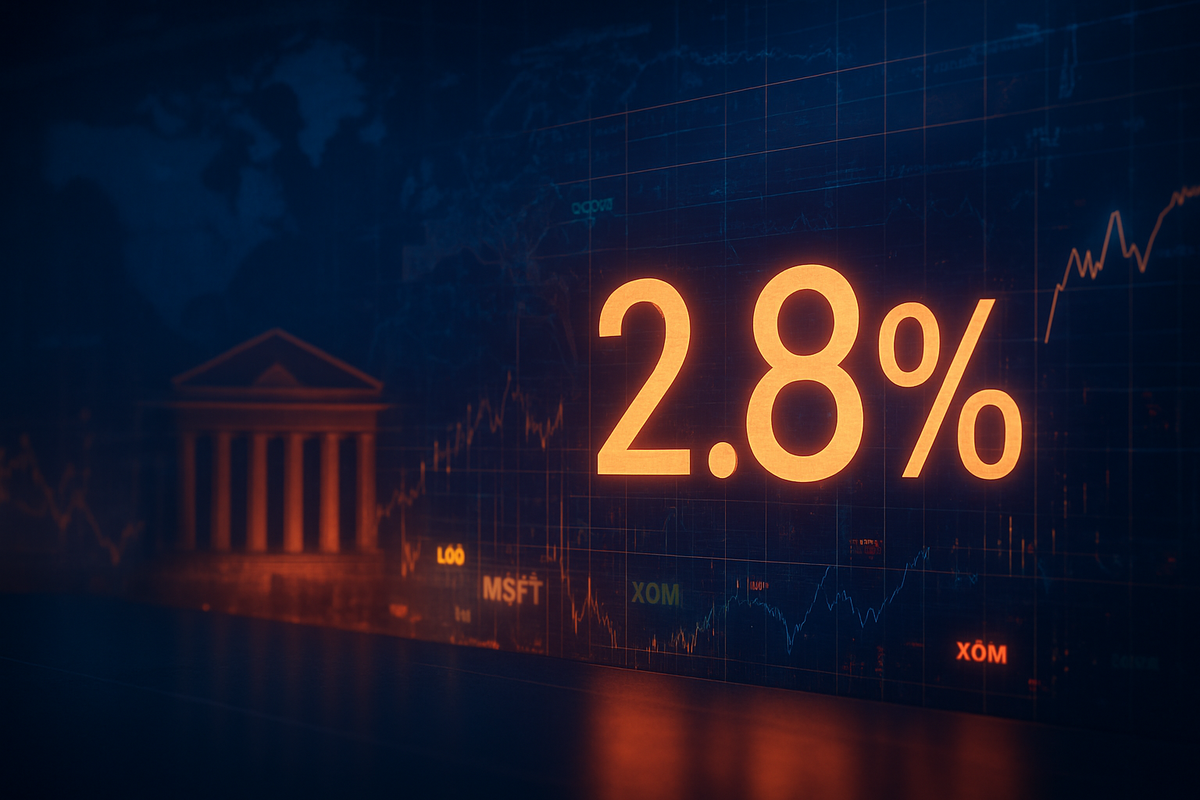
The release of the latest Core Personal Consumption Expenditures (PCE) data on January 22, 2026, has sent a clear message to Wall Street: the "last mile" of the inflation fight is proving to be a marathon. The index, which serves as the Federal Reserve's preferred inflation gauge, rose to 2.8% year-over-year for November 2025—a slight uptick from 2.7% in October. This "sticky" reading has effectively slammed the door on hopes for aggressive rate cuts in the first half of 2026, anchoring the "higher-for-longer" narrative that dominated the early weeks of the year.
The immediate implications for the market are a blend of frustration and forced adaptation. While the 2.8% print was largely in line with consensus forecasts, its failure to break toward the Fed's 2.0% target suggests that price pressures in the services sector and resilient consumer demand have created a persistent floor. Consequently, the Federal Open Market Committee (FOMC) is widely expected to maintain its current federal funds rate range of 3.50% – 3.75% at its January 28 meeting, signaling a cautious, data-dependent pause that could last through much of the year.
Delayed Data and the Hawkish Hold
The road to this latest inflation print was anything but smooth. A late-2025 government shutdown caused significant delays in data reporting, leaving the Bureau of Economic Analysis (BEA) to release a massive "catch-up" report in late January 2026. This data vacuum had created a period of heightened uncertainty, which was only resolved when the 2.8% figure confirmed that inflation momentum had plateaued rather than plummeted. The monthly momentum of 0.2% for both headline and core PCE suggests a "tame" but stubborn environment where the cooling trend seen in early 2025 has hit a psychological and structural barrier.
Key stakeholders, including Federal Reserve Chair Jerome Powell, have shifted their rhetoric toward a "hawkish hold." Following a 25-basis-point cut in December 2025, the central bank’s updated Summary of Economic Projections now hints at only one additional rate cut for the entirety of 2026. This stance is bolstered by a labor market that remains surprisingly resilient, with unemployment holding steady at 4.4%. Market reactions have been characterized by a "closed expectation gap"; the S&P 500 saw modest volatility, ending the week of the release down roughly 0.4%, while 10-year Treasury yields climbed toward 4.30% as investors recalibrated for a world where sub-3% inflation remains elusive.
Winners and Losers in the Great Realignment
The persistence of inflation and the resulting interest rate path have sparked a structural shift in equity markets, often referred to by analysts as the "Revenge of the S&P 493." As the era of cheap capital remains on hiatus, investors are rotating away from pure-play growth and toward "real-world" assets and infrastructure.
- The Tech Resilients: Despite the sector rotation, NVIDIA (NASDAQ: NVDA) remains a standout winner. Shares rose 1.45% to $185.98 following the PCE data, fueled by record data center revenue and the anticipation of the Vera Rubin AI platform. Similarly, Microsoft (NASDAQ: MSFT) climbed 3.28% to $465.95, as its enterprise AI dominance provides a moat against inflationary pressures.
- Energy and Resources: Traditional energy giants like ExxonMobil (NYSE: XOM) and Chevron (NYSE: CVX) have emerged as primary beneficiaries. Chevron, in particular, has been lauded for its 4.5% dividend yield and strategic pivot toward providing power infrastructure for AI data centers. Meanwhile, safe-haven assets like gold have surged to record highs of nearly $5,000/oz as a hedge against both "sticky" inflation and geopolitical instability.
- The Squeezed Retailers: On the losing side, Amazon (NASDAQ: AMZN) faced a sharp 2.9% drop in mid-January. The combination of plateauing inflation and the "Greenland tariff" scare—where President Trump threatened 10% tariffs on European allies—raised concerns about discretionary spending and rising supply chain costs.
- Financial Volatility: JPMorgan Chase (NYSE: JPM) has faced a "double-edged sword." While benefiting from high net interest margins, the bank's shares were pressured by a proposed 10% cap on credit card interest rates and high-profile legal battles with the administration, illustrating the regulatory risks inherent in a high-rate environment.
Geopolitics and the "Nuisance" Level of Inflation
The broader significance of the 2.8% PCE print lies in its intersection with the "Greenland Impact." In January 2026, the market was rocked by threats of a 10% tariff on European nations to leverage the U.S. purchase of Greenland. While the administration eventually backpedaled at the World Economic Forum in Davos, the event highlighted a new "cost-push" inflationary risk. Tariffs and geopolitical friction are now viewed as structural upward pressures that could keep inflation at this "nuisance" level—not a crisis, but high enough to prevent a return to the low-rate decade that preceded 2022.
Historically, this period echoes the mid-1970s "plateau" phases, where inflation would cool but fail to reach the target before another shock arrived. The current "Great Realignment" suggests that the market is finally accepting that the 2% target may be a long-term goal rather than a short-term reality. This has led to a notable outperformance in the Russell 2000 (IWM), which gained 5.57% year-to-date in early 2026, as investors seek value in smaller, domestic-oriented companies that may be less exposed to international tariff wars.
The Path Ahead: Scenarios for 2026
In the short term, the market is bracing for a "wait-and-see" period. The Fed is unlikely to move rates again until at least the second half of 2026, barring a significant economic downturn. Strategic pivots will be required for companies that relied on low-cost debt for expansion. We are likely to see a surge in M&A activity among firms with strong cash flows, as they look to acquire smaller competitors struggling with high financing costs.
Potential scenarios for the remainder of 2026 include a "Soft Landing 2.0," where inflation gradually drifts toward 2.4% without a spike in unemployment. However, a more volatile scenario involves a "Tariff-Triggered Rebound," where geopolitical trade wars push Core PCE back toward 3.5%, forcing the Fed to consider a "u-turn" and resume rate hikes. Investors should prepare for a V-shaped volatility pattern, where geopolitical headlines cause sharp, temporary drawdowns followed by rapid, sentiment-driven recoveries.
Summary and Investor Outlook
The January 2026 inflation report has solidified 2.8% as the new floor for the U.S. economy, at least for the foreseeable future. The key takeaways are clear: the Federal Reserve is no longer in a hurry to cut rates, "sticky" inflation is a structural reality, and geopolitical events like the Greenland negotiations have become primary market movers.
Moving forward, the market appears resilient but fragile. Investors should keep a close eye on the Fed’s June forecast and the evolving "Greenland framework" for clues on trade policy. The focus has shifted from "when will rates fall?" to "who can thrive in a 4% rate environment?" In the coming months, the ability of companies to maintain pricing power and manage supply chain volatility will be the true litmus test for portfolio success in this new economic era.
This content is intended for informational purposes only and is not financial advice.