AUSTIN, Texas — As Tesla (NASDAQ: TSLA) reports its fourth-quarter 2025 earnings today, January 28, 2026, the company finds itself at the most critical juncture in its twenty-year history. Once defined by its dominance in the global electric vehicle (EV) market, the company is now fully rebranding itself as an artificial intelligence and robotics powerhouse. While the financial results show a second consecutive year of declining vehicle deliveries—totaling 1.63 million in 2025 compared to the 1.81 million peak in 2023—Wall Street’s attention is fixed firmly on the horizon of "unsupervised" autonomy and the scaling of the Optimus humanoid robot.
The immediate implications of this earnings report are clear: Tesla’s traditional automotive margins have shrunk to a tight 5.5%, pressured by intense global competition and a maturing EV market. However, CEO Elon Musk’s recent communications from the 2026 Davos summit suggest that the company’s future value no longer rests on the number of Model 3s sold, but on the deployment of its "Cybercab" fleet and the integration of Optimus into the global workforce. For investors, the question is no longer "How many cars did Tesla deliver?" but "When will the first steering-wheel-less taxi take its first unsupervised paid passenger?"
The Road from "We, Robot" to Reality
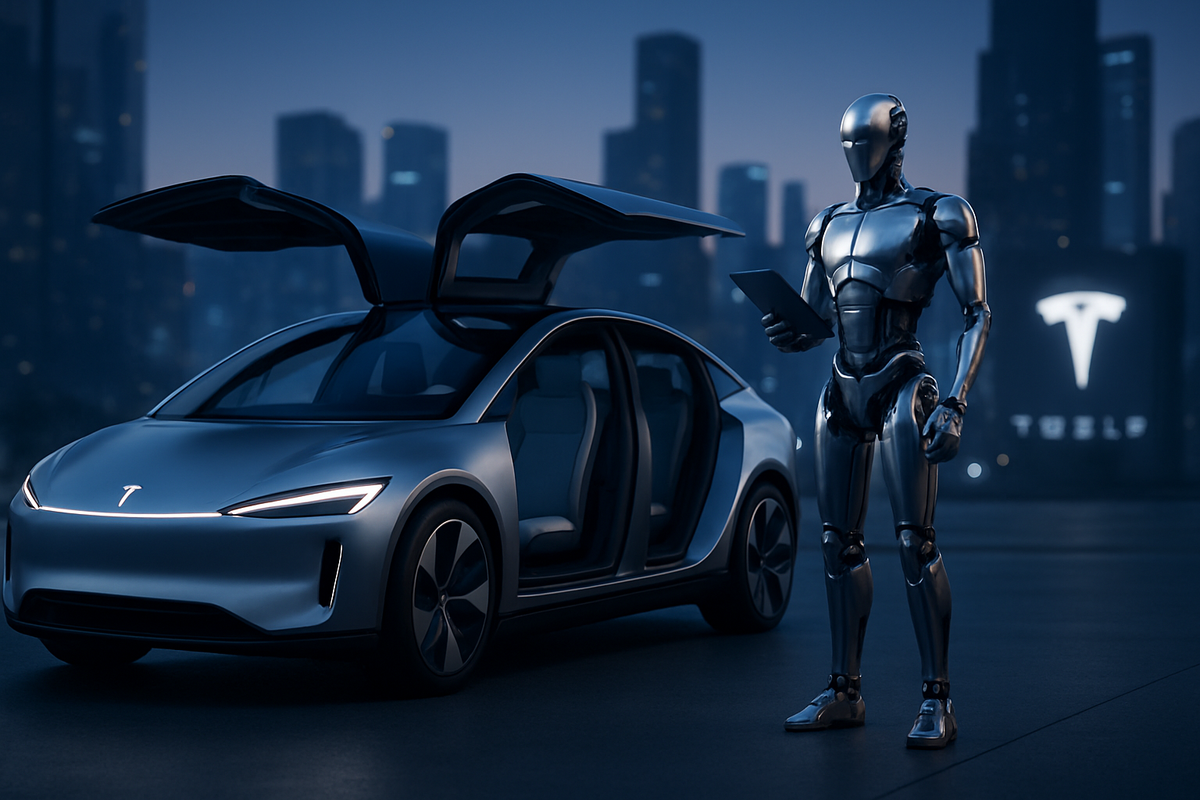
The current trajectory was set in motion during the landmark "We, Robot" event held on October 10, 2024, at Warner Bros. Studios. It was there that Tesla (NASDAQ: TSLA) first unveiled the Cybercab, a dedicated two-seater autonomous vehicle designed without a steering wheel or pedals. This followed months of speculation and a high-profile delay from an original August 2024 date. The event also introduced the Robovan, a high-capacity autonomous transport, and showcased the progress of the Optimus Gen 2 robot. Since that night, Tesla has been racing to turn those prototypes into a commercial reality.
Over the course of 2025, the company successfully launched a supervised autonomous ride-hailing pilot in Austin, Texas, utilizing modified Model Y units. As of early 2026, Tesla has begun the first "unsupervised" trials in geofenced areas of Texas, marking a significant milestone in its "vision-only" Full Self-Driving (FSD) approach. Unlike competitors who rely on expensive LiDAR and high-definition mapping, Tesla continues to bet its future on neural networks and camera-based perception, now updated to FSD version 14.2. Key stakeholders, including institutional bulls like ARK Invest and skeptical regulators at the NHTSA, are closely monitoring the safety data from these Austin trials to determine if the 2026 production goal for the Cybercab remains realistic.
Winners and Losers in the Autonomous Age
As Tesla shifts its weight toward AI, the ripple effects are being felt across the industry. The primary "winners" in this environment appear to be Tesla’s Energy Storage division and specialized AI hardware providers. Tesla’s energy business has become a massive stabilizer for the company’s bottom line, deploying a record 14.2 GWh in the final quarter of 2025. This segment is increasingly viewed as the "fuel" for the future robotaxi network. Furthermore, the aggressive push into robotics has solidified the demand for high-end compute power, benefiting companies like Nvidia (NASDAQ: NVDA) and Tesla’s own internal Dojo supercomputing project.
Conversely, the potential "losers" include traditional ride-sharing platforms like Uber (NYSE: UBER) and Lyft (NASDAQ: LYFT). If Tesla successfully launches a $30,000 Cybercab that can operate at a fraction of the cost of a human-driven car, the economic moat for current ride-hailing giants could evaporate. Additionally, budget-focused EV manufacturers who lack a sophisticated software stack are finding themselves trapped in a "race to the bottom" on price, unable to compete with the high-margin software subscriptions that Tesla is now prioritizing, such as its $99-per-month FSD service.
The Broader Significance: Vision vs. LiDAR
Tesla’s current status represents a major ideological test for the entire tech industry. The company’s refusal to use LiDAR puts it at odds with Waymo, owned by Alphabet (NASDAQ: GOOGL), which recently surpassed 100,000 paid autonomous rides per week using a multi-sensor approach. Tesla's pivot is not just about technology; it is a regulatory gamble. By removing steering wheels and pedals from the Cybercab, Tesla is forcing a conversation with federal regulators about the very definition of a motor vehicle. This mirrors historical precedents like the shift from horses to automobiles, where infrastructure and law had to be rebuilt from the ground up to accommodate a new era of mobility.
Furthermore, the introduction of Optimus Gen 3 into Tesla’s own factories throughout 2025 has provided a blueprint for the future of manufacturing. With 22 degrees of freedom in its hands, the robot is now performing tasks once thought exclusive to humans, such as threading delicate wire harnesses. This evolution suggests that the "Robotics-as-a-Service" model could eventually dwarf the automotive sector in scale. If Musk’s prediction holds—that Optimus could eventually add $20 trillion to Tesla's market cap—the company will have successfully completed the most significant pivot in corporate history.
What Lies Ahead: Production and Public Sale
In the short term, the market is looking for concrete production timelines for the Cybercab at Giga Texas. Musk has teased a mid-2026 start for low-volume production, but history suggests that "Tesla time" can be optimistic. Strategically, Tesla may need to adapt its business model to include fleet management services, as owning and maintaining a fleet of thousands of autonomous taxis requires a different infrastructure than simply selling cars to individuals. The upcoming months will likely see Tesla seeking regulatory approval for "unsupervised" FSD in more states, a move that would be a massive catalyst for the stock.
Looking further ahead to late 2027, the potential public sale of the Optimus robot for under $20,000 remains the ultimate "moonshot." The challenges that emerge will likely be centered around safety protocols and the societal impact of wide-scale labor automation. Investors should watch for any pivots in Tesla’s capital expenditure; a significant shift in funds from vehicle assembly lines to AI training centers and humanoid robot production will be the clearest indicator of where the company believes its future lies.
Summary and Investor Outlook
Tesla’s Q4 2025 earnings serve as a definitive marker that the "EV era" has transitioned into the "AI era." While the decline in vehicle deliveries is a concern for traditional value investors, the rapid growth of the Energy segment and the technical milestones of the Cybercab and Optimus provide a compelling, albeit high-risk, narrative for growth-oriented shareholders. The key takeaways from today's report are the resilience of Tesla's cash flow despite lower auto margins and the relentless pace of its FSD software iterations.
Moving forward, the market will remain bifurcated between those who see Tesla as a struggling car company and those who view it as the world’s leading robotics firm. Investors should keep a sharp eye on two metrics in the coming months: FSD subscription "take rates" and the safety data from the unsupervised Austin pilot. If Tesla can prove its vision-only system is safer than a human driver without the need for a safety monitor, the path to a multi-trillion-dollar valuation becomes much clearer. For now, Tesla remains the most ambitious—and polarizing—experiment in the modern financial market.
This content is intended for informational purposes only and is not financial advice.