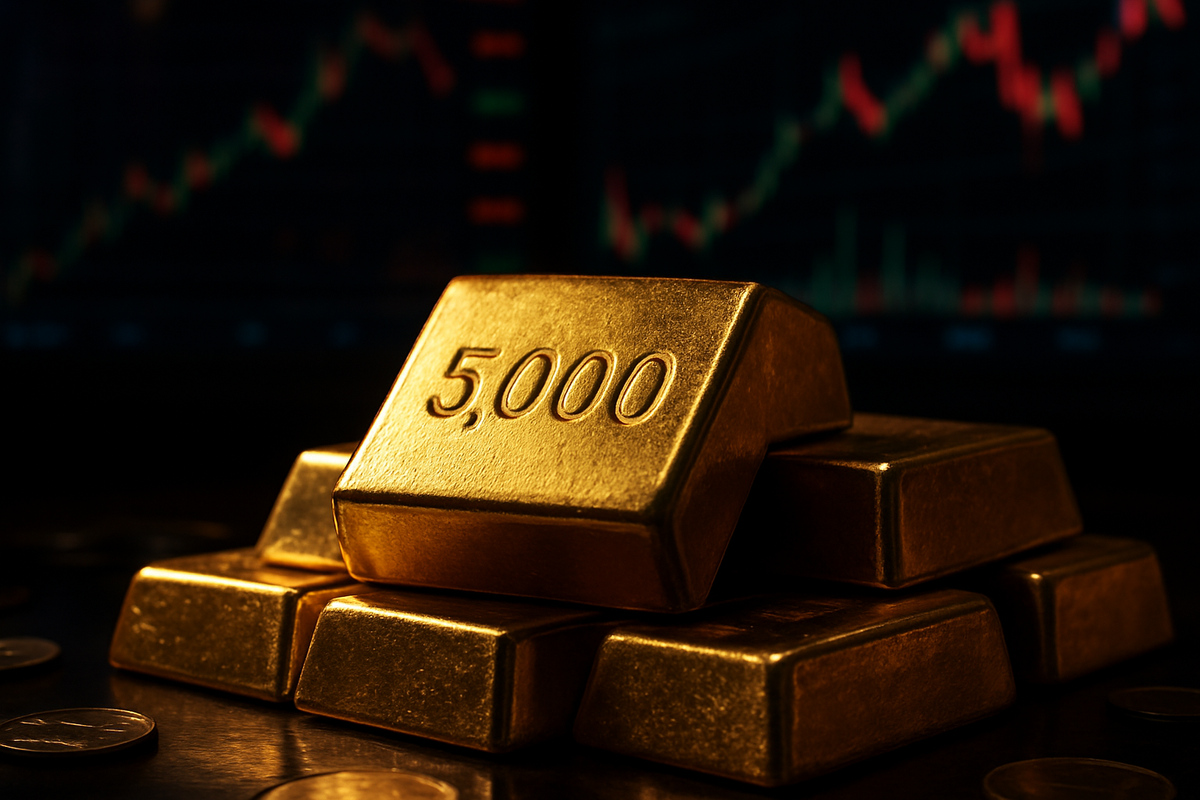
In a historic shift that has reverberated through every corner of the global financial system, gold prices surged past the $5,000 per ounce milestone this week, closing at an unprecedented $5,306 on January 30, 2026. This monumental rally marks a nearly 90% increase in just twelve months, fundamentally altering the calculus for institutional investors, central banks, and sovereign wealth funds. As the "yellow metal" cements its status as the ultimate hedge against a fracturing world order, the immediate implications are clear: the era of fiat dominance is facing its most significant challenge since the collapse of Bretton Woods.
The breach of the $5,000 psychological barrier has triggered a massive rotation of capital out of traditional sovereign debt and into hard assets. For the public, this surge is not just a market statistic but a signal of deep-seated anxiety regarding the stability of the U.S. dollar and the sustainability of Western fiscal policies. Market analysts suggest that the rally has shifted gold from being a "defensive play" to a "strategic overweight" necessity for any diversified portfolio.
The Road to $5,000: A Perfect Storm of Scarcity and Strife
The ascent to $5,000 was not a sudden spike but the culmination of a two-year structural shift that began in early 2024. Throughout 2024 and 2025, central banks across the globe—most notably those in China, India, Russia, and Poland—embarked on an aggressive diversification spree. Spooked by the weaponization of the dollar during previous geopolitical conflicts, these institutions purchased over 1,000 metric tonnes of gold annually for two consecutive years. By the end of 2025, gold had surpassed U.S. Treasuries as a percentage of total reserves for several major developing economies, creating a relentless "floor" for prices.
The final catalyst occurred in late January 2026, following the World Economic Forum in Davos. A diplomatic rift between the United States and its NATO allies—sparked by renewed trade tariffs and a high-stakes disagreement over the strategic control of Greenland—sent volatility indices screaming higher. When news broke that a coalition of "middle powers" was actively seeking to settle trade in a gold-backed alternative to the dollar, the market went into a buying frenzy. On January 27, 2026 alone, gold prices jumped $300 in a single trading session, as institutional "FOMO" (fear of missing out) took hold.
Key stakeholders, including the World Gold Council and major bullion banks, have noted that the 2025 sovereign debt crisis was the "black swan" that many saw coming but few were prepared for. As the U.S. deficit ballooned and political infighting threatened the independence of the Federal Reserve, investors fled to the safety of the SPDR Gold Shares (NYSE Arca: GLD), which saw record-breaking inflows of $4.7 billion in January 2026 alone. The market reaction was swift, with traditional "safe-haven" currencies like the Swiss Franc and Japanese Yen failing to keep pace with the meteoric rise of gold.
Mining Giants and the Profitability Paradox
The primary beneficiaries of this price explosion have been the world’s largest gold mining companies, which are now operating with profit margins that were once considered impossible. Newmont Corporation (NYSE: NEM), the world’s largest producer, saw its stock price soar to record highs near $125 per share this week, a staggering 200% return over the past year. With All-In Sustaining Costs (AISC) remaining relatively stable between $1,100 and $1,300 per ounce, Newmont's cash flow generation has allowed it to aggressively reduce debt and return record dividends to shareholders, despite mounting royalty pressures in jurisdictions like Ghana.
Similarly, Barrick Gold Corporation (NYSE: GOLD) has emerged as a major winner, with its stock price hitting $54 this week. Barrick’s significant copper exposure has provided an additional hedge, but it is the $3,500+ profit margin on every ounce of gold that has captured the market's attention. Analysts at major investment banks have upgraded Barrick to a "Strong Buy," noting that well-managed miners are currently providing 2-3x leverage to the underlying metal’s performance. Agnico Eagle Mines Limited (NYSE: AEM) has also seen a dramatic re-rating, as its low-risk jurisdictional profile in Canada and Finland has made it a darling for institutional investors seeking safety alongside growth.
However, the rally is not without its casualties. The jewelry industry and high-end electronics manufacturers, who rely on gold for high-performance components, are facing a massive cost crunch. Companies in the luxury goods sector have seen their margins eroded, leading to a "price-out" of middle-class consumers. Furthermore, some junior miners that failed to secure long-term financing before the rally are struggling to scale up production quickly enough to capitalize on the prices, facing inflated equipment costs and a shortage of specialized labor.
Geopolitics and the End of the Dollar Standard
The wider significance of gold’s $5,000 milestone lies in its reflection of a de-globalizing world. The historical precedent for such a move can only be compared to the stagflationary period of the late 1970s, but today's rally is driven by a more permanent shift in the global monetary architecture. The "de-dollarization" trend is no longer a fringe theory; it is a reality as BRICS+ nations and even some traditional U.S. allies seek to insulate themselves from the potential for future sanctions and currency volatility.
This event fits into a broader trend of "economic sovereignism," where nations prioritize physical assets over digital promises. The ripple effects are being felt in the commodities markets, where silver, platinum, and copper are also seeing sympathetic rallies as investors seek "cheaper" alternatives to the now-expensive gold. Regulatory implications are also emerging, with several nations considering "windfall taxes" on mining profits and new reporting requirements for private gold holdings to ensure domestic liquidity.
Historically, when gold moves this fast, it signals a lack of confidence in the prevailing world order. The confrontation over Greenland and the imposition of a 100% tariff regime on key trade partners have served as the "match in the powder keg." The market is essentially pricing in the end of the unipolar financial world, moving toward a multipolar system where gold acts as the neutral, universal anchor.
What Comes Next: $6,000 or a Correction?
In the short term, the market is bracing for a period of extreme volatility. While some bulls are already targeting $6,000 per ounce by the end of 2026, others warn that the rally has been too fast, too soon. A potential strategic pivot may be required from the Federal Reserve; if the Fed is forced to raise interest rates aggressively to defend the dollar, it could create a temporary headwind for gold. However, if the Fed chooses to print more money to monetize the national debt, gold could easily blast through the $6,000 level.
Market opportunities are emerging for those looking beyond the metal itself. Strategic investments in gold recycling and high-tech mineral exploration are expected to surge as the incentive to find every last gram of gold increases. Conversely, the challenge for the market will be the "liquidity trap"—as gold becomes too expensive for everyday transactions or small-scale investors, we may see a surge in the popularity of "fractionalized" gold ownership via blockchain-based tokens or more accessible ETFs.
A Summary for the Modern Investor
The breach of $5,000 per ounce is a watershed moment for the global economy. The key takeaways for investors are the undeniable reality of de-dollarization, the massive profitability of senior miners like Newmont and Barrick Gold, and the increased role of geopolitics in driving asset prices. Moving forward, the market will likely remain in a "high-volatility regime," where news of diplomatic rifts or central bank reserve shifts can cause massive price swings.
Investors should watch for three main indicators in the coming months: the monthly gold purchase reports from the People's Bank of China, any changes in U.S. trade policy toward NATO allies, and the "All-In Sustaining Costs" of major miners to see if inflation is beginning to eat into their record profits. While the $5,000 milestone is a peak today, in the context of the next decade, it may just be the beginning of gold's resurgence as the center of the financial universe.
This content is intended for informational purposes only and is not financial advice.