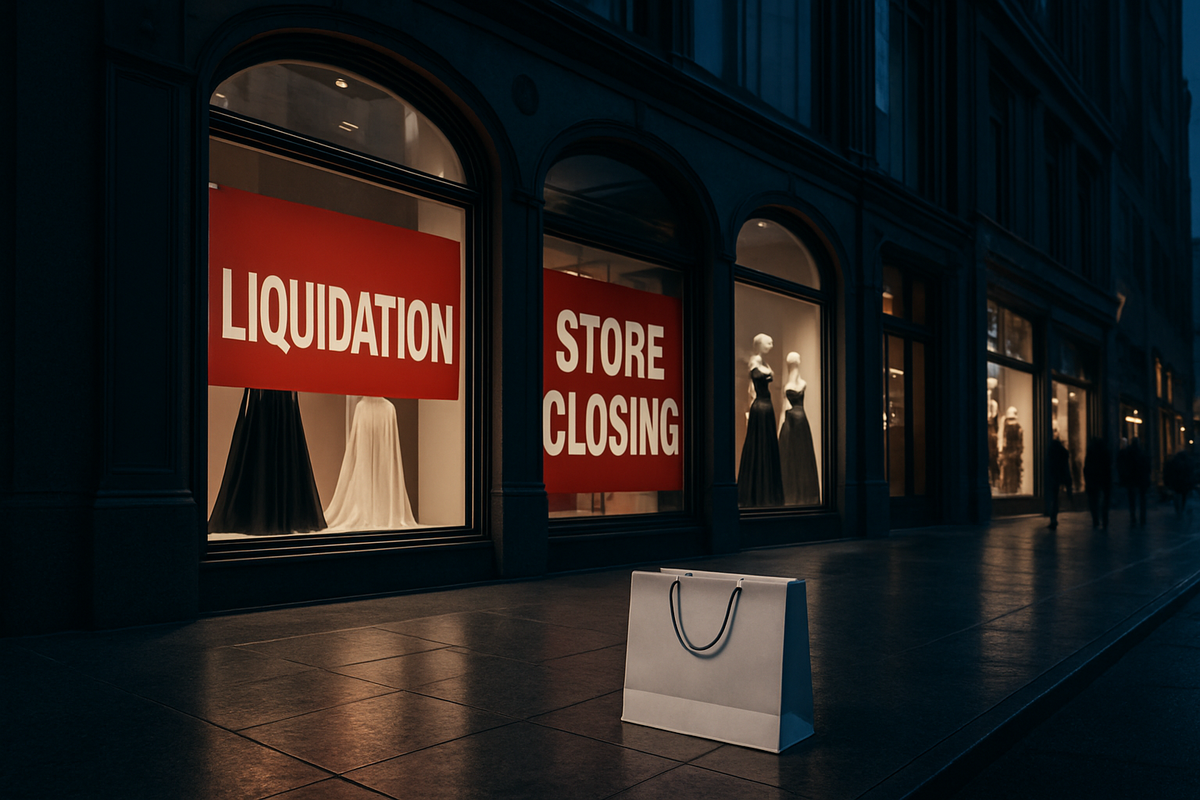
The landscape of American luxury retail was fundamentally reshaped this month as Saks Global Holdings LLC officially filed for Chapter 11 bankruptcy protection. The filing, which took place in the U.S. Bankruptcy Court for the Southern District of Texas on January 13, 2026, marks a stunning reversal for a conglomerate formed just over a year ago with the intent of dominating the high-end market. The most immediate and drastic casualty of the restructuring is Saks OFF 5TH, the company’s off-price division, which is scheduled to liquidate and close nearly all of its physical locations and wind down its e-commerce operations.
This collapse signals the end of an ambitious experiment to combine the heritage of Saks Fifth Avenue and Neiman Marcus Group into a "technology-powered luxury powerhouse." For the market, the implications are immediate: a massive vacuum in the off-price luxury sector and a high-stakes legal battle involving tech giants and fashion houses. The bankruptcy filing reveals a "vicious cycle" of liquidity constraints that left shelves bare during the critical 2025 holiday season, eventually forcing the hand of leadership as debt obligations became insurmountable.
The Fall of a Titan: Debt, Vendors, and a Disastrous Holiday Season
The descent into bankruptcy for Saks Global was precipitated by a crushing debt load of approximately $2.65 billion, much of it inherited or created during the late 2024 acquisition of Neiman Marcus by Hudson’s Bay Company (HBC). While the merger was initially celebrated as a defensive masterstroke against a softening economy, the reality of 2025 proved far harsher. A sharp decline in luxury spending throughout the past year, coupled with rising interest rates, left the newly formed entity struggling to service its obligations. By the fourth quarter of 2025, the company began missing payments to its most critical partners—the luxury houses themselves.
Key stakeholders, including LVMH Moët Hennessy Louis Vuitton (EPA:MC) and Kering (EPA:KER), reportedly halted shipments to Saks Global properties in November 2025 after months of payment delays. This "vicious cycle" meant that during the 2025 holiday window, flagship stores lacked the inventory required to drive high-margin sales. Following the filing, Richard Baker stepped down as CEO, with former Neiman Marcus head Geoffroy van Raemdonck taking the helm to lead the restructuring. The company has since secured $1.75 billion in debtor-in-possession (DIP) financing to keep its core full-price banners—Saks Fifth Avenue, Neiman Marcus, and Bergdorf Goodman—operational while it aggressively sheds its off-price liabilities.
The most dramatic component of the "Transformation Plan" is the near-total liquidation of Saks OFF 5TH. On January 29, 2026, the company confirmed that of its 74 locations, 62 will be permanently shuttered. The remaining 12 stores will be repurposed as a "clearance channel" for residual inventory from the flagship brands rather than functioning as an independent off-price retailer. All five remaining Neiman Marcus Last Call locations are also slated for closure, effectively ending Saks Global’s presence in the discount market.
Winners and Losers: A Shift in Market Dominance
The bankruptcy has created clear divisions between those who stand to gain market share and those caught in the financial crossfire. Macy’s Inc. (NYSE: M) has emerged as a primary beneficiary. Its high-end banner, Bloomingdale’s, is positioned to capture an estimated $300 million in displaced market share. Macy’s stock has seen renewed interest as investors bet on the company’s "Bold New Chapter" strategy, which emphasizes smaller-format luxury boutiques that can now fill the void left by closing Saks locations.
Similarly, Nordstrom—which went private in May 2025 in a $6.25 billion deal led by the Nordstrom family and Mexican retailer El Puerto de Liverpool—is expected to gain roughly $170 million in annual sales. As a private entity, Nordstrom has been able to pivot more nimbly, aggressively courting the high-end vendors who abandoned Saks Global. Conversely, the "losers" in this scenario include major tech investors. Amazon.com, Inc. (NASDAQ: AMZN), which invested $475 million in preferred equity during the 2024 merger, has already declared its investment "presumptively worthless" and is currently filing legal objections to the bankruptcy financing plan, alleging mismanagement. Salesforce, Inc. (NYSE: CRM), another minority investor and tech partner, faces the loss of its equity stake, though its software remains integrated into the company’s digital backbone for the time being.
Broader Industry Trends and the Retreat to "Pure Luxury"
The Saks Global bankruptcy fits into a broader trend of "luxury bifurcation." In 2025 and early 2026, the middle-class "aspirational" luxury consumer largely retreated, leaving retailers that relied on off-price volume—like Saks OFF 5TH—vulnerable. The decision to liquidate the off-price division reflects a strategic pivot toward "Pure Luxury," focusing exclusively on the ultra-high-net-worth individuals who frequent Bergdorf Goodman and Saks Fifth Avenue flagships. This move mirrors historical precedents where retailers like Barneys New York were forced to downsize to their most profitable core to survive.
Furthermore, the event highlights the growing power of luxury conglomerates over department stores. The ability of LVMH and Kering to effectively "starve" Saks Global by withholding inventory underscores a shift toward Direct-to-Consumer (DTC) models. If department stores cannot guarantee financial stability, luxury houses have shown they are more than willing to pull their collections and sell exclusively through their own boutiques or digital platforms. This creates a regulatory and strategic challenge for the remaining multi-brand retailers who must now prove their viability to wary suppliers.
The Road Ahead: Restructuring and Digital Survival
In the short term, the market will witness a massive liquidation event as Saks OFF 5TH begins its "Everything Must Go" sales. This influx of discounted luxury goods may temporarily depress margins for competitors but will eventually clear the way for a more consolidated market. Long-term, the survival of the remaining Saks Global brands depends on their ability to settle the litigious dispute with Amazon and reorganize as a leaner, digital-first entity. The company has indicated a desire to integrate its online presence more closely, though the winding down of the SaksOff5th.com domain suggests a significant contraction in their total addressable market.
Strategic pivots will likely involve a heavier reliance on AI-driven personalization, a project Salesforce originally spearheaded. However, the immediate challenge remains the restoration of vendor trust. Without the latest collections from European fashion houses, the remaining physical "temples of luxury" in Manhattan and Beverly Hills risk becoming obsolete. Analysts are watching for potential "stalking horse" bids on specific assets, should the current restructuring plan falter.
Summary and Investor Outlook
The Saks Global bankruptcy is more than just a corporate restructuring; it is a signal of the end of the "off-price luxury" era as we knew it. The liquidation of Saks OFF 5TH marks the conclusion of a decade-long push to democratize luxury through outlet channels. Key takeaways for investors include the resilience of Bloomingdale’s under the Macy’s umbrella and the strategic advantage currently held by private entities like Nordstrom.
As we move forward into 2026, investors should keep a close eye on the Southern District of Texas court proceedings, particularly the objections raised by Amazon. The outcome of this legal battle will determine whether Saks Global can successfully emerge as a "Pure Luxury" player or if further breakups are inevitable. For the retail sector, the lesson is clear: in a cooling economy, even the most prestigious names are not immune to the pressures of excessive leverage and shifting consumer loyalty.
This content is intended for informational purposes only and is not financial advice.