In a move that has sent shockwaves through global financial markets, President Donald Trump has officially nominated Kevin Warsh to succeed Jerome Powell as the next Chairman of the Federal Reserve. The announcement, made on the morning of January 30, 2026, marks the culmination of a year-long campaign by the Trump administration to reshape the nation's central bank and install a leader more aligned with the President's "America First" economic agenda. While the selection was widely anticipated in prediction markets over the last 24 hours, the formal nomination has triggered immediate volatility across asset classes, as investors grapple with Warsh's complex reputation as a "moderate hawk" who has recently embraced a new brand of productivity-driven monetary policy.
The immediate implications of the Warsh nomination are profound, signaling a definitive end to the Powell era and a potential shift in how the Fed balances its dual mandate of price stability and maximum employment. Markets are currently pricing in a "bear steepener" in the Treasury curve—where long-term yields rise faster than short-term ones—reflecting a belief that while Warsh may accommodate the President’s desire for lower headline rates, his skepticism of "unconventional" monetary tools like Quantitative Easing (QE) could lead to a tighter liquidity environment in the long run.
A Targeted Transition: The Road to the Warsh Nomination
The path to today’s announcement has been defined by a public and often acrimonious struggle between the White House and the current Fed leadership. Throughout 2025, President Trump frequently took to social media and public rallies to criticize Jerome Powell, at one point calling the sitting Chair a "stubborn mule" for not cutting interest rates more aggressively in the face of cooling inflation. The tension reached a boiling point in mid-2025 when the Department of Justice reportedly began a preliminary inquiry into the Federal Reserve’s administrative spending, a move many legal experts viewed as an attempt to pressure Powell into an early resignation before his term officially expires in May 2026.
Kevin Warsh, a former Fed Governor (2006–2011) and Morgan Stanley executive, emerged as the frontrunner after a series of high-profile endorsements from Wall Street heavyweights and key administration advisors. Treasury Secretary Scott Bessent reportedly led the selection process, narrowing a field of candidates that included Fed Governor Christopher Waller and BlackRock executive Rick Rieder. Warsh’s final "audition" arguably took place through a series of editorial pieces in late 2025, where he argued that the U.S. economy was entering a "productivity boom" fueled by Artificial Intelligence and deregulation. This narrative allowed Warsh to bridge the gap between his historical "hawkish" stance against inflation and Trump's demand for lower rates, suggesting that supply-side growth would naturally keep prices down.
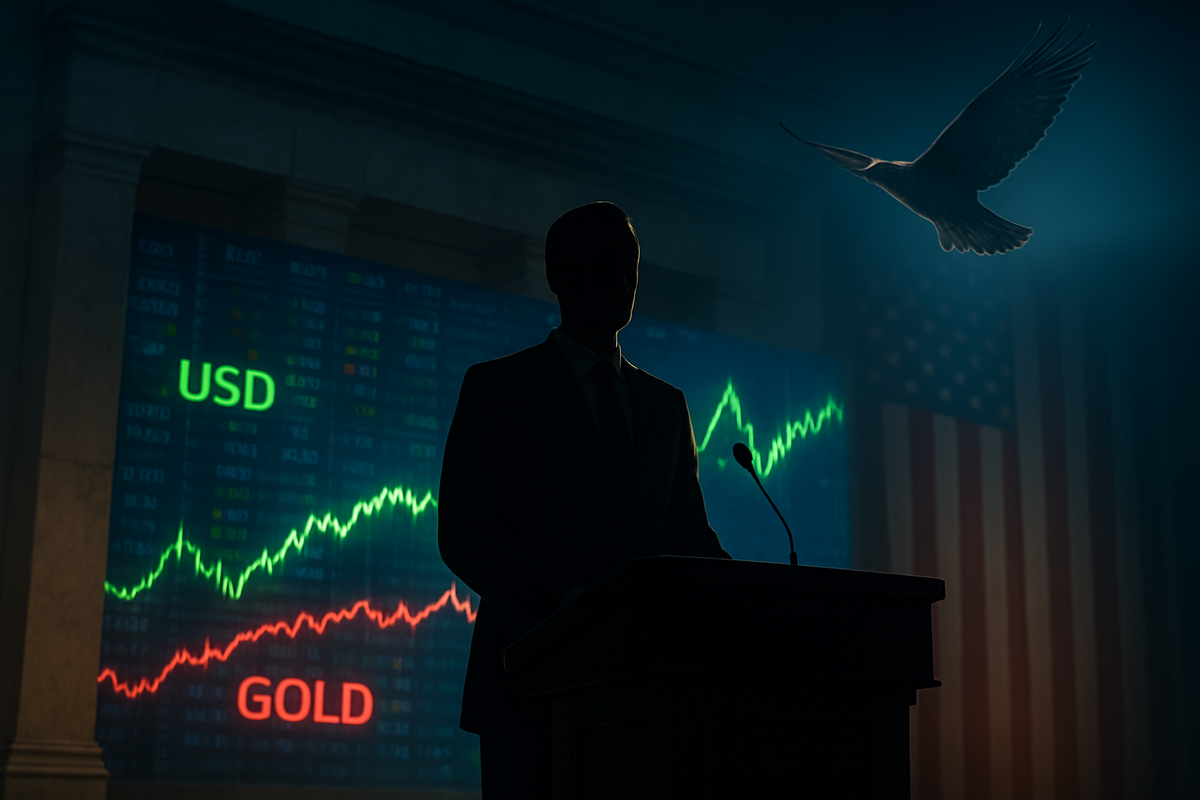
The formal nomination on January 30, 2026, followed a private meeting at the White House the previous evening. The market reaction was instantaneous: the U.S. Dollar Index (DXY) climbed as international investors bet on a more disciplined Fed, while the gold market experienced one of its sharpest single-day declines in recent memory, with prices dropping nearly 5% as the "monetary uncertainty" premium evaporated.
Winners and Losers: Financials Surge While Miners Retrench
The transition to a Warsh-led Federal Reserve is creating clear bifurcations in the equity markets. The primary beneficiaries appear to be the large-cap financial institutions. JPMorgan Chase & Co. (NYSE: JPM) and The Goldman Sachs Group, Inc. (NYSE: GS) saw their shares move higher on the news. Analysts suggest that a Warsh chairmanship will likely coincide with a continued push for financial deregulation, potentially easing the capital requirements that have constrained big banks in recent years. Furthermore, a steeper yield curve—a typical market response to Warsh’s fiscal-focused views—generally improves net interest margins for commercial lenders.
Conversely, the "losers" of the day were concentrated in the commodities and interest-rate-sensitive sectors. The mining industry, in particular, took a significant hit as the strengthening dollar weighed on dollar-denominated assets. Newmont Corporation (NYSE: NEM) and Freeport-McMoRan Inc. (NYSE: FCX) both saw their stock prices tumble as gold and copper prices retreated. Hecla Mining Company (NYSE: HL) also faced intense selling pressure as silver prices plummeted over 10% in the wake of the announcement.
The real estate sector also reacted with caution. While Trump has advocated for lower rates to help the housing market, investors in companies like American Tower Corporation (NYSE: AMT) and Prologis, Inc. (NYSE: PLD) are wary that Warsh’s commitment to "shrinking the Fed’s bloated balance sheet" could keep long-term mortgage and corporate borrowing costs higher than anticipated, despite any cuts to the overnight fed funds rate.
A Paradigm Shift in Central Banking Independence
The nomination of Kevin Warsh represents a significant pivot in the historical relationship between the executive branch and the Federal Reserve. For decades, the "independence" of the Fed was treated as a sacred cow of American technocracy. However, the 2025-2026 transition suggests a move toward a more integrated "policy mix," where the central bank's actions are explicitly coordinated with the administration’s fiscal and deregulatory goals. Warsh has often criticized the Fed for being too insulated from the "real economy," and his appointment suggests a move toward a central bank that is more responsive to political shifts.
This event fits into a broader global trend of "populist monetary policy," where leaders in various G7 nations have increasingly questioned the autonomy of their respective central banks. Critics argue that this risks de-anchoring inflation expectations if the public perceives that the Fed is cutting rates to satisfy political masters rather than economic data. However, supporters of the Warsh nomination argue that the post-2008 consensus of "lower for longer" rates and massive QE has failed to produce organic growth and that a "regime change" is necessary to restore market-driven price discovery.
The historical precedent for such a move is often found in the 1970s, a period of high inflation where the Fed was frequently pressured by the Nixon and Carter administrations. The key difference today, as Warsh himself has argued, is the role of technology. If the AI-driven productivity gains he anticipates do not materialize, a Warsh-led Fed could find itself in a difficult position: forced to choose between loyalty to the administration’s growth targets and its traditional role as the "inflation fighter" of last resort.
The Confirmation Gauntlet and the Road to May
While the nomination is a major milestone, the process is far from over. Kevin Warsh must now face a potentially contentious confirmation hearing in the Senate Banking Committee. While Republicans hold a majority, some "inflation hawks" within the party may grill Warsh on his recent pivot toward a more accommodative stance, while Democrats are expected to focus on the potential loss of Fed independence and the administration’s alleged "intimidation" of Jerome Powell.
In the short term, the market will be looking for "the transition dance" between Powell and Warsh. Powell is expected to remain in his post until his term ends in May 2026, creating a "two-headed" Fed for the next four months. This could lead to mixed messaging if the current Federal Open Market Committee (FOMC) continues on one path while the Chair-designate signals another. Strategic pivots will be required for hedge funds and institutional investors who must now re-calibrate their models for a world where "Quantitative Tightening" (QT) might be accelerated to offset fiscal stimulus.
The potential for a "policy accident" remains a risk. If Warsh moves too quickly to shrink the Fed's balance sheet, he could inadvertently cause a liquidity crunch in the repo markets, similar to the disruptions seen in September 2019. Conversely, if he keeps rates too low to support the administration's agenda, he could reignite the very inflation he spent much of his early career warning against.
Market Outlook: Navigating the "Warsh Era"
The nomination of Kevin Warsh marks a definitive turning point for the U.S. economy. The key takeaway for investors is that the "old rules" of Fed watching—which focused almost exclusively on the "dot plot" and labor market data—are being replaced by a more complex framework that incorporates trade policy, deregulation, and productivity metrics. The market is moving toward a regime where fiscal policy is the primary driver of growth, and the Fed is expected to be a facilitator rather than a gatekeeper.
As we move toward the formal transition in May 2026, the market is likely to remain in a state of heightened sensitivity. Investors should watch for any signs of friction between Powell and Warsh during the upcoming spring FOMC meetings. Furthermore, the performance of the U.S. Dollar and the 10-year Treasury yield will be the most reliable barometers of how the "smart money" views the long-term viability of the Trump-Warsh economic vision.
Ultimately, Kevin Warsh is being tasked with a historic challenge: managing the transition away from the "emergency" monetary policies of the last two decades without triggering a recession or a new inflationary spiral. Whether he can successfully walk this tightrope will define the success of the current administration and the health of the global financial system for the remainder of the decade.
This content is intended for informational purposes only and is not financial advice