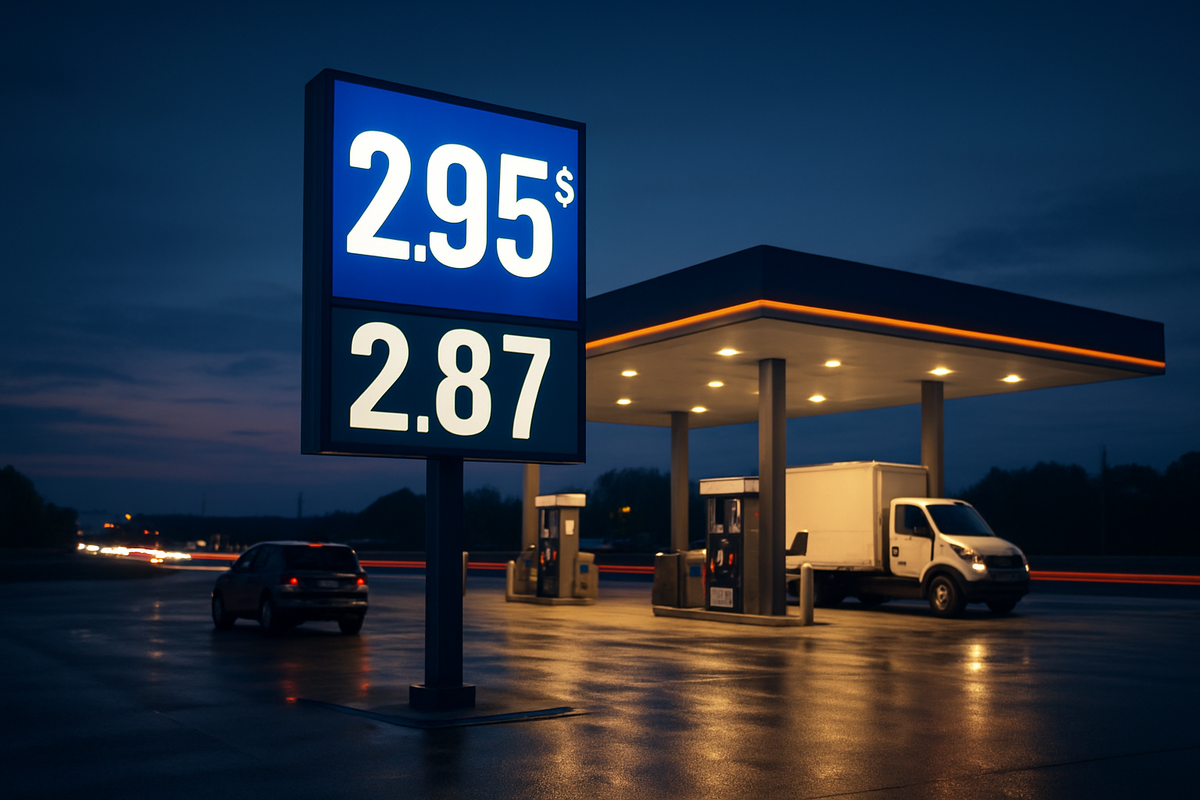
The 2026 forecast marks the culmination of a four-year cooling period following the historic price spikes of 2022, when the national average peaked at over $5.00 per gallon. According to Patrick De Haan, Head of Petroleum Analysis at GasBuddy, the 2026 outlook is characterized by "structural stability." While seasonal fluctuations will still occur—with prices expected to peak between $3.12 and $3.20 in May during the summer-blend transition—the year-end lows could see the national average dip as far as $2.83 by December.
The timeline leading to this moment was accelerated by the events of early January 2026. On January 3, the geopolitical landscape shifted dramatically following "Operation Absolute Resolve," which led to a regime change in Venezuela and the immediate release of nearly 50 million barrels of stored heavy crude into the U.S. Gulf Coast. This supply shock, combined with the "One Big Beautiful Bill" (OBBB) Act signed on July 4, 2025, has incentivized record-breaking U.S. crude production, which is currently averaging 13.5 million barrels per day.
Market Winners and Losers: From Retail Giants to Oil Majors
The shift to sub-$3 gasoline creates a distinct set of winners in the public markets, particularly within the retail and transportation sectors. Walmart Inc. (NYSE: WMT) stands as a primary beneficiary; lower fuel costs act as a functional tax cut for its core consumer base, freeing up discretionary income for general merchandise. Walmart has capitalized on this by expanding its fuel station footprint and offering aggressive loyalty discounts to capture market share. Similarly, Costco Wholesale Corp. (NASDAQ: COST) continues to leverage low gas prices to drive membership renewals, maintaining its status as a value-leader even as top-line fuel revenue softens.
The airline and logistics sectors are also poised for a windfall. Delta Air Lines (NYSE: DAL) and United Airlines Holdings (NASDAQ: UAL) have seen their largest variable expense—jet fuel—plummet alongside crude prices. Analysts expect these carriers to report record free cash flow in 2026, which is already being earmarked for stock buybacks and fleet modernization. In the logistics space, FedEx Corp. (NYSE: FDX) and United Parcel Service Inc. (NYSE: UPS) are in a unique position; by maintaining modified fuel surcharges even as pump prices drop, they are effectively turning lower energy costs into a structural profit lever.
Conversely, the "Upstream" energy sector faces significant headwinds. Exxon Mobil Corp. (NYSE: XOM) and Chevron Corp. (NYSE: CVX) are seeing their exploration and production margins squeezed as West Texas Intermediate (WTI) crude hovers near $55 per barrel. However, independent refiners like Valero Energy Corp. (NYSE: VLO) and Marathon Petroleum Corp. (NYSE: MPC) are thriving. These companies are uniquely equipped to process the heavy, sour crude now flowing from Venezuela, allowing them to capture "super-normal" refining margins due to the steep discount of the feedstock relative to global benchmarks.
Policy Shifts and the "OBBB" Impact
The 2026 energy landscape is inseparable from the broader regulatory environment. The OBBB Act of 2025 has fundamentally reshaped the American energy mix by permanently extending bonus depreciation for oil and gas equipment and rolling back many of the electric vehicle (EV) and renewable energy incentives established earlier in the decade. This policy pivot has slowed the "forced" transition to green energy, allowing internal combustion engine (ICE) vehicles to remain economically dominant for longer than many 2020-era analysts predicted.
Historically, periods of low gas prices have often led to a slowdown in EV adoption, and 2026 appears to be no exception. While EV technology continues to improve, the immediate economic relief provided by $2.90 gasoline has reduced the urgency for many middle-class families to switch. Furthermore, the global supply-demand balance has been tipped by a strategic shift from OPEC+. The cartel has moved away from price-support cuts toward a "market-share defense" strategy, wary of losing further ground to the surging production in the U.S., Brazil, and Guyana.
The Road Ahead: 2027 and Beyond
Looking forward, the primary question for the market is whether these low prices are sustainable or merely a temporary glut. In the short term, the market must absorb the "Venezuela shock" and the continued ramp-up of U.S. shale production. Strategic pivots are already underway; many clean-energy firms are refocusing on industrial applications rather than consumer transport, as they wait for the next inevitable turn in the commodity cycle.
Potential scenarios for late 2026 and 2027 include a possible "demand surge" as cheap fuel encourages more road travel and larger vehicle purchases, which could eventually put upward pressure on prices. However, the increased fuel efficiency of the modern U.S. fleet provides a structural ceiling on demand that did not exist during previous price collapses.
Final Assessment for Investors
The GasBuddy 2026 forecast confirms that the era of extreme energy inflation has transitioned into an era of abundance. For the average household, the drop from $2,716 in annual fuel spending during the 2022 peak to an estimated $2,083 in 2026 represents a vital economic cushion.
Investors should closely monitor the refining "crack spreads" of companies like Valero and the discretionary spending patterns at major retailers. While the low-price environment is a boon for consumers and transport-heavy industries, it serves as a cautionary tale for the upstream oil sector, where discipline and low-cost production will be the only paths to survival. As we move through 2026, the $3 mark will serve as more than just a psychological barrier; it is the new benchmark for a recalibrated global energy economy.
This content is intended for informational purposes only and is not financial advice