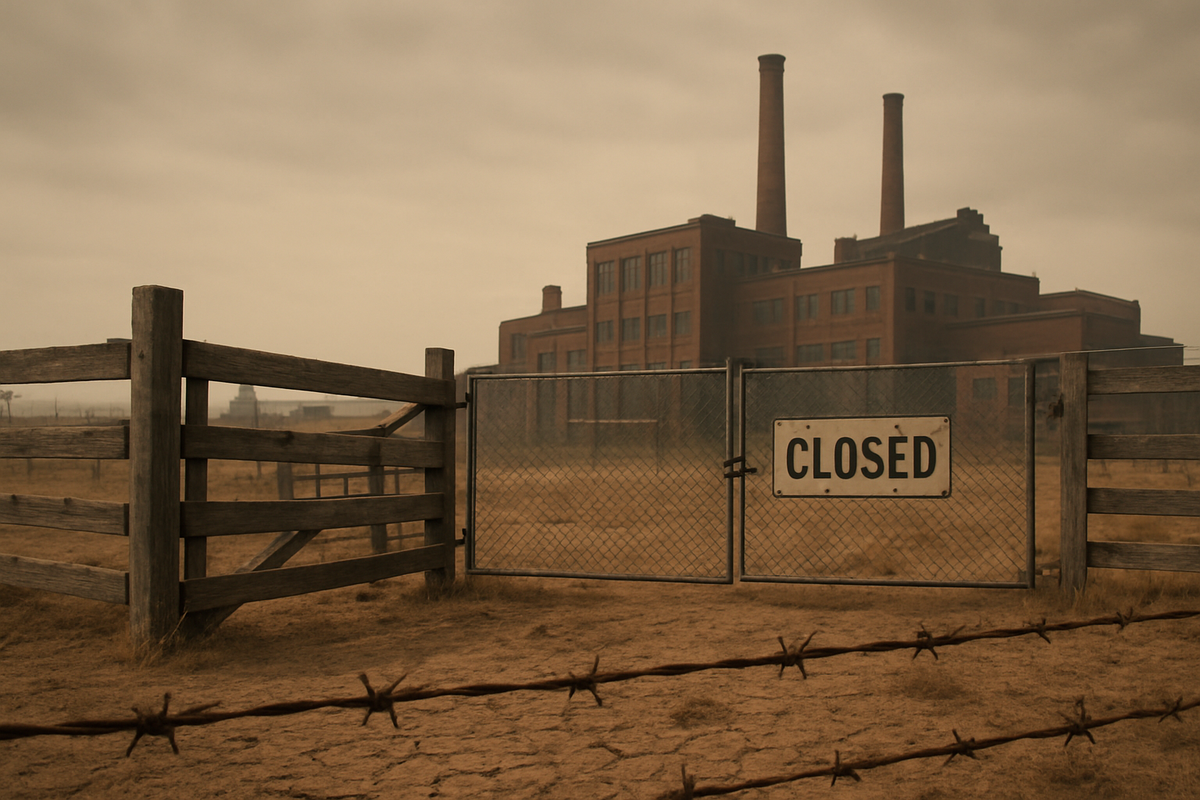
In a move that signals the deepening crisis within the American meat processing industry, Cargill (Private) has announced the permanent closure of its last remaining beef processing facility in Milwaukee, Wisconsin. The decision, which marks the final exit of large-scale meatpacking from a city once central to the industry, will result in the loss of hundreds of specialized roles. When combined with the company’s recent regional consolidation efforts, the withdrawal has effectively eliminated over 600 positions from the local and regional workforce, leaving a significant void in the Midwestern supply chain.
The closure comes as a direct consequence of a "perfect storm" in the agricultural sector: the U.S. cattle herd has shriveled to its lowest levels since the Truman administration, forcing processors into a brutal margin squeeze. As the cost of live animals skyrockets due to scarcity, the industrial giants that once dominated the market are now shuttering plants and slashing workforces to stem historic financial losses. For consumers, the immediate implication is clear—record-high retail beef prices are here to stay as the structural contraction of the American beef supply reaches a critical tipping point.
A Final Exit from the "Cream City"
The shuttering of Cargill’s ground-beef facility on Emmber Lane in Milwaukee represents the final chapter of a decade-long retreat from the region. The timeline of this decline reached a fever pitch in early February 2026, when Cargill officials confirmed that production would cease by April, with a total plant shutdown scheduled for May 31, 2026. This announcement follows a historical precedent of downsizing; in 2014, the company shuttered its Canal Street slaughterhouse, laying off approximately 600 workers. The 2026 closure of the remaining processing site—and the resulting displacement of the final 221 employees—completes the exodus, bringing the total number of meatpacking jobs lost in the city to over 800.
The decision was not made in a vacuum. Cargill has been grappling with a global revenue decline, reporting a nearly 10% drop in annual earnings in late 2025. In December 2024, the company announced a massive 5% global workforce reduction, affecting 8,000 employees. The Milwaukee closure is a localized symptom of this broader restructuring, as the company shifts ground-beef production to more modern, consolidated facilities in Butler, Wisconsin, and Nebraska to maximize "operational efficiencies" in a high-cost environment.
Industry reactions have been somber but unsurprised. Labor advocates in Wisconsin have decried the loss of high-paying union roles, while market analysts view the move as an inevitable response to the "negative crush" facing beef packers. With livestock costs representing roughly 80% of a processor’s expenses, the current price of cattle has made urban, smaller-scale processing increasingly untenable.
The Big Four Under Fire: Winners and Losers
The strain is not limited to Cargill. The "Big Four" meatpackers—Cargill, Tyson Foods (NYSE: TSN), JBS S.A. (OTC: JBSAY), and National Beef—are all navigating a period of unprecedented financial volatility. Tyson Foods has emerged as one of the most visible "losers" in this cycle, reporting staggering beef-segment losses of over $400 million in 2025. In January 2026, Tyson shocked the market by shuttering its massive Lexington, Nebraska beef plant, a move that resulted in 3,212 layoffs and removed nearly 5% of the total U.S. daily slaughter capacity.
JBS S.A. has similarly struggled, closing its Riverside, California facility in February 2026 and reporting deep operating losses in its North American beef division. For these publicly traded giants, the "win" is not found in growth, but in survival through diversification. Both Tyson and JBS have leaned heavily on their poultry and pork segments to offset beef losses, as consumers "trade down" to cheaper proteins.
In contrast, smaller, niche processors and regional direct-to-consumer ranchers may find a silver lining. As the industrial giants consolidate and raise prices, local "gate-to-plate" operations are seeing increased interest from consumers willing to pay a premium for transparency and local sourcing. However, these smaller players lack the scale to fill the massive gap left by the closure of multi-thousand-head facilities like those owned by Tyson and Cargill.
A 75-Year Low: The Structural Roots of the Crisis
The wider significance of the Milwaukee closure lies in the data provided by the USDA’s January 2026 Cattle Inventory Report. The total U.S. cattle and calf inventory has fallen to 86.2 million head—the lowest level since 1951. This contraction is the result of years of compounding factors, primarily a multi-year drought in the Southern Plains that forced ranchers to liquidate their herds rather than pay for expensive feed and water.
Furthermore, a late-2025 screwworm outbreak in Mexico led the U.S. Department of Agriculture to implement a total border closure to live cattle imports. This cut off an annual supply of 1.2 million feeder cattle that normally bolster U.S. feedlots, sending livestock prices into the stratosphere. By February 2026, packer margins—the difference between what a processor pays for a cow and what they receive for the meat—had plummeted to an estimated loss of $298 per head.
This event mirrors the "Great Contraction" of the early 1950s, but with a modern twist: the industry is now far more concentrated. The closure of a single plant today has a much larger ripple effect on the national supply chain than it did seventy years ago. The current environment is also fueling regulatory scrutiny; the DOJ recently launched an antitrust probe into the "Big Four," investigating whether the recent wave of plant closures is a coordinated effort to keep retail prices high despite the supply shortage.
What Comes Next: The Long Road to Recovery
The short-term outlook for the beef sector remains grim. Herd rebuilding is a slow, biological process; a heifer must be retained, bred, and her calf raised before the beef supply increases. Market analysts do not expect a meaningful recovery in cattle numbers until at least 2027 or 2028. In the interim, more plant closures are likely as the industry "right-sizes" to match the diminished herd.
Investors should expect a strategic pivot toward "value-added" products. Rather than relying on high-volume commodity beef, companies like Cargill and Tyson are investing in pre-seasoned, pre-cooked, and portion-controlled products that command higher margins. There is also a growing emphasis on precision technology and automation within plants to reduce reliance on an increasingly expensive and scarce labor force.
However, a potential scenario of "protein substitution" is the greatest threat to the industry. If retail ground beef remains at its current record high of $6.69 per pound, or if premium cuts exceed $15 per pound, the shift toward chicken and plant-based alternatives could become permanent, permanently shrinking the market share for American beef even after the herd recovers.
Summary and Investor Outlook
The closure of Cargill’s Milwaukee plant and the resulting loss of hundreds of jobs is a landmark moment in the restructuring of the American food system. It marks the end of an era for a historic meatpacking hub and serves as a warning for the broader economy. The key takeaways for the market are the 75-year low in cattle supply, the persistent negative margins for major processors, and the resilience of retail prices which continue to squeeze the average consumer.
Moving forward, the market will likely see continued volatility in the shares of Tyson Foods (NYSE: TSN) and JBS S.A. (OTC: JBSAY). Investors should keep a close watch on USDA quarterly reports for any signs of heifer retention, which would indicate the start of a multi-year rebuilding phase. Until then, the meat processing sector will remain a landscape of consolidation and survival, where only the most diversified and efficient players will weather the storm.
This content is intended for informational purposes only and is not financial advice