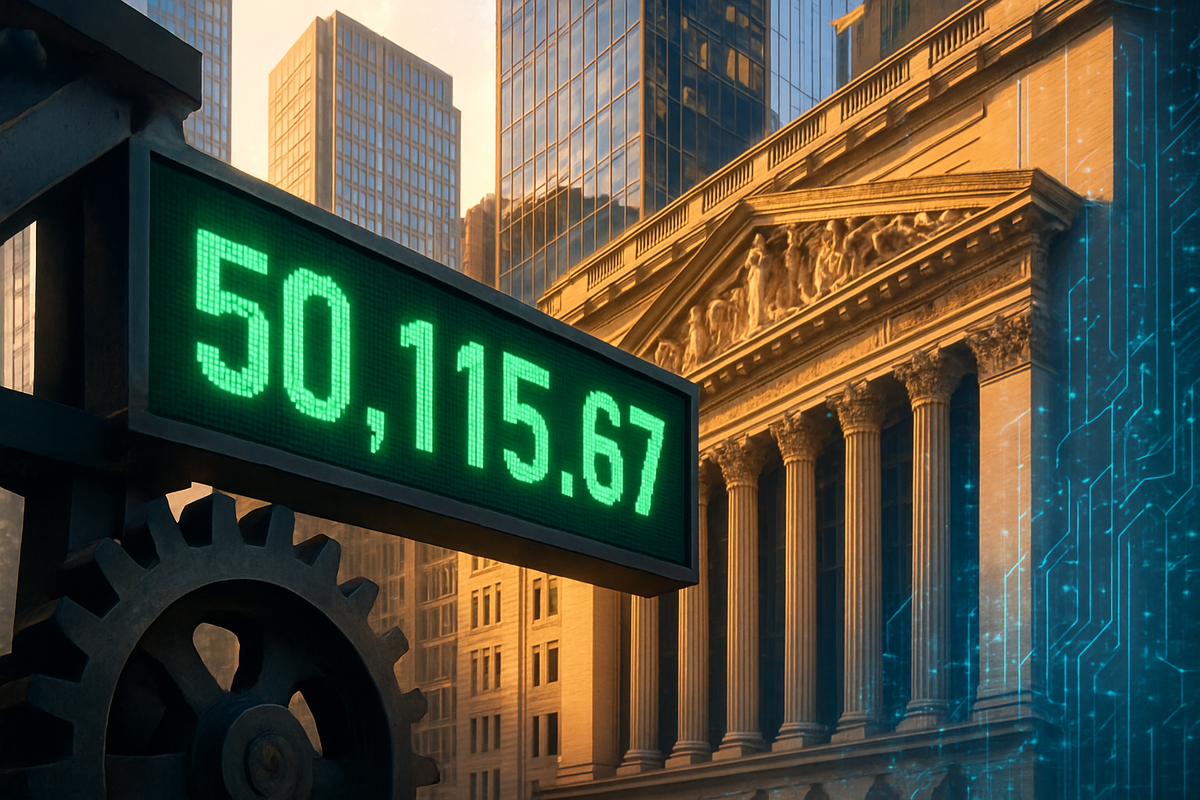
The global financial landscape reached a historic milestone on February 6, 2026, when the Dow Jones Industrial Average (DJIA) breached the 50,000-point threshold for the first time in its 130-year history. Closing the session at 50,115.67, the index signaled a definitive shift in investor sentiment, marking a departure from the tech-heavy dominance of previous years toward a more balanced, "broadened" market. This psychological and mathematical triumph serves as a testament to the resilience of the American economy and a strategic pivot by institutional capital into the foundational pillars of industry and finance.
The breach of 50,000 is not merely a numerical achievement; it represents the fastest 10,000-point ascent in the history of the Dow, occurring just 431 trading days after it first touched 40,000 in May 2024. For market participants, this moment validates the narrative that the "Old Economy" is far from obsolete. Instead, these industrial and financial giants are proving to be the primary beneficiaries of a new era defined by tangible earnings growth, fiscal stimulus, and the pragmatic implementation of artificial intelligence across traditional sectors.
The Road to 50,115: A Timeline of Resilience
The ascent to 50,000 was catalyzed by a series of fundamental shifts that began in late 2024. A critical turning point occurred on November 8, 2024, when S&P Dow Jones Indices overhauled the 30-stock average, replacing Intel with NVIDIA (NASDAQ: NVDA) and swapping Dow Inc. for Sherwin-Williams (NYSE: SHW). These changes modernized the index, ensuring it captured the growth of the semiconductor revolution and the materials sector. Throughout 2025, while the Nasdaq faced headwinds from valuation fatigue, the Dow quietly gained momentum as investors sought refuge in companies with high "price-to-reality" ratios—those with solid balance sheets and clear earnings visibility.
On the morning of February 6, the atmosphere on the floor of the New York Stock Exchange was electric. The index opened at 49,890, fueled by a stellar earnings report from Caterpillar (NYSE: CAT), which posted record revenues and a staggering $51 billion backlog. By mid-day, a wave of buying in the financial sector, led by Goldman Sachs (NYSE: GS) and JPMorgan Chase (NYSE: JPM), pushed the average over the 50,000 line. The rally was supported by a growing consensus that the "AI-at-any-price" era had matured into an "AI-for-efficiency" era, where traditional firms began reaping the margin-expanding rewards of technology they spent billions integrating over the last 24 months.
Initial market reactions were a mix of euphoria and calculation. While some analysts cautioned that the milestone could trigger a short-term "sell the news" event, the underlying strength of the breakout suggested a structural shift. Volume on the day was 20% above the 30-day average, indicating significant institutional commitment. This was not a speculative bubble fueled by retail frenzy, but rather a calculated rotation by asset managers reweighting portfolios toward value-oriented cyclicals that had been overlooked during the 2023–2024 tech surge.
Winners and Losers in the Great Rotation
The winners in this new market regime are the heavyweights of the "Old Economy." Caterpillar has emerged as a titan of the 50,000 era, benefiting from the 2025 "One Big Beautiful Bill" (OBBB), which made the 2017 tax cuts permanent and restored 100% bonus depreciation. This policy change incentivized massive domestic infrastructure investment, turning industrial stocks into high-growth engines. Similarly, UnitedHealth (NYSE: UNH) has leveraged AI to streamline claims processing and clinical workflows, targeting over $1 billion in cost reductions for 2026, which has propelled its stock to new heights as its earnings growth remains remarkably consistent.
In the financial sector, Goldman Sachs and JPMorgan Chase have capitalized on a revitalized deal-making environment and stable fee-based income. Despite JPMorgan warning of an "expense shock" due to continued AI investments and branch expansions, investors have rewarded the bank's dominant market share and growing Net Interest Income (NII). These companies have seen their multiples expand as they provide a "safe haven" of liquidity and dividends, contrasting sharply with the high-multiple volatility seen in the software-as-a-service (SaaS) sector.
Conversely, the "losers" of this milestone are the high-multiple growth stocks that defined the early 2020s. While Microsoft (NASDAQ: MSFT) and Apple (NASDAQ: AAPL) remain core holdings due to their massive cash flows, many Tier-2 and Tier-3 tech firms have seen their valuations compressed. The market is no longer willing to pay 40 times earnings for growth that is not accompanied by immediate margin improvement. This "valuation fatigue" has caused a divergence where the Dow has consistently outperformed the Nasdaq-100 over the last two quarters, a trend few predicted at the start of the AI boom.
Analyzing the Significance: A Broadening Horizon
The significance of Dow 50,000 lies in its reflection of a "broadening" market. For years, critics argued that the market was top-heavy, held up by only a handful of tech giants. Today’s milestone proves that the rally has finally reached the broader economy. This shift is a direct result of the "AI implementation phase." Unlike 2023, where only the chipmakers won, 2026 is seeing the "users" of technology win. Banks, healthcare providers, and manufacturers are using generative models to automate middle-office tasks, leading to the "tangible earnings growth" that investors are now chasing.
From a historical perspective, the Dow's 431-day journey from 40k to 50k is a feat of modern fiscal and monetary coordination. The passage of the OBBB in July 2025 provided a significant fiscal tailwind just as the Federal Reserve began its pivot toward a neutral rate. This "Goldilocks" environment—where growth remains above 2.5% while inflation stabilizes near the 2% target—has allowed the Dow to flourish. It mirrors the late 1990s in its technological optimism but is grounded in the industrial strength reminiscent of the post-WWII expansion.
Furthermore, the milestone has profound regulatory implications. The Supreme Court's recent rulings on tariff authority have kept industrial players like Caterpillar and Boeing (NYSE: BA) on high alert. However, the current administration’s focus on domestic manufacturing and "near-shoring" has created a protective moat for these Dow components. As these companies become more critical to the national economic security infrastructure, their stock prices have increasingly begun to reflect their status as "too essential to fail."
What Comes Next: The Path to 53,000 and Beyond
As we look toward the remainder of 2026, the question is whether the Dow can maintain its momentum. Most analysts at major firms like Wells Fargo and Morgan Stanley have already raised their year-end targets, with some eyeing the 53,000 mark. The short-term focus will be on the Federal Reserve’s upcoming meetings. With two rate cuts expected in early 2026, the cost of capital for capital-intensive industrials and financials is set to decline further, likely fueling another round of share buybacks and increased dividend payouts.
However, challenges remain on the horizon. The transition of leadership at the Federal Reserve, as Jerome Powell’s term nears its conclusion in mid-2026, could introduce a period of policy uncertainty. Additionally, the "windfall" from early 2026 tax refunds and lower withholdings may provide only a temporary boost to consumer-facing components like Walmart (NYSE: WMT) and Home Depot (NYSE: HD). Investors will need to watch for signs of "over-earning" in the industrial sector, particularly as the massive backlog of projects begins to be cleared.
Strategic pivots will be required for companies that have not yet fully embraced the AI-efficiency model. We are likely to see a wave of mergers and acquisitions (M&A) as "Old Economy" giants use their record-high stock prices as currency to acquire smaller tech innovators. This cross-pollination of traditional scale and modern agility will likely be the theme of the next leg of this bull market.
Conclusion: A New Era for the American Blue-Chip
The Dow Jones Industrial Average crossing 50,000 is a watershed moment that marks the maturity of the post-pandemic economic cycle. It validates the transition from a speculative, tech-centric market to one grounded in the industrial and financial backbone of the United States. The "Great Rotation" has proven that value is not just about low multiples, but about the ability to generate consistent, tangible earnings in a complex global environment.
Moving forward, the market appears poised for continued, albeit perhaps more moderate, gains. The broadening of participation is a healthy sign for long-term stability, reducing the risk of a systemic collapse should one sector falter. Investors should remain vigilant, watching for shifts in Fed leadership and the realization of AI-driven margin expansions in upcoming quarterly reports.
In the final assessment, Dow 50,000 is a celebration of American corporate ingenuity. From the semiconductor prowess of NVIDIA to the earth-moving dominance of Caterpillar, the 30 stocks that make up this storied index are more diverse and technologically advanced than ever before. As the 50,000 barrier fades into the rearview mirror, the focus shifts to the next frontier, with the "Old Economy" leading the charge into the future.
This content is intended for informational purposes only and is not financial advice.