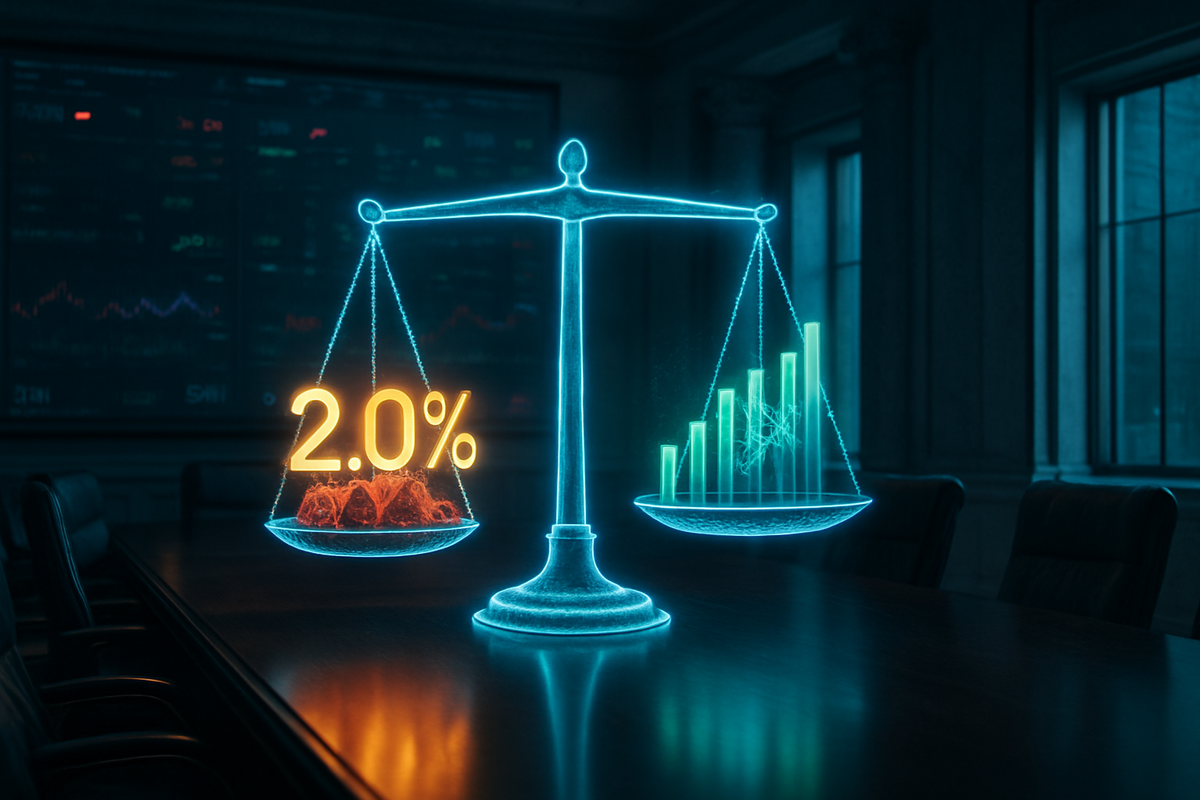
The Federal Reserve has signaled a stark shift in its monetary trajectory, as minutes from the January 27–28, 2026, meeting—released yesterday, February 18—showed a central bank deeply divided over the path of interest rates. After three consecutive rate cuts in late 2025, the Federal Open Market Committee (FOMC) opted to maintain the federal funds rate at a target range of 3.50% to 3.75%, opting for what many analysts are calling a "hawkish pause." The decision reflects growing anxiety among policymakers that the final stretch toward the 2% inflation target may be more arduous than previously anticipated.
The immediate fallout from the minutes has been a sharp recalibration of market expectations. According to CME FedWatch data, the probability of a rate cut at the upcoming March meeting has plummeted to a mere 6%, down from nearly 50% just a month ago. This shift underscores a reality where "higher-for-longer" is once again the dominant narrative on Wall Street, as officials voiced concerns that easing policy too quickly could jeopardize the progress made on price stability.
A Policy Tug-of-War: The January Minutes Breakdown
The January meeting saw a 10–2 vote to hold rates steady, but the consensus was far from unanimous in spirit. Federal Reserve Governors Stephen Miran and Christopher Waller emerged as the two dissenting voices, advocating for a 25-basis-point cut to preemptively support an economy that had shown signs of cooling late last year. However, the majority of the committee argued that the current rate is likely at a "neutral" level—neither stimulating nor restricting growth—and that a cautious approach is necessary to ensure inflation doesn't stage a comeback.
The minutes revealed a significant shift in rhetoric, with "several" participants suggesting the adoption of "two-sided" language in future communications. This would effectively put rate hikes back on the table if inflation progress stalls, a move that caught many investors off guard. The committee specifically pointed to "sticky" core services inflation and the lingering inflationary impact of recent trade tariffs as primary obstacles. Despite headline inflation sitting at 2.4%, the Fed’s preferred gauge, Core Personal Consumption Expenditures (PCE), remains stubbornly near 3.0%, creating a wedge between political pressure for lower rates and the Fed's statutory mandate.
The timeline leading to this impasse began in late 2024, as the Fed successfully navigated a soft landing. However, the unexpected resilience of the labor market—with unemployment currently at 4.3%—and a surge in productivity linked to artificial intelligence have complicated the Fed's calculus. Initially, the market reacted with volatility; the U.S. Dollar (USD) firmed against major currencies, while risk-sensitive assets experienced a sell-off as the reality of a prolonged pause set in.
Winners and Losers in a Persistent High-Rate Environment
The "hawkish pause" has created a clear divergence in the equity markets, favoring value-oriented sectors while penalizing high-growth technology firms. Financial institutions such as JPMorgan Chase & Co. (NYSE: JPM) and The Goldman Sachs Group, Inc. (NYSE: GS) are poised to benefit from sustained net interest margins, as the prospect of rapidly falling rates fades. Similarly, the S&P 500 Value Index has outperformed its growth counterpart since the start of the year, as investors seek refuge in companies with strong cash flows and lower valuations.
Conversely, the tech giants that drove the 2024–2025 bull market face renewed pressure. Companies like NVIDIA Corporation (NASDAQ: NVDA) and Microsoft Corporation (NASDAQ: MSFT), which trade at high multiples based on future earnings, are particularly sensitive to higher discount rates. While these firms continue to benefit from the AI boom, the "higher-for-longer" interest rate environment acts as a persistent headwind to their valuation expansion. Furthermore, smaller, capital-intensive firms in the renewable energy sector, such as NextEra Energy, Inc. (NYSE: NEE), may struggle as borrowing costs remain elevated for longer than anticipated.
One of the most notable winners in this climate has been gold. With inflation remaining sticky and geopolitical tensions simmering, gold prices have surged toward a historic $5,000 per ounce. This has provided a massive tailwind for mining majors like Newmont Corporation (NYSE: NEM) and Barrick Gold Corporation (NYSE: GOLD), which have seen their shares rally as investors seek a hedge against both inflation and the potential for a central bank policy error.
The Broader Significance: AI Productivity and Political Friction
The January FOMC minutes do more than just outline rate paths; they provide a window into a changing economic structure. Several participants highlighted that the U.S. economy is currently benefiting from a "productivity miracle" driven by massive investments in artificial intelligence. This surge in productivity allows the economy to grow at a projected 2.2% for 2026 without necessarily stoking the fires of inflation, providing the Fed with a unique buffer as it keeps rates steady. This phenomenon has few historical precedents, though some analysts compare it to the internet-driven productivity boom of the late 1990s.
However, the Fed's independence is being tested like never before. The minutes were released amid intense political friction, with the White House publicly advocating for rates to be slashed to as low as 1%. This external pressure adds a layer of complexity to the Fed’s communication strategy. By maintaining a hawkish stance, Jerome Powell is attempting to cement his legacy of price stability before his term ends in May 2026. The nomination of Kevin Warsh to succeed him has already begun to influence market sentiment, as investors weigh whether a "Warsh Fed" would be even more aggressive in pursuing the 2% target.
Regulatory implications are also surfacing. With rates remaining high, the Fed is keeping a close eye on the commercial real estate sector and regional banking health. The decision to pause rather than cut suggests that the Fed is confident that the banking system can handle current levels of stress, though the minutes did acknowledge that downside risks to the labor market have "diminished" relative to the previous quarter.
What’s Next: The March Pivot or a Summer Slumber?
As we look toward the March 2026 meeting, the central question is whether the Fed will maintain this pause or if the dissenting voices for a cut will gain more traction. Much will depend on the upcoming February inflation and employment data. If core PCE shows any sign of accelerating, the "two-sided" language discussed in the minutes could become a reality, potentially leading to a rate hike—a scenario that is currently not priced into most portfolios.
Strategically, corporations may need to pivot. Firms that were waiting for lower rates to refinance debt may now have to accept the current rate environment as the "new normal." This could lead to a wave of corporate restructuring or a slowdown in mergers and acquisitions as the cost of capital remains high. For investors, the opportunity lies in active management; the era of "a rising tide lifts all boats" is ending, replaced by a market where sector selection and balance sheet strength are paramount.
Wrap-Up: Navigating the 'New Normal' of 2026
The release of the January FOMC minutes marks a pivotal moment in the current economic cycle. The Federal Reserve has made it clear that while it is no longer in an aggressive tightening phase, the road to 2% inflation is fraught with obstacles that preclude further easing for now. The "hawkish pause" is a signal that the Fed is willing to prioritize its inflation mandate over political pressure and short-term market enthusiasm.
For the market, the message is one of caution. Investors should brace for continued volatility in growth stocks and keep a close eye on the 10-year Treasury yield, which has already begun to climb in response to the minutes. The transition from Jerome Powell to Kevin Warsh will be the defining narrative of the coming months, as the Fed seeks to navigate a high-productivity, high-interest-rate world.
In summary, the 2% target remains the "North Star" for the Fed, even if it remains just out of reach. Investors should watch for the February PCE report and any shifts in labor market participation, as these will be the key catalysts for the Fed's next move. For now, the "wait-and-see" approach is the order of the day, and the market must adjust to a Federal Reserve that is in no hurry to return to the era of ultra-low rates.
This content is intended for informational purposes only and is not financial advice.