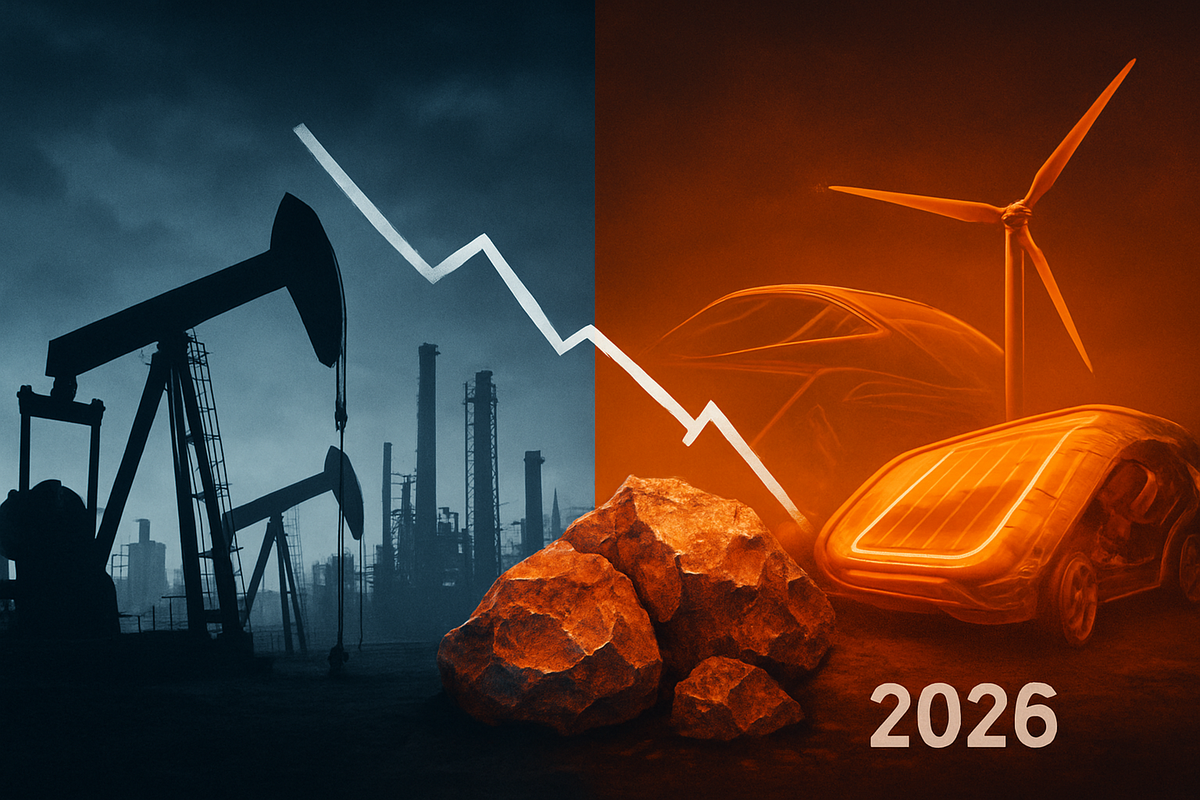
The global commodities market is standing at a historic crossroads as we move further into 2026. According to the latest World Bank Commodity Markets Outlook, aggregate commodity prices are projected to plunge to their lowest levels since 2020 by the end of this year. This downward trajectory, characterized by a staggering 7% decline in the price index for 2025 followed by another 7% drop in 2026, is largely driven by a massive oversupply in the crude oil market and a structural cooling of the Chinese economy. While this provides a welcome disinflationary relief for central banks and consumers, it signals a period of intense margin compression for traditional energy giants.
However, the "commodity slump" of 2026 is far from uniform. Even as oil prices retreat toward the $60 mark, a sharp divergence has emerged within the metals and energy transition sectors. While bulk commodities like iron ore suffer from the ongoing property crisis in Asia, "future-facing" metals—particularly copper—are defying the broader trend to hit nominal record highs. This fragmentation is creating a complex landscape for investors, where the gains from falling energy costs are being partially offset by the soaring expense of the raw materials required for the global green energy pivot.
The Great Surplus: A Detailed Look at the World Bank’s Projections
The World Bank’s October 2025 report, which serves as the definitive roadmap for the current market cycle, highlights a "massive" global oil surplus that is fundamentally reshaping the energy landscape. By late 2026, the global oil glut is expected to be 65% higher than the peak seen during the 2020 pandemic. This surplus is the result of a multi-year surge in production from non-OPEC+ nations, led by the United States, Brazil, and Guyana, which has effectively neutralizes the supply-side discipline previously maintained by the OPEC+ alliance. Brent crude, which averaged $68 per barrel in 2025, is now forecasted to slide to a five-year low of $60 per barrel by year-end.
The timeline leading to this price floor began in late 2024, when global industrial activity hit a significant "soft patch." Throughout 2025, the rapid adoption of electric vehicles (EVs)—with annual sales now exceeding 20 million units—permanently altered the long-term demand curve for transportation fuel. Combined with China’s strategic shift away from energy-intensive manufacturing toward a more services-oriented and electrified economy, the world’s largest oil importer has seen its consumption flatten. This structural stagnation has left major producers competing for a shrinking slice of demand, creating a "buyer's market" for the first time in nearly a decade.
Initial market reactions to these findings have been swift. Bond yields in major economies have seen a slight downward adjustment as traders price in lower headline inflation, while currencies of major commodity exporters, particularly the Canadian dollar and the Norwegian krone, have faced selling pressure. Conversely, European and Indian equity markets have shown resilience, buoyed by the prospect of lower input costs for their massive manufacturing and transport sectors.
Corporate Fallout: Winners and Losers in the 2026 Landscape
The projected $60-per-barrel oil environment creates a challenging outlook for traditional integrated oil majors. Exxon Mobil Corp (NYSE: XOM) and Chevron Corp (NYSE: CVX), despite their robust balance sheets and low-cost Permian Basin assets, are facing pressure to pivot from production growth to aggressive capital discipline and share buybacks. Similarly, European giants like Shell PLC (NYSE: SHEL) and BP PLC (NYSE: BP) are finding their high-cost offshore projects under intense scrutiny, as the "supply wave" of 2025–2026 threatens the internal rate of return on long-cycle investments.
In the mining sector, the impact of the World Bank's outlook is bifurcated. Rio Tinto Group (NYSE: RIO) and Vale S.A. (NYSE: VALE) are navigating headwinds as iron ore prices tumble, driven by the persistent stagnation of China’s residential construction sector. These firms are now aggressively reallocating capital toward their copper and nickel portfolios to offset the decline in their legacy iron ore businesses. On the winning side, BHP Group Ltd (NYSE: BHP) and Glencore PLC (LSE: GLEN) are positioned to benefit from the soaring demand for electrification metals. Glencore, in particular, stands to gain from its unique dual role as a major producer of copper and a dominant global commodity trader, allowing it to capitalize on the volatility and logistical shifts caused by the global supply glut.
Strategic Shifts and the New Geopolitical Reality
The 2026 commodity slump is not merely a cyclical downturn; it represents a fundamental shift in how resources are valued and traded. For the first time, we are seeing a decoupling of energy and metal prices. Historically, a drop in oil prices would drag down the entire commodity complex. Today, the energy transition has created a "floor" for metals like copper, lithium, and silver. This event fits into a broader trend of "resource nationalism" and fragmented markets. The World Bank notes that the U.S. and EU are increasingly focused on strategic stockpiling initiatives, such as the American "Project Vault," to secure critical minerals despite the broader price decline in fossil fuels.
This paradigm shift mirrors the "oil shocks" of the 1970s but in reverse. Rather than a shortage of supply causing economic pain, a surplus of supply—coupled with a technological transition—is creating a disinflationary dividend for the West while challenging the fiscal stability of petrostates. The ripple effects are already being felt by competitors in the renewable energy space. Lower natural gas and coal prices (projected to fall by 9% and 7% respectively in 2026) are making traditional power generation more competitive in the short term, potentially slowing the pace of the green transition in price-sensitive emerging markets.
What Comes Next: Pivots, Scenarios, and Long-Term Outlook
As we look toward the second half of 2026 and into 2027, the primary question for the market is whether OPEC+ will surrender market share to maintain prices or initiate a "price war" to force high-cost producers out of the market. Most analysts anticipate a strategic pivot toward market-share defense, which could keep oil prices depressed for an extended period. For energy companies, this means a "lower-for-longer" environment will necessitate further consolidation in the U.S. shale patch as smaller players struggle to maintain liquidity.
In the short term, the primary market opportunity lies in the "disinflation trade." If the World Bank’s projections hold, the persistent drop in energy and food prices will allow the Federal Reserve and the European Central Bank to continue cutting interest rates throughout 2026. However, a potential risk remains in the form of geopolitical "wildcards." While the surplus provides a buffer, any significant disruption in the Strait of Hormuz or a sudden escalation in regional conflicts could cause temporary, violent spikes in an otherwise bearish market. Investors should also watch for a "second wave" of Chinese stimulus that targets industrial consumption, which could catch the market off-guard and reverse the downward trend in base metals.
Conclusion: A Market in Transition
The World Bank’s latest Commodity Markets Outlook paints a picture of a global economy that is finally cooling after years of post-pandemic volatility. The projection of a six-year low in commodity prices by late 2026 is a testament to the surging productivity of non-OPEC+ oil producers and the irreversible shift toward electrification. While the "oil glut" dominates the headlines, the real story for investors is the divergence between falling fossil fuel costs and the record-breaking prices of the metals required to build the future.
Moving forward, the market will likely be defined by "volatility within the trend." Even as the aggregate index falls, the scramble for copper and precious metals like gold—which continues to hit record highs as a hedge against geopolitical uncertainty—will create distinct pockets of hyper-growth. For the savvy investor, the coming months will require a discerning eye that separates the legacy commodity losers from the strategic winners of the energy transition.
This content is intended for informational purposes only and is not financial advice