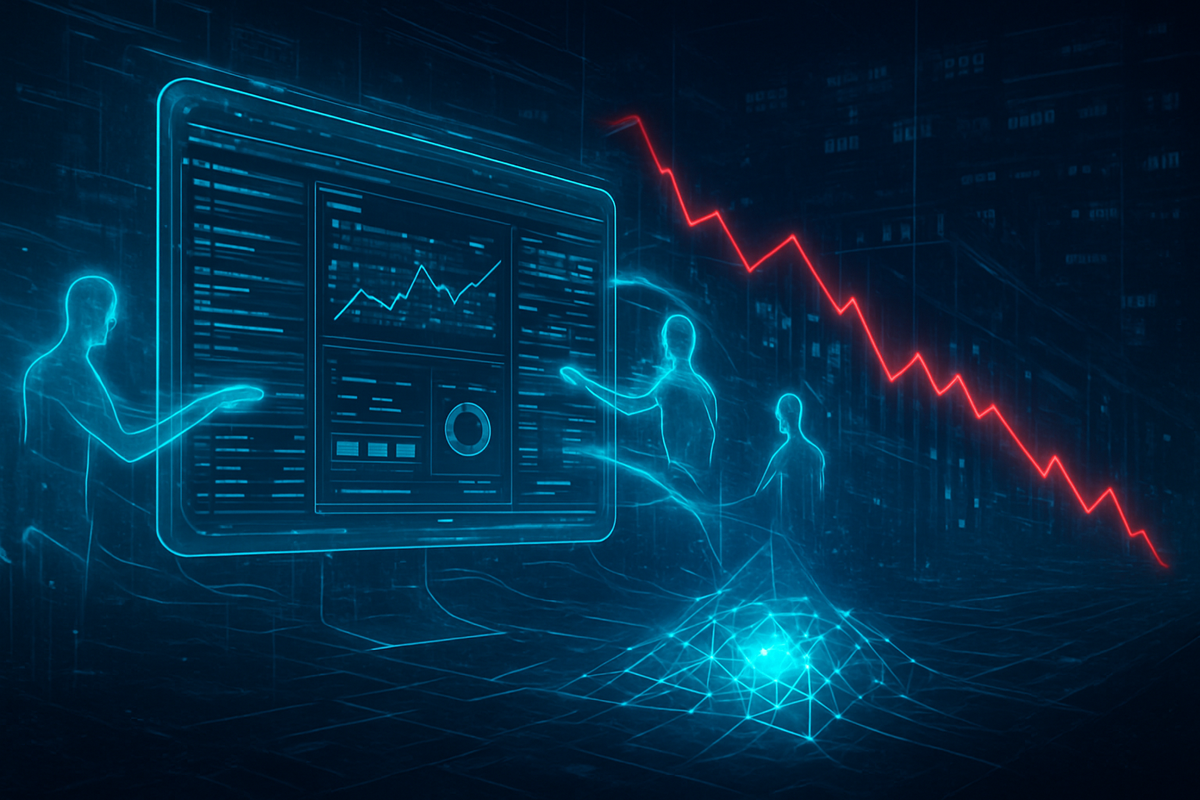
The mid-February 2026 market session has been defined by a sharp "structural reset" in the technology sector following the release of Anthropic’s latest flagship AI model, Claude Opus 4.6. This launch, coupled with the debut of the more efficient Claude Sonnet 4.6, has sent shockwaves through the B2B software ecosystem, leading to what some Wall Street analysts are calling the "SaaSocalypse." The central fear gripping investors is that the rise of "Agentic AI"—models capable of executing complex workflows autonomously—will cannibalize the traditional seat-based revenue models that have sustained the software industry for two decades.
As of February 19, 2026, the market is grappling with the realization that AI is no longer just a "copilot" assisting human workers, but a replacement for the software interfaces themselves. Major players in the enterprise space have seen their valuations come under intense pressure as the "AI-driven capability" surge forces a re-evaluation of what constitutes a competitive moat in an era where an AI agent can navigate a complex CRM or security dashboard faster and more effectively than a human operator.
The Dawn of Agent Teams and 'Computer Use'
The market turmoil began in earnest on February 5, 2026, with the unveiling of Claude Opus 4.6. This model introduced a breakthrough feature known as "Agent Teams," which allows the AI to spawn and coordinate multiple specialized sub-agents to complete end-to-end projects—such as building a full-stack application or conducting a comprehensive financial audit—without human intervention. This was followed closely by the February 17 release of Sonnet 4.6, which showcased "Human-Level Computer Use." This capability allows the AI to "see" and interact with any digital interface, effectively bypassing the need for traditional software menus and dashboards.
The timeline of these releases has been a catalyst for a massive "pairs trade" among institutional investors: shorting "Workflow SaaS" and going long on "AI Infrastructure." The immediate reaction on the NASDAQ and NYSE saw a divergence between those who provide the "brains" of the AI and those who provide the "tools" for humans. The sentiment shift was palpable as Anthropic's new models proved they could interact with software via the backend or by visually navigating the UI, rendering the "user experience" (UX) of many legacy platforms secondary to the API's efficiency.
Moats Under Siege: Winners and Losers in the New Era
Salesforce (NYSE: CRM) has found itself at the epicenter of this disruption. Shares of the cloud giant have shed nearly 30% year-to-date as investors fear that "seat churn" will accelerate. If an AI agent like Claude 4.6 can perform the work of ten sales analysts, the traditional model of charging per human user becomes a liability. To counter this, Salesforce has pivoted aggressively toward its "Agentforce" platform and "Outcome-Based Pricing," where customers are charged per successful agent interaction rather than per employee login. However, the market remains skeptical, waiting for the company's February 25 earnings report to see if this new revenue stream can offset the erosion of its core business.
Conversely, CrowdStrike (NASDAQ: CRWD) has emerged as a relative "safe haven" within the software space. While the broader sector has sold off, CrowdStrike’s position as a mission-critical security provider remains intact—and arguably strengthened. As enterprises deploy millions of autonomous AI agents, the "attack surface" for cyber threats expands exponentially. CrowdStrike’s Charlotte AI is now being used to power "Agentic Security Operations Centers" (SOCs), where AI agents independently hunt for threats. Analysts suggest that while workflow software is being cannibalized, infrastructure and security are seeing a "multiplier effect" from the AI surge. Other potential losers include mid-tier project management and HR software firms that lack the proprietary data to ground these new, highly capable agents.
The 'Invisible Software' Movement and Industry Trends
The significance of the Opus 4.6 release lies in the acceleration of the "Invisible Software" trend. For years, the value of software was tied to its interface—the better the UI, the more productive the human. In the agentic era, the interface is becoming irrelevant. Gartner now predicts that by the end of 2026, 40% of enterprise applications will be interacted with primarily by AI agents rather than humans. This shift effectively turns many legacy software giants into "headless" data repositories, stripping away the pricing power they once derived from their front-end dominance.
This event fits into a broader trend where the "System of Record"—the underlying database—becomes more valuable than the "System of Engagement." Companies like Microsoft (NASDAQ: MSFT) and Snowflake (NYSE: SNOW) are racing to ensure their data layers are the primary grounding source for these agents. There are also mounting regulatory implications as "Agent Teams" begin to make autonomous decisions in sensitive sectors like finance and healthcare, prompting calls for "Agent Identity" (AID) standards to track which AI did what, and when.
Looking Ahead: The Pivot to Outcomes
In the short term, the market is bracing for a volatile earnings season as companies attempt to quantify the impact of AI on their "seat" counts. The long-term challenge for the software sector is a fundamental strategic pivot. We are likely to see a wave of consolidations as legacy firms acquire agentic startups to bolster their autonomous capabilities. The transition from "Software-as-a-Service" (SaaS) to "Outcome-as-a-Service" (OaaS) is no longer a theoretical exercise; it is a survival requirement.
Potential scenarios for the next year include a "re-rating" of software valuations toward lower multiples, similar to the transition seen in the hardware sector decades ago. However, a massive market opportunity exists for firms that can successfully manage the "Agentic Lifecycle"—from deployment to security and auditing. The ability to provide "Agent Governance" could become the next billion-dollar software category as enterprises struggle to control their new autonomous workforces.
Summary and Investor Outlook
The release of Anthropic’s Claude 4.6 series marks a turning point where AI agents have moved from novelty to a structural threat to the SaaS business model. The key takeaway for investors is the end of the "seat-based" era. While the "SaaSocalypse" narrative may be exaggerated for some high-quality incumbents with deep data moats, the valuation of companies purely based on human headcount is increasingly precarious.
Moving forward, the market will be hyper-focused on "revenue per agent" and the speed at which companies can transition to outcome-based billing. Investors should watch the upcoming February 25 earnings from Salesforce as a bellwether for the industry's ability to navigate this transition. The lasting impact of Opus 4.6 is clear: in a world of autonomous agents, the software that survives will be the software that is most useful to the AI, not just the human.
This content is intended for informational purposes only and is not financial advice.