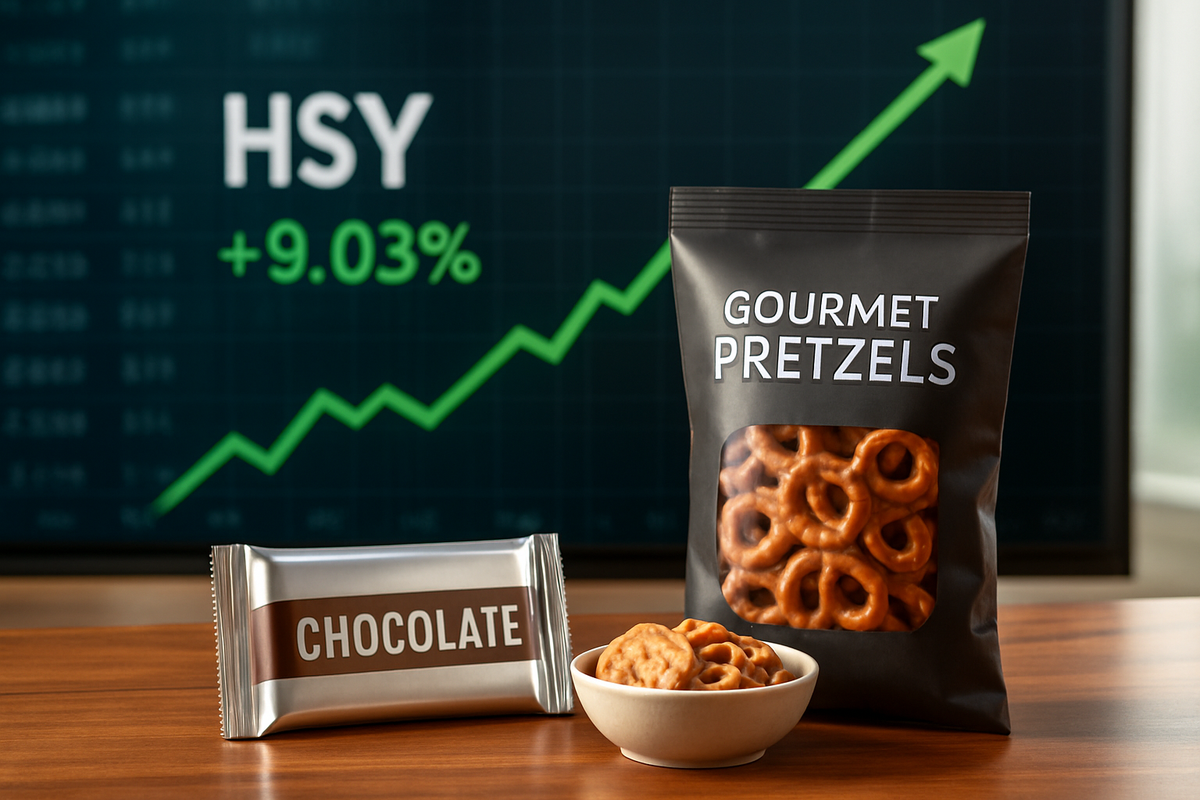
In a dramatic shift for the consumer staples sector, The Hershey Company (NYSE: HSY) saw its stock price climb more than 9% following the release of its fourth-quarter 2025 earnings report. The confectionery giant not only shattered analyst expectations for both profit and revenue but also provided a surprisingly robust forecast for 2026, suggesting that the "perfect storm" of high commodity costs that has plagued the company for two years is finally beginning to dissipate.
The rally, which saw shares effectively erasing a year of underperformance in a single trading session, serves as a powerful signal for the broader market. As inflationary pressures on raw materials like cocoa begin to cool, Hershey’s ability to maintain premium pricing while lowering its cost of goods sold is positioning the company for a significant margin expansion. For investors, the move highlights a potential "mean reversion" for defensive stocks that were largely overlooked during the artificial intelligence-led bull market of 2024 and 2025.
A Breakthrough Quarter Driven by "Cocoa Deflation" and Salty Success
On February 5, 2026, Hershey reported fiscal results for the quarter ending December 2025 that far outpaced Wall Street's conservative models. The company posted an adjusted earnings per share (EPS) of $1.71, soundly beating the analyst consensus of $1.40. Revenue for the quarter reached $3.09 billion, a 7% year-over-year increase that topped estimates of $2.97 billion. Perhaps most significantly, the company issued a bullish full-year 2026 guidance, projecting adjusted EPS between $8.20 and $8.52—well above the $7.09 analysts had penciled in.
The primary catalyst behind this financial windfall is the dramatic "cocoa collapse." After prices for the key ingredient peaked above $12,000 per tonne in late 2024 due to supply failures in West Africa, the market saw a massive correction. By early February 2026, cocoa was trading near $4,400 per tonne, a decline of more than 60% from its highs. While Hershey spent much of 2025 working through expensive inventory, the new guidance reflects a reality where lower-cost raw materials are finally flowing through the supply chain.
Beyond chocolate, Hershey’s strategic pivot into savory snacks under CEO Kirk Tanner has begun to pay significant dividends. The company’s Salty Snacks segment—which includes brands like Dot’s Homestyle Pretzels and SkinnyPop—recorded an 18% volume growth in the final quarter of 2025. This diversification has provided a vital hedge against the price elasticity seen in the chocolate aisle, proving that Hershey’s transformation into a "snacking powerhouse" is more than just marketing rhetoric.
Winners and Losers in the Snacking Wars
While Hershey (NYSE: HSY) shareholders celebrated, the ripple effects across the sector were uneven. The clear winner is Hershey itself, which is now trading toward the $225–$230 level, a price point that many analysts thought would be out of reach until late 2027. The company's decision to raise its quarterly dividend by 6% to $1.452 per share further solidified its status as a top-tier defensive play for income-seeking investors.
In contrast, Mondelez International (NASDAQ: MDLZ) faced a more difficult week. Despite beating its own earnings estimates earlier in the month, its stock dropped 4% as management issued a "tepid" 2026 outlook. Analysts noted that Mondelez appeared to be locked into higher-priced cocoa hedges for a longer duration than Hershey, preventing it from immediately capturing the benefits of the falling spot prices. Meanwhile, The J.M. Smucker Company (NYSE: SJM) saw a muted market reaction, as it continues to grapple with "consumer stress" and higher input inflation in its coffee and peanut butter divisions, which have not seen the same price relief as the cocoa market.
The global giant Nestlé S.A. (OTC: NSRGY) also remains in a state of flux. Having reported a 10% fall in profits earlier in 2025 due to margin decreases, the market is anxiously awaiting its next earnings update scheduled for February 18. Hershey’s results suggest that while the environment is improving, the "winners" of 2026 will be those who managed their supply chains and hedging strategies most effectively during the 2024 crisis.
Industry Trends: Margin Rockets and Regulatory Breathing Room
The Hershey surge fits into a broader historical precedent often seen in the consumer staples sector. Much like the cocoa cycle of 2011-2012, companies that raise retail prices to combat a commodity spike often find themselves with "margin rockets" when those commodity prices eventually fall. Because retailers and consumers have already become accustomed to the higher prices, Hershey has been able to keep its price tags elevated, effectively pocketing the difference as its production costs plummet. This "price retention" is a classic defensive strategy that is currently driving the sector’s recovery.
Regulatory developments have also provided an unexpected tailwind. The industry was recently granted a major reprieve when the European Union Deforestation Regulation (EUDR) was officially delayed. Large operators now have until December 30, 2026, to comply with strict traceability requirements. This delay has saved companies like Hershey and its competitors from immediate compliance-related supply disruptions and administrative costs, allowing them to focus on farm-level geolocation data without the threat of immediate fines.
Furthermore, the sector is bracing for the U.S. FDA’s "Front-of-Pack" (FOP) nutrition labeling rule, expected to be finalized in Spring 2026. While this will eventually require new packaging for high-sugar snacks, the current earnings beat suggests that Hershey has the financial flexibility to absorb these upcoming capital expenditures. The historical resilience of "inelastic demand" products—items consumers buy regardless of the economic climate—remains the backbone of this industry trend.
What’s Next: The March Transition and Inventory Cycles
In the short term, all eyes will be on Hershey’s leadership transition. A new CEO is set to take the helm in March 2026, tasked with maintaining the momentum generated by the current "margin rocket" phase. Investors will be looking for signs of further strategic pivots, particularly in the health-conscious snacking space, as the company prepares for the finalized FDA labeling requirements.
The long-term challenge for Hershey will be managing the "inventory tail," as the last of the $12,000-per-tonne cocoa is finally cycled out of the system. If cocoa prices stabilize in the $4,000 to $5,500 range, as many analysts predict, Hershey could see record-breaking profit margins through the end of 2026 and into 2027. However, any renewed volatility in West African harvests or geopolitical instability in key shipping lanes could quickly disrupt this optimistic trajectory.
Market opportunities are also emerging in international expansion. With a stronger balance sheet and rising stock price, Hershey may look toward strategic acquisitions in the savory snack market to further reduce its reliance on the volatile chocolate supply chain. The coming months will be a period of "optimization" rather than "survival" for the company.
A New Chapter for Defensive Investing
The 9% jump in Hershey’s stock is more than just a reaction to a good quarter; it is a signal that the extreme volatility of the 2024-2025 commodity crisis is coming to an end. By beating estimates and providing a dominant outlook, Hershey has demonstrated the enduring power of brand loyalty and price retention in the consumer staples space. For the market, this move validates the sector's "mean reversion," proving that even in a high-tech economy, there is significant value in the companies that fill the world's pantries.
Moving forward, investors should keep a close watch on the Spring 2026 FDA labeling announcements and the mid-year cocoa harvest reports. While the current outlook is undeniably "sweet," the industry remains sensitive to both regulatory shifts and environmental factors in the Global South. For now, however, Hershey stands as a beacon of stability and growth, proving that even after a bitter two-year struggle, the rewards of a disciplined strategy can be substantial.
This content is intended for informational purposes only and is not financial advice.