As of March 10, 2026, the era of the "Magnificent Seven" moving as a monolithic block has come to an abrupt and jarring end. For years, these tech titans served as the undisputed engine of the global markets, but the first quarter of 2026 has witnessed a dramatic "dispersion." Investors are no longer buying the group on blind faith in artificial intelligence; instead, a rigorous "ROI Audit" is separating the companies successfully monetizing the new tech from those struggling under the weight of massive capital expenditures and intensifying global competition.
The immediate implications are profound for both institutional and retail portfolios. The traditional correlation between these stocks has evaporated, leading to a "regime change" where some of the world's most innovative companies are being revalued as defensive value plays, while others face double-digit corrections. This fracture is creating a massive churn at the index level, even as the broader S&P 500 maintains a fragile resilience thanks to a rotation into the "Impressive 493"—the rest of the market that is finally beginning to harvest the productivity gains of the AI era.
The Performance Split: A Tale of Two Januaries
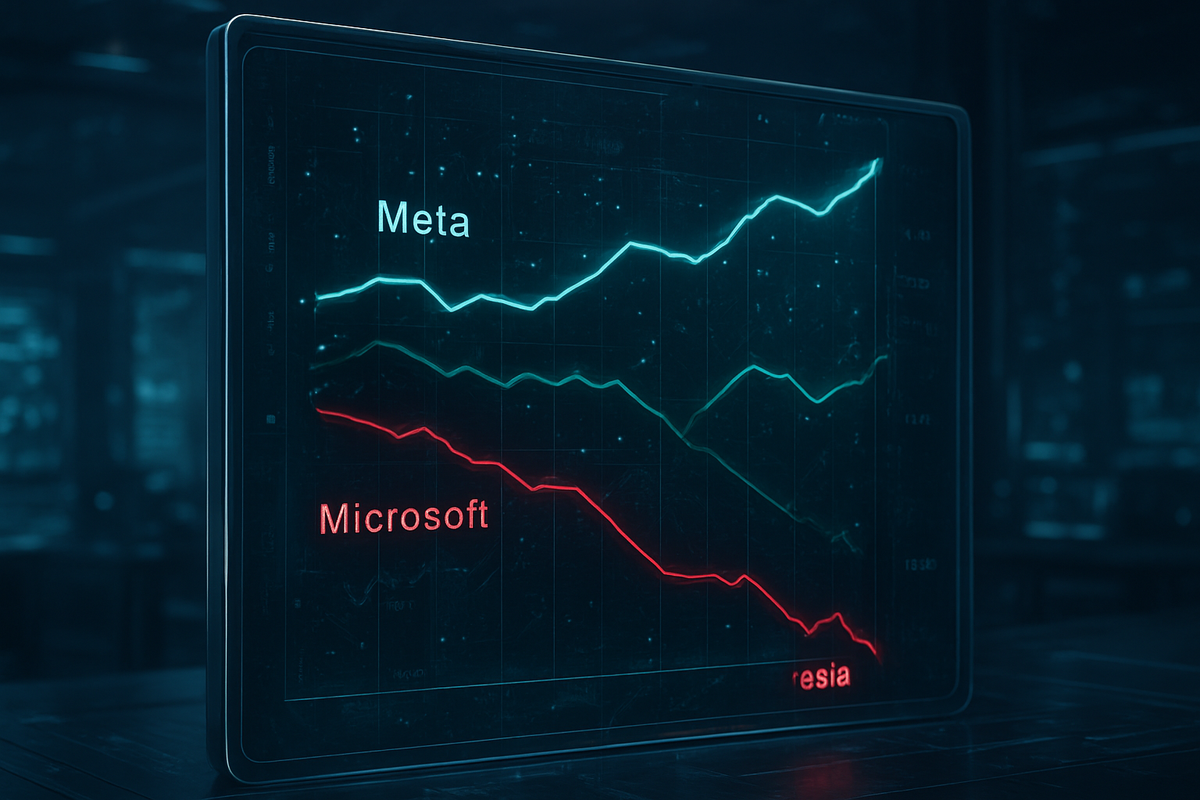
The timeline of this divergence began in earnest during the January 2026 earnings season, a period analysts are now calling the "Great Reckoning." On January 28, 2026, Microsoft Corporation (NASDAQ: MSFT) delivered what many considered a "perfect storm" of a report. Despite beating top-line estimates, the software giant revealed a staggering $37.5 billion in quarterly capital expenditures dedicated to AI infrastructure. Investors, spooked by a lack of corresponding short-term free cash flow and a deceleration in Azure cloud growth, triggered a massive sell-off. Since the start of the year, Microsoft has seen its market value erode by 15%, as the market re-evaluates its previous premium valuation of 34x earnings.
Simultaneously, Tesla, Inc. (NASDAQ: TSLA) has faced a grueling start to 2026, with its stock price sliding 7% year-to-date. The narrative for the electric vehicle pioneer has shifted from high-margin tech visionary to a cyclical automaker embattled by price wars. Shocking delivery data from early 2026 showed an 88% decline in registrations in Norway and a 67% drop in the Netherlands. With Chinese rival BYD and legacy players like Volkswagen gaining significant ground in Europe, Tesla’s margins have remained compressed, forcing a leadership shuffle that saw Joe Ward elevated to a global sales lead to arrest the slide.
The volatility was further exacerbated in late January by the "DeepSeek Shock." A breakthrough from the Chinese AI startup DeepSeek suggested that high-performance models could be built at a fraction of the cost previously assumed by Western firms. This roiled the semiconductor sector, leading to a single-day $600 billion market cap loss for the industry leader Nvidia Corporation (NASDAQ: NVDA). However, unlike Microsoft, Nvidia’s price correction has settled into a surprising new reality: the company is now being viewed as a value play relative to its explosive growth.
Winners and Losers in the ROI Audit
The biggest winners in this new landscape are ironically the companies that were once considered the most speculative. Meta Platforms, Inc. (NASDAQ: META) has emerged as the "value darling" of 2026. Trading at a forward P/E ratio between 21.8x and 26.1x, Meta is now priced roughly in line with, or even slightly below, the S&P 500 average (currently sitting at 23.6x). This valuation comes as Meta’s Llama 5 integration into its advertising stack has proven to be the most successful example of immediate AI monetization, driving record ad revenues while the company maintains a leaner operational structure than its peers.
Nvidia, too, has entered the value conversation. Despite the DeepSeek scare, its revenue growth remains robust at 73% for the early part of the year. With its forward P/E ratio compressing to approximately 22.1x, Nvidia is no longer the "expensive" stock it was in 2024. Investors are increasingly viewing it as a foundational utility for the AI age—a company with a lower multiple than several consumer staple stocks, yet with significantly higher growth potential. This "multiple compression" reflects a market that is pricing in "AI gravity" but rewarding the actual earnings being generated today.
Conversely, the "losers" of this dispersion—Microsoft and Tesla—are struggling with specific structural headwinds. Microsoft’s heavy dependency on OpenAI has raised concentration risk concerns, while its massive infrastructure spending has yet to yield the "Copilot" revenue surge that bulls had predicted. Tesla, meanwhile, is finding it difficult to maintain its "Magnificent" status as it transitions into a mature, highly competitive global automotive market. The divergence shows that being a "tech leader" is no longer enough; the market now demands a clear, high-margin path to cash flow.
The End of the AI Hype Cycle and Broader Market Shifts
This event fits into a broader industry trend known as the "Return on Investment Audit." In 2024 and 2025, companies were rewarded for simply announcing AI initiatives or purchasing thousands of H100 GPUs. In 2026, that "blind faith" has been replaced by a demand for proof. This shift is rippling through the entire tech ecosystem, forcing startups and partners to provide more granular data on how AI is actually improving their bottom lines. The days of the "AI premium" are fading, replaced by a "Execution Premium."
Regulatory and legislative factors have also played a crucial role. The "One Big Beautiful Bill Act" (OBBBA), signed in July 2025, provided permanent tax cuts for domestic manufacturing and 100% bonus depreciation. This has fundamentally shifted capital away from multinational mega-cap tech and toward small-cap and domestic "real economy" stocks. The Russell 2000 has seen a resurgence as a result, contributing to the rotation out of the Magnificent Seven. Furthermore, the geopolitical spike in oil prices following the Iran conflict in late February 2026 introduced a "war risk premium" that has punished high-multiple growth stocks while benefiting safe havens.
Historically, this dispersion resembles the "dot-com" aftermath where the survivors of the initial bubble had to prove their business models before being re-rated by the market. However, unlike the 2000 crash, the 2026 dispersion is characterized by the high quality of the underlying businesses. Companies like Alphabet Inc. (NASDAQ: GOOGL) and Amazon.com, Inc. (NASDAQ: AMZN) have managed to buck the downward trend of their peers, suggesting that the "Magnificent Seven" trade is not dead, but rather evolving into a more discerning, individual stock-picking environment.
The Road Ahead: Scenarios for the Rest of 2026
In the short term, the market expects continued "churn" as portfolios rebalance away from the crowded Microsoft and Tesla trades and into the relatively cheaper Meta and Nvidia. A key scenario to watch is whether Microsoft can demonstrate a "breakout" in AI software revenue during its Q2 report. If the company can prove that its $37.5 billion CapEx is leading to a surge in enterprise productivity sales, it could spark a massive "relief rally" that narrows the dispersion gap.
Long-term, the strategic pivot for these giants will involve a move toward specialized AI. We are likely to see a wave of acquisitions as the Mag Seven use their massive cash piles to buy up smaller firms that have perfected niche AI applications in healthcare, legal, and manufacturing. This would allow them to move away from "general-purpose" AI infrastructure and toward more "sticky," high-margin vertical software. For Tesla, the path forward likely requires a definitive breakthrough in its Full Self-Driving (FSD) software or a pivot toward a low-cost "Model 2" to regain market share in Europe and Asia.
Market opportunities are also emerging in the "secondary AI plays"—the companies that provide power, cooling, and cybersecurity for the data centers that Nvidia and Microsoft are building. As the mega-caps disperse, these mid-cap "pick and shovel" plays may offer the growth that investors are no longer finding in the traditional tech leaders. The potential for a "Magnificent Three" or "Fab Four" to emerge from the ashes of the original seven is high, as the market consolidates around the true winners of the AI revolution.
Summary and Investor Outlook
The 2026 dispersion of the Magnificent Seven marks a critical turning point in market history. The era of the "easy trade," where investors could simply buy an index of the seven largest tech companies and expect outperformance, is over. The divergence between Nvidia and Meta's "value" status and Microsoft and Tesla's "struggling growth" status highlights a more sophisticated, earnings-driven market. Investors must now be as diligent with tech valuations as they are with any other sector, paying close attention to capital expenditure efficiency and real-world AI adoption.
Moving forward, the market appears to be in a healthy, if volatile, transition. The rotation into the broader S&P 500 and the re-rating of tech leaders as value plays suggests that the AI revolution is moving into its second, more mature phase. This phase will be defined not by the hardware being built, but by the value that hardware creates for shareholders. The "Magnificent Seven" may have fractured, but the companies within that group remain some of the most profitable and influential entities in history.
For the coming months, investors should watch for three key indicators: the stabilization of Tesla's European margins, the trajectory of Microsoft’s AI-related free cash flow, and the continued integration of AI into Meta’s advertising revenue. The "Great Tech Fracture" isn't a sign of the end of tech dominance, but rather a maturation process that will ultimately reward the most efficient and innovative players in the space.
This content is intended for informational purposes only and is not financial advice