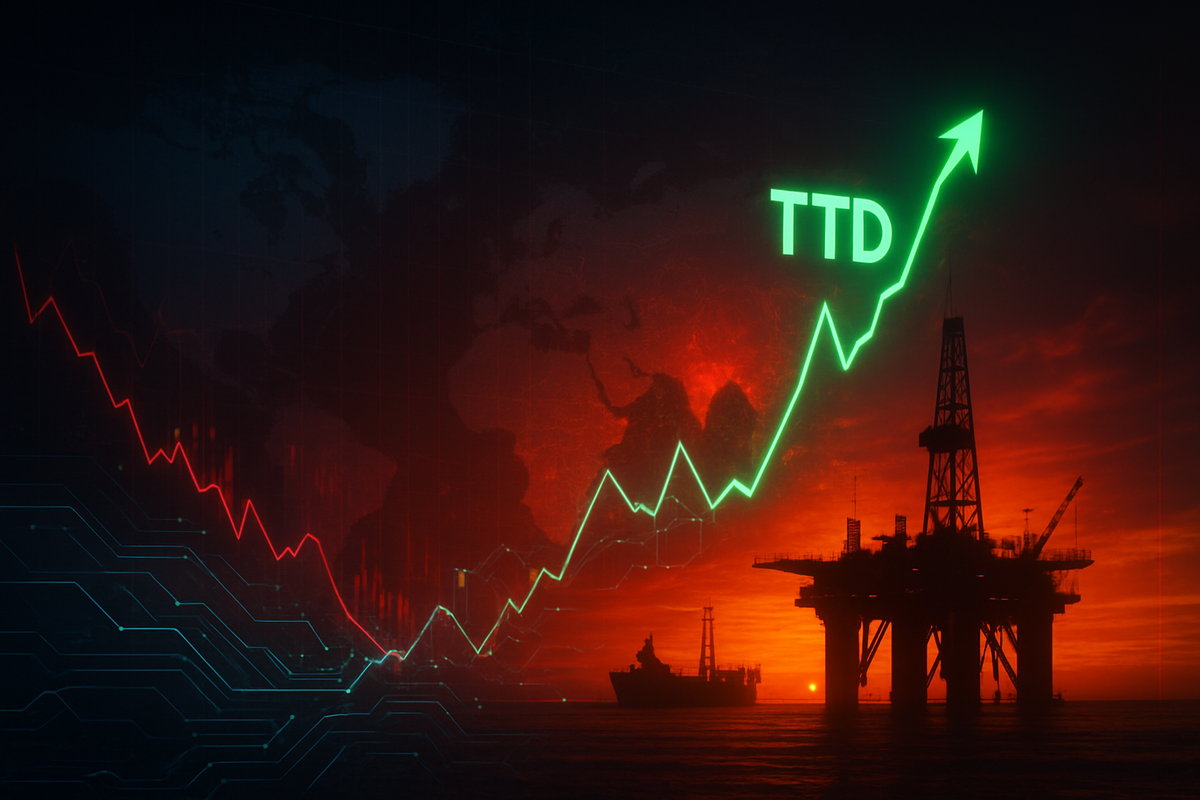
In a stunning display of individual stock resilience, The Trade Desk (NASDAQ: TTD) saw its shares skyrocket by more than 18% on March 5, 2026, closing at $29.79. The surge occurred on a day when the broader financial markets were gripped by panic, as a sudden escalation in Middle Eastern tensions sent oil prices soaring and triggered a massive sell-off across major indices. While the Dow Jones Industrial Average plummeted over 1,000 points intraday, The Trade Desk managed to decouple from the "risk-off" sentiment, finishing the session as one of the market's top performers and signaling a potential shift in how investors view the independent ad-tech giant.
The divergence between The Trade Desk and the rest of the market was nothing short of extraordinary. As West Texas Intermediate (WTI) crude spiked over 7% to settle near $87 per barrel, investors feared a return to stagflation and a more hawkish Federal Reserve. Yet, TTD’s intraday high of $32.90 suggested that for some participants, the company's specific growth catalysts and internal confidence were far more compelling than the macro-economic headwinds threatening the global supply chain.
The rally on March 5 was fueled by a "double catalyst" of historic insider buying and high-stakes partnership rumors. The primary spark was a regulatory filing revealing that CEO and co-founder Jeff Green had purchased approximately 6 million shares of the company between March 2 and March 4. This $150 million investment represents the largest single insider buy in the company’s history, sending a definitive signal to the market that leadership viewed the recent valuation—following a post-earnings dip in February—as a significant entry point.
Compounding the enthusiasm was a report from The Information suggesting that The Trade Desk is in advanced discussions with OpenAI to manage advertising sales for the AI research lab’s various consumer-facing platforms. Analysts at Evercore ISI noted that such a deal would be transformative, essentially positioning The Trade Desk as the "essential infrastructure" for the next generation of AI-driven search and generative content. This news arrived just one day after the company launched "OpenTTD," a unified portal that streamlines its open-source identity and authentication tools, such as Unified ID 2.0 (UID2) and OpenPass, for developers worldwide.
The timeline of these events coincided perfectly with a geopolitical crisis in the Strait of Hormuz. On the morning of March 5, reports of an Iranian missile attack on an American tanker caused a flight to safety in most sectors. While the S&P 500 (INDEXSP: .INX) fell 0.6% and the tech-heavy Nasdaq Composite (INDEXNASDAQ: .IXIC) lost 0.3%, TTD’s momentum was unstoppable. The company’s announcement of reaching "critical mass" for its UID2 solution, with new integrations from Databricks and Spotify (NYSE: SPOT), further bolstered the narrative that TTD is winning the war for the post-cookie internet.
The ripple effects of TTD’s breakout were felt across the advertising and technology sectors. Magnite (NASDAQ: MGNI), a key supply-side partner for TTD, also showed resilience, gaining 2.39%. Magnite benefited from the positive sentiment surrounding the independent open web, as well as its own $200 million share buyback program. Conversely, the "Walled Garden" giants faced a difficult day. Alphabet (NASDAQ: GOOGL) and Meta Platforms (NASDAQ: META) both closed in negative territory, weighed down by the broader Nasdaq decline and growing investor concerns that their closed ecosystems are losing ground to the transparent, programmatic model championed by The Trade Desk.
Connected TV (CTV) players were also in focus. While Roku (NASDAQ: ROKU) has struggled with hardware-related margin pressures, The Trade Desk’s late-February launch of the "Ventura" ecosystem—a new operating system designed specifically for the CTV supply chain—has positioned TTD as a direct threat to existing gatekeepers. In a market where energy costs are expected to dampen consumer spending, companies with high-margin, software-driven recurring revenue like TTD are increasingly viewed as safer havens compared to traditional manufacturing or transportation stocks.
The semiconductor sector (NASDAQ: SMH) was particularly hard hit by the oil shock, falling over 1% on fears that a protracted conflict in the Middle East would disrupt global logistics and increase production costs. This made TTD’s 18% gain even more of an anomaly, as it proved that "big data" and "ad-tech" could occasionally act as defensive plays if the underlying growth narrative is strong enough.
The significance of TTD’s performance extends far beyond a single day of trading. It represents a fundamental shift in the market's perception of ad-tech. For years, programmatic advertising was seen as a discretionary expense that would be the first to be cut during an economic downturn or an energy-driven inflation spike. However, the surge on March 5 suggests that The Trade Desk is now viewed as an "AI infrastructure play." By potentially partnering with OpenAI and consolidating its identity solutions via OpenTTD, the company is moving toward becoming a utility for the digital economy.
This event also highlights a growing trend of "decoupling" in the tech sector. Historically, a 1,000-point drop in the Dow would have dragged all growth stocks down in tandem. The fact that TTD could rise 18% in such an environment points to a more sophisticated investor base that is willing to reward specific corporate execution even during macro turmoil. This mirrors historical precedents like the "flight to quality" seen in certain software stocks during the mid-2010s, but with a modern focus on AI integration and first-party data.
Regulatory implications are also looming. As The Trade Desk expands its footprint through the Ventura ecosystem and potentially manages OpenAI’s ad stack, it may face increased scrutiny from antitrust regulators who are already wary of dominant platforms. However, TTD’s commitment to the "open web" has so far served as a strategic shield, contrasting its business model with the anti-competitive allegations frequently leveled against Google’s ad-tech suite.
Looking ahead, the primary question for investors is whether The Trade Desk can maintain this momentum if the oil-driven market shock persists. In the short term, the company must finalize the rumored OpenAI partnership and demonstrate that the Ventura OS can gain traction with hardware manufacturers and streaming services. Strategic pivots may be required if global consumer demand softens significantly due to sustained high energy prices, forcing advertisers to become even more selective with their budgets.
In the long term, the success of UID2 and OpenTTD will be the true barometers of the company's value. If TTD can successfully replace the third-party cookie as the industry standard for identity, it will control the "currency" of digital advertising. This would create a moat that even the most severe geopolitical shocks would struggle to breach. Market opportunities are also emerging in international markets, where EUID (the European version of UID2) is seeing rapid adoption among broadcasters and publishers.
However, challenges remain. The volatility seen on March 5 is a reminder that the global economy is in a fragile state. If the conflict in the Middle East escalates further, the resulting inflationary pressure could eventually reach even the most resilient tech companies. TTD will need to prove that its platform provides such a high return on investment (ROI) for advertisers that it becomes "recession-proof."
The Trade Desk’s 18.36% surge on March 5, 2026, will likely be remembered as a watershed moment for the company. By defying a massive market sell-off triggered by an oil price shock, TTD has cemented its status as a leader in the next phase of the digital economy. The combination of Jeff Green's massive share purchase and the potential OpenAI collaboration provided a powerful narrative that overwhelmed the prevailing fear in the broader market.
Moving forward, the market remains on edge, with investors closely watching energy prices and Federal Reserve commentary. For The Trade Desk, the focus shifts to execution. The company has laid out an ambitious roadmap involving CTV ecosystems and AI-driven ad management; now, it must deliver the financial results to match the current hype.
For investors, the key takeaway is that quality and leadership conviction can still drive alpha even in the most chaotic environments. While the "oil shock of 2026" may continue to weigh on the S&P 500, The Trade Desk has proven that it has the internal engines necessary to chart its own course. Investors should watch for official confirmation of the OpenAI deal and the initial adoption rates of the Ventura OS in the coming months.
This content is intended for informational purposes only and is not financial advice.