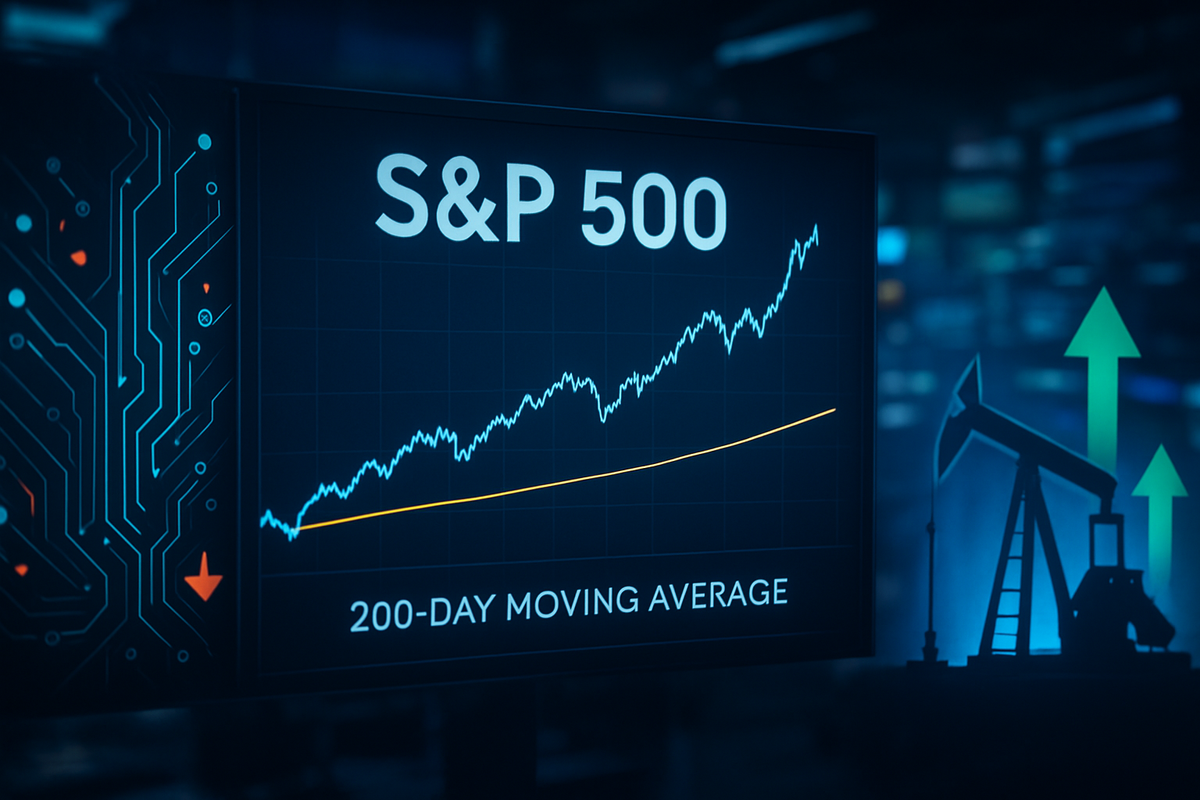
As of March 18, 2026, the S&P 500 is navigating a high-stakes technical crossroads, characterized by a stark divergence between the cooling artificial intelligence sector and a resurgent energy market. Despite a series of sharp pullbacks in technology "hyperscalers" over the last quarter, the broader index remains surprisingly resilient, currently trading approximately 5% above its 200-day moving average—a level technical analysts view as the ultimate "line in the sand" for the multi-year bull market.
This 5% premium, while historically a sign of healthy momentum, belies a period of intense intraday volatility that has gripped Wall Street since the start of the year. Investors are grappling with a "Great Rotation" where capital is fleeing the once-untouchable AI giants and seeking refuge in tangible commodities and defensive value plays. The immediate implication is a market that appears stable on the surface but is undergoing a violent internal restructuring, leaving passive index investors shielded while active tech traders face significant drawdowns.
The Technical Tightrope: 200-Day SMA and the AI Fatigue
The S&P 500’s journey to its current technical standing has been anything but linear. Following a record-breaking surge in late 2025 that saw the index cross the psychological 7,000 mark, the market entered a period of "Capex fatigue" in January 2026. The technical setup now centers on the 200-day moving average, which sits near the 6,650 level. By maintaining a 5% buffer above this trendline, the index has avoided a formal technical breakdown, yet the narrowing market breadth suggests this support is being tested by a dwindling number of sectors.
The timeline leading to this moment was punctuated by the "Tech Wreck" of November 2025, triggered when SoftBank Group Corp. (OTC: SFTBY) divested a significant portion of its stake in NVIDIA (NASDAQ: NVDA), sparking fears that the AI infrastructure build-out had peaked. This was followed by a tumultuous Q4 2025 earnings season in January and February 2026, where even "blowout" results failed to ignite new rallies. The market’s reaction has shifted from rewarding potential to demanding immediate, tangible returns on the billions spent on AI data centers.
Key stakeholders, from institutional asset managers to retail "HODLers" of tech stocks, are now watching the VIX—the market’s "fear gauge"—which has spiked to a range of 23.5 to 27.2 this month. This elevated volatility reflects the uncertainty surrounding geopolitical tensions in the Middle East and their impact on global supply chains. The current technical cushion of 5% above the 200-day moving average is largely being propped up by a massive rotation into the Energy sector, which has offset the 19.6% year-to-date decline in former market leaders.
Winners and Losers: The Great Sector Rotation
The primary losers in this new market regime are the titans of the "AI Era." Microsoft (NASDAQ: MSFT) has emerged as a primary laggard in 2026, with its stock price pressured by concerns over a projected $107 billion in capital expenditures for the fiscal year. While Microsoft’s cloud growth remains steady, the sheer scale of investment required to maintain its lead in generative AI has led to a valuation re-rating. Similarly, NVIDIA (NASDAQ: NVDA) is currently trading roughly 11% below its October 2025 highs, as investors move away from "infrastructure plays" toward companies that can prove AI is boosting their bottom line today, not tomorrow.
On the winning side of the ledger, the Energy sector has become the S&P 500’s unlikely savior. With Brent crude oil surging to $103 per barrel in mid-March 2026 due to disruptions in the Strait of Hormuz, ExxonMobil (NYSE: XOM) and Chevron (NYSE: CVX) have seen their shares climb by more than 25% year-to-date. ExxonMobil, in particular, has capitalized on record production levels in the Permian Basin, turning the commodity price spike into a windfall for shareholders through aggressive buyback programs.
Alphabet (NASDAQ: GOOGL) occupies a middle ground, showing more resilience than its peer, Microsoft, due to a robust AI-integrated advertising model that has maintained margins. However, even Alphabet has faced headwinds from a "compliance cycle" as new regulatory frameworks in the EU and US begin to bite. This divergence within the "Magnificent Seven" indicates that the days of monolithic tech rallies are over, replaced by a "show-me" market where individual stock selection has returned to the forefront.
Broader Significance: AI Maturity and the Return of Macro
This event signifies a major transition in the current economic cycle: the move from AI speculation to AI maturity. Historically, this mirrors the "post-hype" phases of previous technological revolutions, such as the mid-1990s internet boom, where initial infrastructure build-outs were followed by a period of consolidation and volatility before the true productivity gains were realized. The current AI-driven pullbacks are not necessarily a sign of the technology's failure, but rather a correction of the "irrational exuberance" that characterized 2024 and early 2025.
Furthermore, the surge in energy prices to $103/bbl introduces the specter of "commodity-driven stagflation," a scenario the Federal Reserve has been desperate to avoid. The central bank now faces a dual challenge: cooling persistent inflation driven by energy costs while ensuring that the tech-heavy Nasdaq doesn’t enter a full-blown bear market that could dampen consumer spending. This macro-environment has complicated the Fed's "dot plot," with earlier hopes for aggressive rate cuts in 2026 now being replaced by a "higher for longer" stance.
The ripple effects are felt globally. Competitors in the AI space are now pivoting their strategies to focus on "efficiency and monetization" rather than raw compute power. For partners and suppliers in the semiconductor supply chain, the volatility in NVIDIA and Microsoft signals a more cautious procurement environment. This shift is likely to lead to more stringent regulatory oversight as governments seek to ensure that the massive investments in AI do not create systemic risks to the broader financial markets.
What Comes Next: Strategic Pivots and Market Scenarios
In the short term, market participants should expect continued "range-bound" trading as the S&P 500 attempts to hold its 5% buffer above the 200-day moving average. A move below 6,600 would likely trigger a wave of algorithmic selling, potentially leading to a 10-15% correction as the "safety zone" evaporates. Conversely, if the Energy sector remains strong and AI firms provide evidence of margin expansion in the next earnings cycle, the index could mount a challenge back toward the 7,000 level by mid-summer.
Strategic pivots are already underway. Many tech firms are expected to shift their narrative from "AI capability" to "AI profitability" in upcoming investor days. We may see a wave of consolidation in the mid-cap tech space as larger firms use their cash reserves to acquire smaller AI startups that can provide immediate revenue streams. In the energy sector, the focus will likely remain on returning capital to shareholders, though a prolonged stay at $100+ oil could invite increased political scrutiny and calls for windfall taxes.
Longer-term, the market’s trajectory will depend on whether the AI productivity gains promised in 2024 finally manifest in broader corporate earnings. If the S&P 500 can broaden its rally beyond just Energy and Tech—moving into Industrials and Financials—the "cautiously bullish" year-end targets of 7,600 from firms like Goldman Sachs may still be within reach. However, the "bear case" remains a looming shadow, with the Federal Reserve’s recent stress tests modeling a potential systemic event if the AI bubble were to burst more violently.
Wrap-Up: A Market at a Crossroads
The technical state of the S&P 500 in March 2026 is a study in contrasts. While the index's position 5% above its 200-day moving average suggests a bull market that is still intact, the underlying volatility and the correction in AI leaders tell a story of significant fragility. The "Great Rotation" has provided a temporary floor, but the market's dependence on high oil prices and energy stocks to offset tech losses is a precarious foundation for long-term growth.
Moving forward, investors should watch the 6,650 level on the S&P 500 with extreme care; it is the definitive boundary between a healthy correction and a technical bear market. The era of "blindly buying the AI dip" has been replaced by a more disciplined environment where valuation and tangible cash flow are the primary metrics of success.
In the coming months, the key indicators will be the sustainability of energy prices and the ability of tech giants to prove that their massive capital investments are translating into earnings per share. For now, the S&P 500 remains in a "testing phase," and the outcome will likely define the investment landscape for the remainder of the decade.
This content is intended for informational purposes only and is not financial advice.