On a day that began with the specter of a broad regional conflict in the Middle East, the U.S. stock market demonstrated a staggering display of resilience. Following a weekend of unprecedented military escalation between the U.S., Israel, and Iran, indices opened deep in the red as investors braced for the fallout of a potentially shuttered Strait of Hormuz and skyrocketing energy costs. However, what started as a panic-induced sell-off transformed into a classic "buy the dip" rally by midday, led by a resurgence in technology and a surge in defense and energy sectors.
By the closing bell on Monday, March 2, 2026, the Nasdaq Composite (INDEXNASDAQ: .IXIC) had not only erased a morning deficit of 1.6% but finished the day up 0.4% at 22,748.86. The S&P 500 (INDEXSP: .INX) followed a similar trajectory, clawing back from a 1.4% early drop to finish virtually flat, up a marginal 0.1% at 6,881.62. This intraday turnaround underscores a market that, while sensitive to geopolitical shocks, remains anchored by robust secular trends in artificial intelligence and a disciplined institutional investor base that has grown accustomed to the "fog of war" volatility.
The Fog of War: Strikes on Iran and the Strait of Hormuz
The primary driver of the morning's volatility was a series of coordinated strikes launched by the United States and Israel over the weekend of February 28 to March 1. The operation targeted high-value strategic assets within Iran and resulted in the reported death of Iran’s Supreme Leader, Ayatollah Ali Khamenei. The gravity of this event cannot be overstated; it represents a tectonic shift in Middle Eastern geopolitics and immediately raised fears of a symmetric Iranian retaliation. As news of the strikes circulated, reports emerged that the Strait of Hormuz—the world’s most critical oil chokepoint—was effectively blocked as commercial tankers ceased movement due to the threat of missile fire.
The immediate reaction across global markets was a flight to safety. Gold prices surged to an all-time high, surpassing $5,300 per ounce, while the U.S. Dollar Index climbed above 98.00. Brent crude oil saw an instantaneous spike of nearly 13%, briefly flirting with levels that analysts feared would reignite the inflationary pressures the Federal Reserve has worked for years to quell. For the first two hours of trading on March 2, it appeared the market was entering a correction phase driven by the fear that a prolonged conflict would derail the expected "soft landing" and force the Fed to maintain higher interest rates for the remainder of 2026.
However, the panic began to subside by 11:30 AM ET. Market participants began to differentiate between the geopolitical shock and the fundamental health of the U.S. domestic economy. The narrative shifted from "total war" to "containment," as the State Department issued statements emphasizing that the strikes were a targeted response to previous provocations rather than the opening salvo of a ground invasion. This clarity allowed institutional algorithms and retail investors alike to step back into the market, focusing on the sectors poised to benefit from increased defense spending and those with enough "moat" to withstand temporary energy spikes.
Winners and Losers: Defense and Tech Lead the Charge
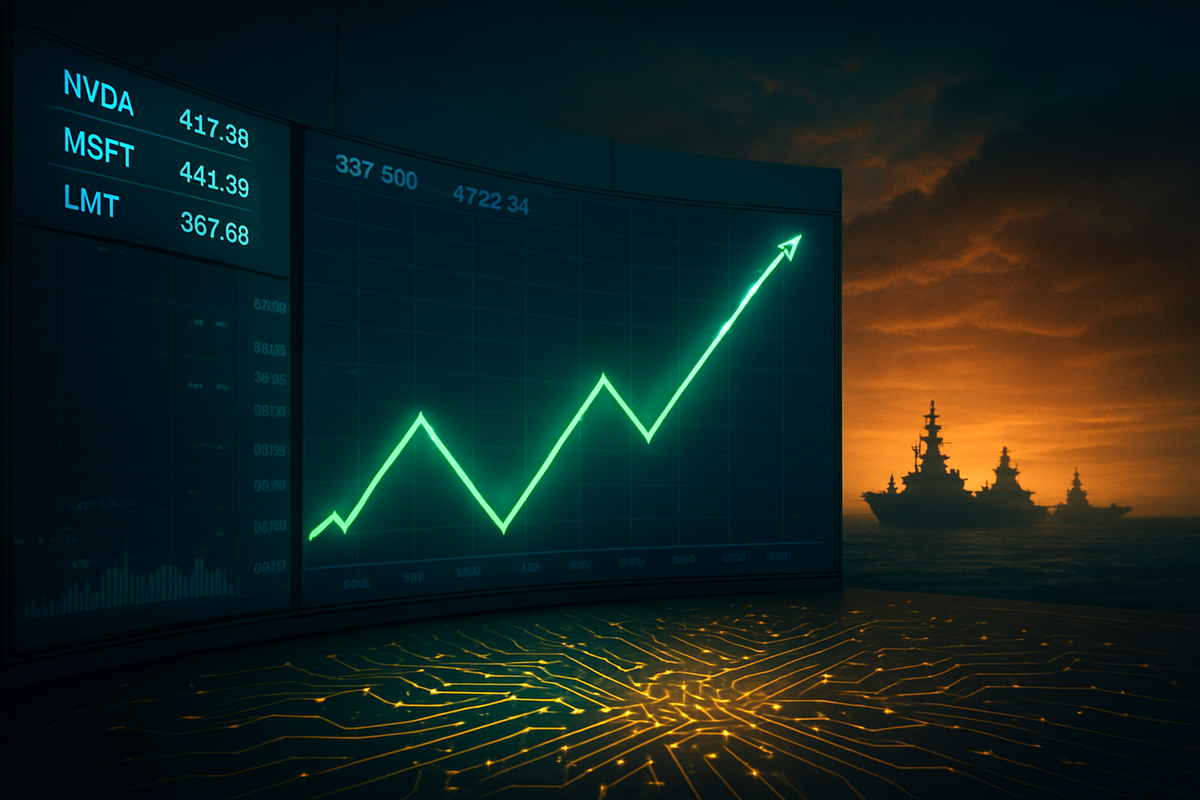
The clear beneficiaries of the day’s volatility were the traditional "safe havens" of the military-industrial complex and the energy giants. Lockheed Martin (NYSE: LMT) and Northrop Grumman (NYSE: NOC) saw their shares jump 4.5% and 5.2% respectively, as investors anticipated a fresh wave of government contracts for missile defense and surveillance systems. Palantir (NYSE: PLTR) also experienced a significant 6% surge, as its battlefield analytics software is expected to play a crucial role in managing the escalating tensions. In the energy sector, Exxon Mobil (NYSE: XOM) and Chevron (NYSE: CVX) rallied alongside crude prices, providing a necessary counterbalance to the S&P 500’s broader weakness.
Conversely, the technology sector provided the engine for the Nasdaq's afternoon recovery. While tech initially sold off on inflation fears, leaders like Nvidia (NASDAQ: NVDA) and Microsoft (NASDAQ: MSFT) proved resilient. Nvidia, in particular, closed up 3% as its dominant position in the AI hardware space continues to make it a preferred destination for capital, regardless of the macro environment. Cybersecurity firms also saw a notable "tail-lift," with companies like CrowdStrike (NASDAQ: CRWD) gaining 4.2% on concerns that Iranian retaliation would likely manifest through state-sponsored cyberattacks against Western financial and energy infrastructure.
The casualties of the day’s "war worry" were found primarily in the travel and consumer cyclical sectors. Airlines such as Delta Air Lines (NYSE: DAL) and United Airlines (NASDAQ: UAL) fell between 3% and 5% as the double-whammy of higher jet fuel costs and potential airspace closures in the Middle East weighed heavily on sentiment. Similarly, cruise operators and discretionary retailers lagged the broader market, as investors worried that a sustained spike in oil prices would eventually eat into the consumer’s wallet, dampening the demand for luxury goods and international travel.
A New Market Paradigm: Resilience Amidst Chaos
The market’s ability to "shrug off" a historic assassination and the potential closure of the world’s most important energy artery suggests a significant shift in investor psychology. Historically, events of this magnitude—comparable to the 1970s oil shocks—would have triggered multi-day sell-offs. In 2026, however, the market appears to be operating under a different set of rules. The "AI floor" has become a tangible reality; the massive capital expenditures in computing power have created a subset of stocks that are viewed as essential infrastructure, largely decoupled from traditional geopolitical risk.
This event also highlights a broader industry trend toward "deglobalization-ready" portfolios. Investors are increasingly favoring companies with domestic production capabilities or those that provide the security and energy independence required in a fractured world. The resilience shown today is a testament to the diversification of the modern S&P 500, which is less dependent on the flow of physical goods through the Strait of Hormuz than it is on the flow of data and the expansion of digital services.
Furthermore, the policy implications are already being debated on Capitol Hill and at the Federal Reserve. While the spike in oil is inflationary in the short term, some analysts argue that a geopolitical crisis could ironically prevent the Fed from tightening too much, as they seek to provide liquidity and stability during a time of international crisis. This "Fed Put" 2.0—the idea that the central bank will support the markets through geopolitical turmoil—likely emboldened the buyers who rushed back into the Nasdaq and S&P 500 this afternoon.
The Road Ahead: Monitoring Retaliation and Energy Volatility
Looking ahead, the primary concern for the market is the nature of the "other shoe" to drop. While today's recovery was impressive, it was based on the assumption that the conflict will remain contained. A direct, large-scale retaliatory strike by Iran or its proxies on regional energy infrastructure could easily send Brent crude above $100 per barrel, a level that would severely test the market’s current resilience. Investors will be keeping a close eye on satellite imagery of the Strait of Hormuz and diplomatic cables coming out of regional capitals for any sign of a prolonged blockade.
In the short term, we may see a strategic pivot toward defensive positioning even if the broader indices continue to trend higher. Fund managers are likely to increase weightings in cybersecurity, domestic energy production, and AI-driven automation, which reduces reliance on complex global supply chains. The market's "V-shaped" recovery today might be a blueprint for the coming months: sharp, news-driven drops followed by aggressive opportunistic buying, provided that the underlying corporate earnings remain strong.
Strategic adaptations will also be required for companies in the transport and logistics sectors. If Middle Eastern tensions remain elevated, we could see a permanent re-rating of airline and shipping stocks as they price in a "geopolitical risk premium." Conversely, the current environment presents a massive opportunity for the U.S. shale industry to re-assert its dominance, potentially leading to a new era of American energy exports to a world wary of Middle Eastern instability.
Summary and Final Thoughts for Investors
The events of March 2, 2026, will likely be remembered as a masterclass in market psychology. Despite the initial shock of a major military escalation and the death of a world leader, the Nasdaq and S&P 500 managed to close near their daily highs. This recovery was fueled by a combination of the "AI tailwind," a surge in defense and energy stocks, and a growing consensus that the U.S. economy is better insulated from Middle Eastern shocks than it was in previous decades.
The key takeaway for investors is that volatility remains a feature, not a bug, of the current market environment. While the resilience shown today is encouraging, it does not mean the danger has passed. The threat of cyberwarfare, sustained high energy prices, and the potential for further military escalation will continue to be the primary risks as we head into the second quarter of the year.
Moving forward, the focus will shift back to the Federal Reserve and its reaction to the oil-driven inflation spike. Investors should watch for the next round of CPI data and the Fed’s March meeting minutes for clues on whether the "geopolitical discount" will affect their rate-cutting path. For now, the bulls remain in control, but they are charging through a landscape filled with more uncertainty than we have seen in years.
This content is intended for informational purposes only and is not financial advice