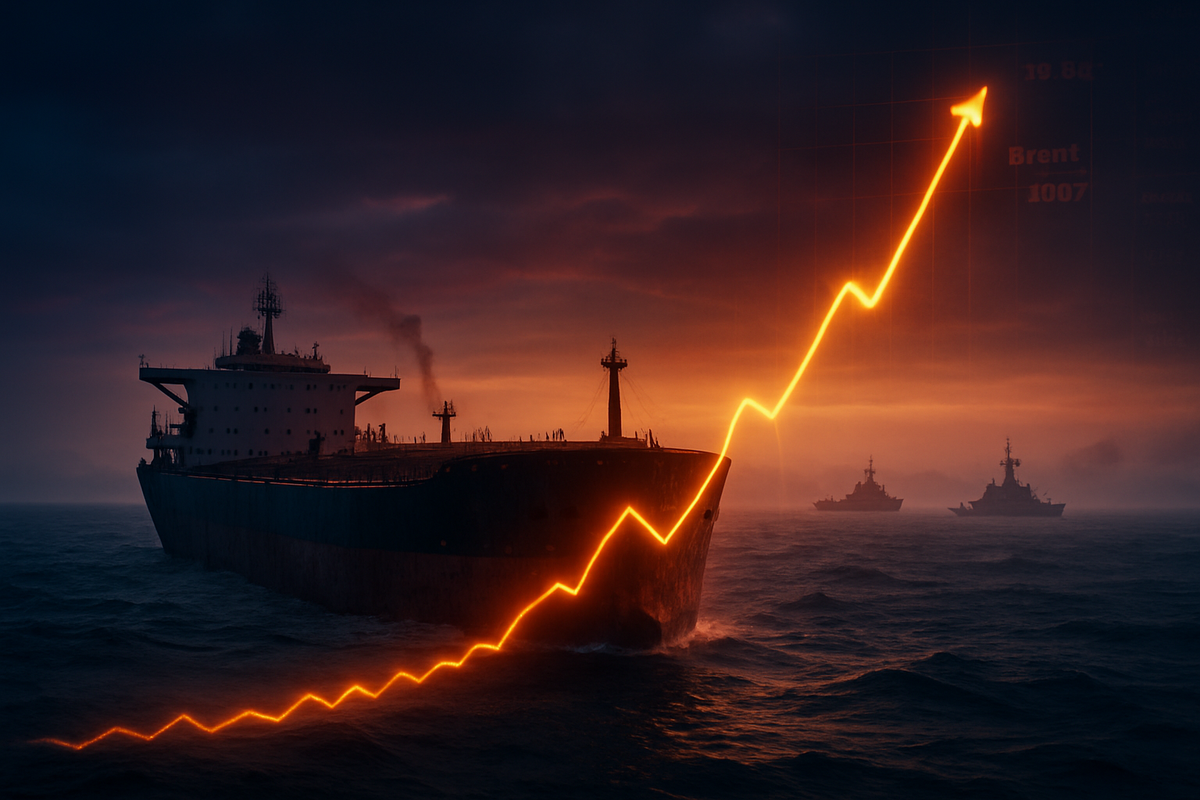
The global energy landscape shifted violently today, March 5, 2026, as Brent and WTI crude prices spiked toward the $80 mark, driven by a rapid escalation in military conflict between a U.S.-led coalition and Iran. Following days of mounting tension in the Persian Gulf, the markets reacted with alarm as the flow of oil through the world’s most critical maritime chokepoints came to a virtual standstill. The sudden surge has upended months of relative price stability, sending shockwaves through Wall Street and raising the specter of a prolonged inflationary period.
The immediate implications of this price spike are stark: a 15% jump in crude benchmarks in less than a week. With the Strait of Hormuz effectively closed, nearly 20% of the world's daily oil supply is now in jeopardy. For consumers, this translates to an almost instantaneous rise in gasoline and heating costs, while for central banks, it threatens to derail the hard-won progress made in taming global inflation over the past two years.
The Escalation: From 'Operation Epic Fury' to a Maritime Lockdown
The current crisis traces back to February 28, 2026, when a coalition launched "Operation Epic Fury," a series of precision strikes aimed at Iranian military and nuclear infrastructure. The geopolitical landscape was permanently altered following the reported assassination of Iran’s Supreme Leader, Ali Khamenei, during these strikes. In retaliation, the Islamic Revolutionary Guard Corps (IRGC) declared the Strait of Hormuz a closed military zone on March 2, 2026. By today, March 5, the situation has worsened significantly with reports of at least four tankers being targeted by explosive-laden remote-controlled boats and drone strikes near the ports of Iraq and Kuwait.
The market reaction has been swift and brutal. Brent crude is currently trading between $83 and $84 per barrel, while West Coast Intermediate (WTI) is aggressively testing the $78 to $80 resistance level. This "geopolitical risk premium" is being fueled by a physical supply crunch, as Iraq has already been forced to slash production by 1.5 million barrels per day due to a lack of viable export routes. Furthermore, Qatar, the world’s leading liquefied natural gas (LNG) exporter, declared force majeure yesterday after drone strikes damaged key processing facilities, sending European gas prices up by over 30%.
Key stakeholders, including the International Energy Agency (IEA) and major OPEC+ producers, are currently in emergency sessions. While Saudi Arabia and the UAE possess spare capacity, the closure of the Strait of Hormuz prevents that oil from reaching global markets. The logistical nightmare has left approximately 300 commercial vessels stranded, creating a bottleneck that some analysts fear could take months to clear even if a ceasefire were reached tomorrow.
Market Winners and Losers: Energy Giants Surge as Transport Founders
In the equities market, the divide between sectors is widening. Energy stocks have become the primary "flight-to-safety" trade, with the Energy Select Sector SPDR ETF surging as investors bet on sustained high commodity prices. ExxonMobil (NYSE: XOM) has seen its shares jump as its integrated model—spanning from Permian Basin production to global refining—allows it to capture margins at every stage of the crisis. Similarly, Chevron (NYSE: CVX) is being viewed as a strategic hedge, given its significant assets in South America and its high dividend yield, which offers a cushion against broader market volatility.
Occidental Petroleum (NYSE: OXY) has emerged as one of the biggest winners of the week, with its high sensitivity to crude prices and aggressive production profile in the U.S. domestic market making it a favorite for tactical investors. On the service side, Halliburton (NYSE: HAL) has seen a 5% gain as the industry anticipates a renewed push for domestic drilling to offset the Middle Eastern shortfall. These "winners" are benefiting from a market that is pricing in an era of "higher for longer" energy costs.
Conversely, the transport and consumer discretionary sectors are reeling. United Airlines (NASDAQ: UAL) and Delta Air Lines (NYSE: DAL) saw their stocks "nosedive" this morning, falling 8% and 6% respectively. Fuel accounts for nearly a third of airline operating costs, and the inability to hedge against such a sudden, violent spike has left carriers vulnerable. Logistics giants like UPS (NYSE: UPS) are also facing significant pressure, although FedEx (NYSE: FDX) has remained surprisingly resilient, hitting multi-month highs on the back of its planned internal restructuring and freight spinoff.
A Return to the 1970s? Analyzing the Wider Significance
The parallels to the 1973 and 1979 oil shocks are becoming impossible to ignore. Analysts at Wood Mackenzie have noted that an $85 to $90 barrel of oil in 2026 is the inflation-adjusted equivalent of the prices that triggered the 1970s energy crisis. The fear is a "stagflationary" loop: where high energy costs act as a tax on consumers, slowing economic growth, while simultaneously driving up the price of goods and services. Before this conflict, global inflation was projected to settle at 3.8% for 2026; current estimates now suggest it could easily spike above 4.5% if the Strait remains blocked.
The regulatory and policy implications are profound. U.S. Secretary of State Marco Rubio and Treasury Secretary Scott Bessent have both signaled that the administration is preparing "direct actions" to secure shipping lanes. This could involve a massive deployment of naval assets to escort tankers, a move that carries the risk of even greater military escalation. Furthermore, the Federal Reserve’s roadmap for 2026 has been thrown into chaos. New York Fed President John Williams warned today that "upside pressure on inflation" is now the primary concern, leading markets to wipe out any expectations for interest rate cuts in the first half of the year.
This crisis also highlights the vulnerabilities of the global energy transition. While renewable energy capacity has grown, the world remains tethered to fossil fuels for heavy transport and industrial heat. The current shock serves as a reminder that geopolitical stability in the Middle East remains the linchpin of the global economy, despite decades of efforts to diversify energy sources.
What Comes Next: Strategic Pivots and Scenarios
In the short term, the market will be looking toward a coordinated release of the Strategic Petroleum Reserve (SPR) by IEA member nations. While this can provide a temporary supply buffer, it does not solve the physical transport issue created by the closure of the Strait of Hormuz. Strategic pivots are already occurring; traders are frantically rerouting tankers around the Cape of Good Hope, a move that adds 10 to 14 days to delivery times and significantly increases freight costs.
If the blockade persists for more than three weeks, Goldman Sachs warns that Brent crude will likely breach the $100 per barrel mark. This would necessitate a massive shift in corporate strategy across the globe, forcing companies to implement aggressive fuel surcharges and potentially leading to a sharp contraction in consumer spending. For the energy sector, the opportunity lies in accelerating non-OPEC production, particularly in the U.S. shale patch and offshore Guyana, which could see a historic influx of capital in the coming months.
A Precarious Path Forward
The "March Spike" of 2026 is more than just a fluctuation in commodity prices; it is a fundamental stress test for the post-pandemic global economy. The key takeaway for investors is that the "peace dividend" that kept energy prices low for much of the early 2020s has officially evaporated. Moving forward, the market will be characterized by extreme volatility and a renewed focus on energy security over energy transition.
In the coming months, investors should keep a close watch on three things: the status of the Strait of Hormuz, the Federal Reserve’s rhetoric on interest rates, and the ability of U.S. shale producers to ramp up supply. The lasting impact of this event may well be a permanent shift in how risk is priced in the global energy market. As we have seen today, the bridge between a stable market and a global energy shock can be crossed in a matter of hours.
This content is intended for informational purposes only and is not financial advice