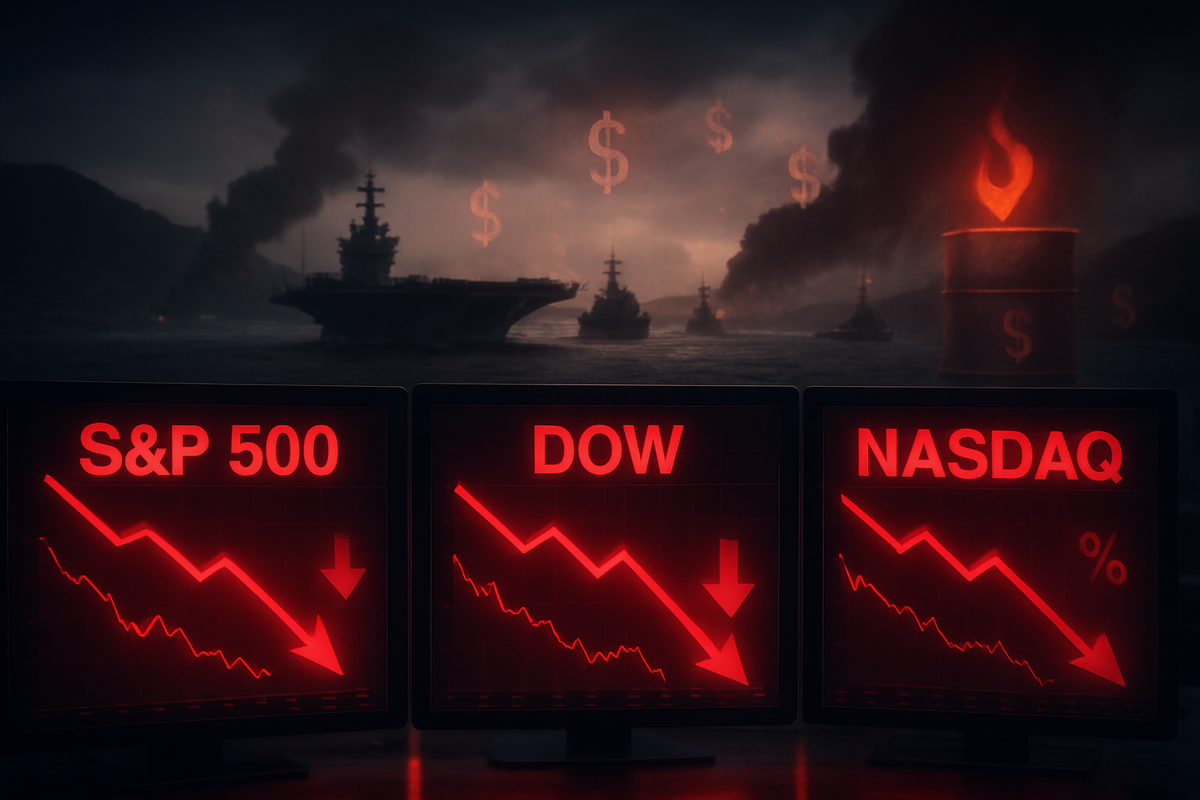
The U.S. stock market faced a brutal wave of selling on March 6, 2026, as the escalating conflict between the United States, Israel, and Iran sent shockwaves through global financial centers. Panic gripped Wall Street as the S&P 500 continued its downward spiral, erasing all year-to-date gains and leaving investors scrambling for safe-haven assets. The Dow Jones Industrial Average and the Nasdaq Composite followed suit, weighed down by the terrifying prospect of a full-scale regional war and a total shutdown of the world’s most critical energy transit points.
The immediate implications of this decline are far-reaching, as the "fear index" (VIX) spiked to levels not seen in years. With Brent Crude oil surging past $91 per barrel and the Strait of Hormuz effectively closed to tanker traffic, the specter of "stagflation"—low growth combined with high inflation—has returned to haunt the American economy. Markets are now pricing in a prolonged military engagement, as diplomatic channels appear to have collapsed entirely in favor of hardline rhetoric and expanded combat operations.
Escalation in the Gulf: A Week of Fire and Fury
The market carnage on March 6 was the direct result of a dramatic intensification of "Operation Epic Fury," a joint U.S.-Israeli military campaign that began in late February. Overnight, Israeli forces launched a massive wave of airstrikes targeting the defense industrial bases and missile production facilities in Tehran and Beirut. This "new phase" of the war, as described by military officials, signaled an intent to decapitate Iran's strategic capabilities. However, the human cost of the escalation became the grim focus of global headlines following reports of a strike on a primary school in Minab, southern Iran, which tragically resulted in the deaths of over 160 children.
The timeline leading to this moment has been a rapid descent into chaos. Following the initial strikes on February 28, the situation devolved from targeted skirmishes to a multi-front war involving Hezbollah and various proxy groups. By March 5, the Dow had already shed 784 points (1.61%), and the momentum of the sell-off carried into today’s session. Iran has retaliated with concentrated drone and missile attacks on U.S. military assets, specifically targeting Camp Buehring in Kuwait and a base in Erbil, Iraq. The breakdown in diplomacy was punctuated by President Donald Trump’s declaration that there would be no negotiations with Tehran short of an "unconditional surrender," a stance that has effectively slammed the door on any immediate de-escalation.
Key stakeholders, including the Pentagon and the Israeli Defense Forces (IDF), have maintained that these strikes are necessary to prevent a broader regional nuclear threat. However, the initial market reaction has been one of pure defensive positioning. The S&P 500 fell another 0.54% to 6,794.06 today, while the Nasdaq saw losses between 0.3% and 0.6% as the tech sector, which had previously been buoyed by AI demand, finally succumbed to the overwhelming weight of geopolitical instability.
Winners and Losers: Defense Giants and the Energy Crunch
The primary "winners" in this volatile environment have traditionally been the major defense contractors, though even they faced a reality check on March 6. Lockheed Martin (NYSE: LMT) and Northrop Grumman (NYSE: NOC) had both reached all-time highs earlier in the week as backlogs for missile defense systems and advanced aircraft swelled. However, on March 6, Lockheed Martin (NYSE: LMT) saw a 2.16% correction to $650.12 as investors moved to lock in profits and expressed concerns over the broader economic recession that a total war might trigger. Similarly, RTX Corp (NYSE: RTX) slipped 3.33% to $201.74, while Northrop Grumman (NYSE: NOC) traded down to $741.73.
The energy sector has been the most volatile battleground. Oil majors like ExxonMobil (NYSE: XOM) and Chevron (NYSE: CVX) have benefited from the skyrocketing price of Brent Crude, which surged 7% today to $91.20 per barrel. With the Strait of Hormuz—the artery for 20% of global oil—shut down to all but a handful of tankers, these companies are seeing their margins expand rapidly. However, the gains in the energy sector are a "tax" on the rest of the market, particularly the airline industry. United Airlines (NASDAQ: UAL) and Delta Air Lines (NYSE: DAL) have seen their stock prices decimated by the dual threat of soaring jet fuel costs and the closure of major Middle Eastern flight corridors.
The manufacturing and aerospace giant Boeing (NYSE: BA) also found itself on the losing side of the ledger, with its stock slipping 3.52% to $219.48. While Boeing has significant defense interests, its massive commercial aviation segment is under immense pressure as global travel demand falters in the face of rising costs and safety concerns. Even technology leaders like Apple (NASDAQ: AAPL) and NVIDIA (NASDAQ: NVDA) were not immune to the carnage, as the global "risk-off" sentiment forced institutional investors to reduce exposure to growth stocks in favor of cash and gold.
A New Era of Geopolitical Risk and Stagflation
The events of March 6, 2026, fit into a broader trend of deglobalization and the fragmentation of the international order. This is not merely a localized conflict; it is a seismic shift that threatens the "just-in-time" supply chains that the global economy relies upon. Analysts are drawing parallels to the 1973 oil crisis, noting that a prolonged blockage of the Strait of Hormuz could send oil prices toward $150 per barrel, a level that would almost certainly trigger a global recession. This event has shattered the "soft landing" narrative that had dominated Wall Street for the past year, replacing it with fears of a "hard landing" fueled by energy-driven inflation.
The ripple effects are already being felt across the globe. Emerging markets, particularly those in Asia like India and South Korea, have seen their indexes crash as the cost of importing energy becomes unsustainable. The KOSPI index in South Korea experienced a record 12% loss earlier this week, signaling that the "oil war" domino effect is in full swing. Furthermore, this conflict has significant regulatory and policy implications. The U.S. Federal Reserve now finds itself in a nearly impossible position: it must decide whether to raise interest rates to combat war-driven inflation or lower them to support a flagging economy.
Historically, geopolitical shocks like the 2020 strike on Qasem Soleimani or the 2022 invasion of Ukraine have led to short-term market dips followed by recoveries. However, the scale of "Operation Epic Fury" and the involvement of multiple regional powers suggest that the 2026 conflict is of a different magnitude. This is not a "buy the dip" moment for many analysts; it is a fundamental repricing of risk in an era where military force has once again become a primary tool of statecraft.
What Comes Next: Diplomacy or Ground Invasion?
In the short term, the market will remain hyper-sensitive to any news regarding the Strait of Hormuz. If the U.S. Navy can successfully escort tankers and reopen the waterway, we may see a relief rally in equities and a cooling of oil prices. However, if Iran follows through on its threats to use its "silent" submarine fleet and sea mines to keep the strait closed, the economic fallout will intensify. Strategically, public companies will need to adapt by diversifying their supply chains away from the Middle East and accelerating the transition to alternative energy sources—a process that will take years, not months.
The long-term possibility of a U.S. ground invasion of Iran is the "black swan" event that currently hangs over the market. Such a move would require a massive increase in government spending, potentially ballooning the national debt and putting further upward pressure on bond yields. Conversely, if back-channel diplomacy through neutral parties like Oman or Switzerland can find a way to de-escalate, the market could see one of the most violent upward "short squeezes" in history. For now, however, the rhetoric from Washington and Tehran remains stubbornly bellicose.
Market participants should prepare for extreme volatility. Opportunities may emerge in cybersecurity firms and renewable energy stocks as the world seeks to mitigate the risks of conventional warfare and fossil fuel dependency. However, these are small silver linings in an otherwise dark clouds. The potential for a "protracted stalemate" could keep oil prices elevated for the remainder of 2026, acting as a persistent drag on consumer spending and corporate earnings.
Wrap-Up: Navigating a War-Torn Market
The events of March 6, 2026, mark a turning point for the decade. The sharp decline in the S&P 500, Dow, and Nasdaq reflects a fundamental shift in investor sentiment from optimistic growth to survivalist capital preservation. The key takeaways are clear: the era of cheap energy is under threat, and the geopolitical premium on stocks has returned with a vengeance. As the smoke clears from the latest round of airstrikes, the market is left to grapple with the reality that the "peace dividend" of the late 20th century has truly expired.
Moving forward, the market will likely remain in a "wait-and-see" mode, with every headline from the Persian Gulf causing triple-digit swings in the Dow. For the average investor, the significance of this day cannot be overstated; it is a reminder that the stock market does not exist in a vacuum and is deeply vulnerable to the whims of international politics. Diversification into commodities and defense-linked assets may provide some protection, but a broader market recovery will require a clear path toward regional stability that currently does not exist.
In the coming months, investors should watch the "Three S's": the Strait of Hormuz (for oil supply), Spending (for defense and debt implications), and Sentiment (as measured by the VIX and consumer confidence). Until there is a cooling of tensions or a decisive military outcome, the path of least resistance for the market appears to be lower.
This content is intended for informational purposes only and is not financial advice.