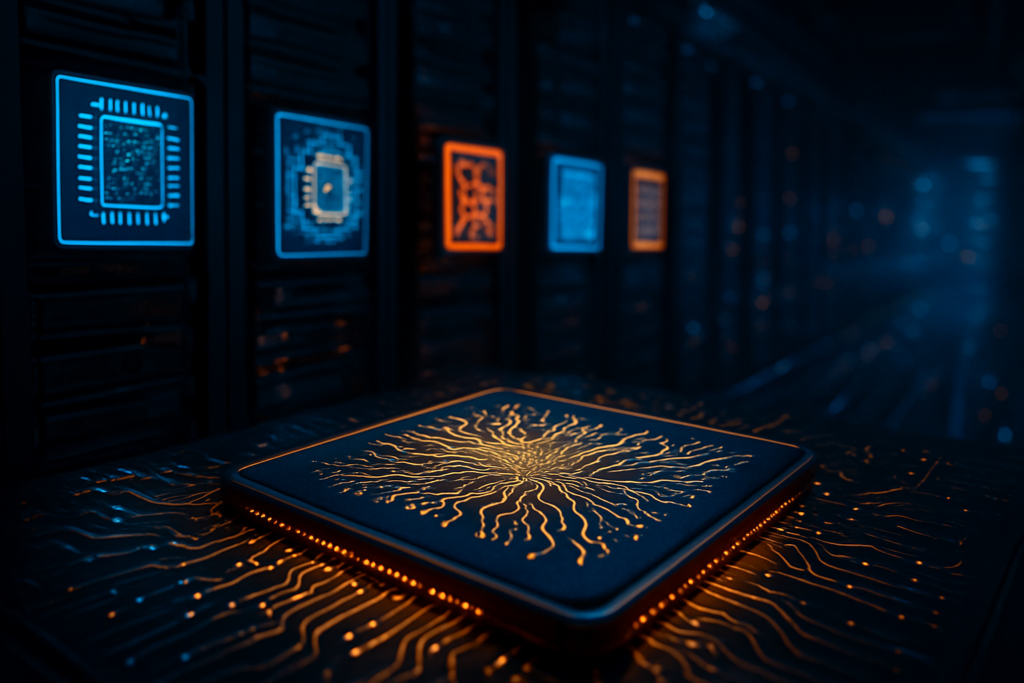
As of late 2025, the artificial intelligence industry has reached a pivotal inflection point: the era of "Silicon Sovereignty." For years, the world’s largest cloud providers were beholden to a single gatekeeper for the compute power necessary to fuel the generative AI revolution. Today, that dynamic has fundamentally shifted. Microsoft, Amazon, and Google have successfully transitioned from being NVIDIA's largest customers to becoming its most formidable architectural competitors, deploying a new generation of custom-designed Application-Specific Integrated Circuits (ASICs) that are now handling a massive portion of the world's AI workloads.
This strategic pivot is not merely about cost-cutting; it is about vertical integration. By designing chips like the Maia 200, Trainium 3, and TPU v7 (Ironwood) specifically for their own proprietary models—such as GPT-4, Claude, and Gemini—these hyperscalers are achieving performance-per-watt efficiencies that general-purpose hardware cannot match. This "great decoupling" has seen internal silicon capture a projected 15-20% of the total AI accelerator market share this year, signaling a permanent end to the era of hardware monoculture in the data center.
The Technical Vanguard: Maia, Trainium, and Ironwood
The technical landscape of late 2025 is defined by a fierce arms race in 3nm and 5nm process technologies. Alphabet Inc. (NASDAQ: GOOGL) has maintained its lead in silicon longevity with the general availability of TPU v7, codenamed Ironwood. Released in November 2025, Ironwood is Google’s first TPU explicitly architected for massive-scale inference. It boasts a staggering 4.6 PFLOPS of FP8 compute per chip, nearly reaching parity with the peak performance of the high-end Blackwell chips from NVIDIA (NASDAQ: NVDA). With 192GB of HBM3e memory and a bandwidth of 7.2 TB/s, Ironwood is designed to run the largest iterations of Gemini with a 40% reduction in latency compared to the previous Trillium (v6) generation.
Amazon (NASDAQ: AMZN) has similarly accelerated its roadmap, unveiling Trainium 3 at the recent re:Invent 2025 conference. Built on a cutting-edge 3nm process, Trainium 3 delivers a 2x performance leap over its predecessor. The chip is the cornerstone of AWS’s "Project Rainier," a massive cluster of over one million Trainium chips designed in collaboration with Anthropic. This cluster allows for the training of "frontier" models with a price-performance advantage that AWS claims is 50% better than comparable NVIDIA-based instances. Meanwhile, Microsoft (NASDAQ: MSFT) has solidified its first-generation Maia 100 deployment, which now powers the bulk of Azure OpenAI Service's inference traffic. While the successor Maia 200 (codenamed Braga) has faced some engineering delays and is now slated for a 2026 volume rollout, the Maia 100 remains a critical component in Microsoft’s strategy to lower the "Copilot tax" by optimizing the hardware specifically for the Transformer architectures used by OpenAI.
Breaking the NVIDIA Tax: Strategic Implications for the Giants
The move toward custom silicon is a direct assault on the multi-billion dollar "NVIDIA tax" that has squeezed the margins of cloud providers since 2023. By moving 15-20% of their internal workloads to their own ASICs, hyperscalers are reclaiming billions in capital expenditure that would have otherwise flowed to NVIDIA's bottom line. This shift allows tech giants to offer AI services at lower price points, creating a competitive moat against smaller cloud providers who remain entirely dependent on third-party hardware. For companies like Microsoft and Amazon, the goal is not to replace NVIDIA entirely—especially for the most demanding "frontier" training tasks—but to provide a high-performance, lower-cost alternative for the high-volume inference market.
This strategic positioning also fundamentally changes the relationship between cloud providers and AI labs. Anthropic’s deep integration with Amazon’s Trainium and OpenAI’s collaboration on Microsoft’s Maia designs suggest that the future of AI development is "co-designed." In this model, the software (the LLM) and the hardware (the ASIC) are developed in tandem. This vertical integration provides a massive advantage: when a model’s specific attention mechanism or memory requirements are baked into the silicon, the resulting efficiency gains can disrupt the competitive standing of labs that rely on generic hardware.
The Broader AI Landscape: Efficiency, Energy, and Economics
Beyond the corporate balance sheets, the rise of custom silicon addresses the most pressing bottleneck in the AI era: energy consumption. General-purpose GPUs are designed to be versatile, which inherently leads to wasted energy when performing specific AI tasks. In contrast, the current generation of ASICs, like Google’s Ironwood, are stripped of unnecessary features, focusing entirely on tensor operations and high-bandwidth memory access. This has led to a 30-50% improvement in energy efficiency across hyperscale data centers, a critical factor as power grids struggle to keep up with AI demand.
This trend mirrors the historical evolution of other computing sectors, such as the transition from general CPUs to specialized mobile processors in the smartphone era. However, the scale of the AI transition is unprecedented. The shift to 15-20% market share for internal silicon represents a seismic move in the semiconductor industry, challenging the dominance of the x86 and general GPU architectures that have defined the last two decades. While concerns remain regarding the "walled garden" effect—where models optimized for one cloud's silicon cannot easily be moved to another—the economic reality of lower Total Cost of Ownership (TCO) is currently outweighing these portability concerns.
The Road to 2nm: What Lies Ahead
Looking toward 2026 and 2027, the focus will shift from 3nm to 2nm process technologies and the implementation of advanced "chiplet" designs. Industry experts predict that the next generation of custom silicon will move toward even more modular architectures, allowing hyperscalers to swap out memory or compute components based on whether they are targeting training or inference. We also expect to see the "democratization" of ASIC design tools, potentially allowing Tier-2 cloud providers or even large enterprises to begin designing their own niche accelerators using the foundry services of Taiwan Semiconductor Manufacturing Company (NYSE: TSM).
The primary challenge moving forward will be the software stack. NVIDIA’s CUDA remains a formidable barrier to entry, but the maturation of open-source compilers like Triton and the development of robust software layers for Trainium and TPU are rapidly closing the gap. As these software ecosystems become more developer-friendly, the friction of moving away from NVIDIA hardware will continue to decrease, further accelerating the adoption of custom silicon.
Summary: A New Era of Compute
The developments of 2025 have confirmed that the future of AI is custom. Microsoft’s Maia, Amazon’s Trainium, and Google’s Ironwood are no longer "science projects"; they are the industrial backbone of the modern economy. By capturing a significant slice of the AI accelerator market, the hyperscalers have successfully mitigated their reliance on a single hardware vendor and paved the way for a more sustainable, efficient, and cost-competitive AI ecosystem.
In the coming months, the industry will be watching for the first results of "Project Rainier" and the initial benchmarks of Microsoft’s Maia 200 prototypes. As the market share for internal silicon continues its upward trajectory toward the 25% mark, the central question is no longer whether custom silicon can compete with NVIDIA, but how NVIDIA will evolve its business model to survive in a world where its biggest customers are also its most capable rivals.
This content is intended for informational purposes only and represents analysis of current AI developments.
TokenRing AI delivers enterprise-grade solutions for multi-agent AI workflow orchestration, AI-powered development tools, and seamless remote collaboration platforms.
For more information, visit https://www.tokenring.ai/.