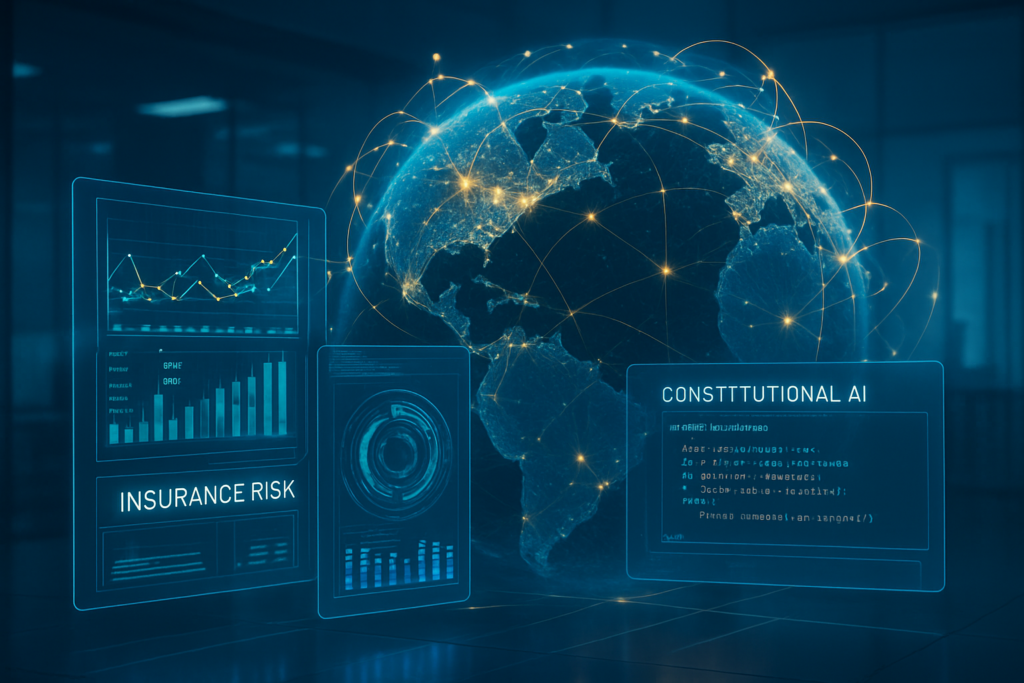
The significance of this deal cannot be overstated; it represents a major shift in how highly regulated industries approach generative AI. By prioritizing "Constitutional AI" and auditable decision-making, Allianz is betting that a safety-first approach will not only satisfy global regulators but also provide a competitive edge in efficiency and customer trust. As the insurance industry faces mounting pressure to modernize legacy systems, this partnership serves as a blueprint for the "agentic" future of enterprise automation.
Technical Integration and the Rise of Agentic Insurance
The technical core of the partnership centers on the full integration of Anthropic’s latest Claude model family into Allianz’s private cloud infrastructure. A standout feature of this deployment is the implementation of Anthropic’s Model Context Protocols (MCP). MCP allows Allianz to securely connect Claude to disparate internal data sources—ranging from decades-old policy archives to real-time claims databases—without exposing sensitive raw data to the model’s underlying training set. This "walled garden" approach addresses the data privacy concerns that have long hindered AI adoption in the financial sector.
Furthermore, Allianz is utilizing "Claude Code" to modernize its sprawling software architecture. Thousands of internal developers are reportedly using these specialized AI tools to refactor legacy codebases and accelerate the delivery of new digital products. The partnership also introduces "Agentic Automation," where custom-built AI agents handle complex, multi-step workflows. In motor insurance, for instance, these agents can now manage the end-to-end "intake-to-payment" cycle—analyzing damage photos, verifying policy coverage, and issuing "first payments" within minutes, a process that previously took days.
Initial reactions from the AI research community have been notably positive, particularly regarding the partnership’s focus on "traceability." Unlike "black box" AI systems, the co-developed framework logs every AI-generated decision, the specific rationale behind it, and the data sources used. Industry experts suggest that this level of transparency is a direct response to the requirements of the EU AI Act, setting a high bar for "explainable AI" that other tech giants will be forced to emulate.
Shifting the Competitive Landscape: Anthropic’s Enterprise Surge
This partnership marks a significant victory for Anthropic in the "Enterprise AI War." By early 2026, Anthropic has seen its enterprise market share climb to an estimated 40%, largely driven by its reputation for safety and reliability compared to rivals like OpenAI and Google (NASDAQ: GOOGL). For Allianz, the move puts immediate pressure on global competitors such as AXA and Zurich Insurance Group to accelerate their own AI roadmaps. The deal suggests that the "wait and see" period for AI in insurance is officially over; firms that fail to integrate sophisticated reasoning models risk falling behind in operational efficiency and risk assessment accuracy.
The competitive implications extend beyond the insurance sector. This deal highlights a growing trend where "blue-chip" companies in highly regulated sectors—including banking and healthcare—are gravitating toward AI labs that offer robust governance frameworks over raw processing power. While OpenAI remains a dominant force in the consumer space, Anthropic’s strategic focus on "Constitutional AI" is proving to be a powerful differentiator in the B2B market. This partnership may trigger a wave of similar deep-integration deals, potentially disrupting the traditional consulting and software-as-a-service (SaaS) models that have dominated the enterprise landscape for a decade.
Broader Significance: Setting the Standard for the EU AI Act
The Anthropic-Allianz alliance is more than just a corporate deal; it is a stress test for the broader AI landscape and its ability to coexist with stringent government regulations. As the EU AI Act enters full enforcement in 2026, the partnership’s emphasis on "Constitutional AI"—a set of rules that prioritize harmlessness and alignment with corporate values—serves as a primary case study for compliant AI. By embedding ethical guardrails directly into the model’s reasoning process, the two companies are attempting to solve the "alignment problem" at an industrial scale.
However, the deployment is not without its concerns. The announcement coincided with internal reports suggesting that Allianz may reduce its travel insurance workforce by 1,500 to 1,800 roles over the next 18 months as agentic automation takes hold. This highlights the double-edged sword of AI integration: while it promises unprecedented efficiency and faster service for customers, it also necessitates a massive shift in the labor market. Comparisons are already being drawn to previous industrial milestones, such as the introduction of automated underwriting in the late 20th century, though the speed and cognitive depth of this current shift are arguably unprecedented.
The Horizon: From Claims Processing to Predictive Risk
Looking ahead, the partnership is expected to evolve from reactive tasks like claims processing to proactive, predictive risk management. In the near term, we can expect the rollout of "empathetic" AI assistants for complex health insurance inquiries, where Claude’s advanced reasoning will be used to navigate sensitive medical data with a human-in-the-loop (HITL) protocol. This ensures that while AI handles the data, human experts remain the final decision-makers for terminal or highly sensitive cases.
Longer-term applications may include real-time risk adjustment based on IoT (Internet of Things) data and synthetic voice/image detection to combat the rising threat of deepfake-generated insurance fraud. Experts predict that by 2027, the "Allianz Model" of AI integration will be the industry standard, forcing a total reimagining of the actuarial profession. The challenge will remain in balancing this rapid technological advancement with the need for human empathy and the mitigation of algorithmic bias in policy pricing.
A New Benchmark for the AI Era
The partnership between Anthropic and Allianz represents a watershed moment in the history of artificial intelligence. It marks the transition of large language models from novelty chatbots to mission-critical infrastructure for the global economy. By prioritizing responsibility and transparency, the two companies are attempting to build a foundation of trust that is essential for the long-term viability of AI in society.
The key takeaway for the coming months will be how successfully Allianz can scale these "agentic" workflows without compromising on its safety promises. As other Fortune 500 companies watch closely, the success or failure of this deployment will likely dictate the pace of AI adoption across the entire financial services sector. For now, the message is clear: the future of insurance is intelligent, automated, and—most importantly—governed by a digital constitution.
This content is intended for informational purposes only and represents analysis of current AI developments.
TokenRing AI delivers enterprise-grade solutions for multi-agent AI workflow orchestration, AI-powered development tools, and seamless remote collaboration platforms.
For more information, visit https://www.tokenring.ai/.