Google, a subsidiary of Alphabet Inc. (NASDAQ: GOOGL), has officially moved the goalposts in the generative AI arms race with the wide release of Veo 3.1. Launched as a major update on January 13, 2026, the model marks a shift from experimental text-to-video generation to a production-ready creative suite. By introducing a "co-director" philosophy, Veo 3.1 aims to solve the industry’s most persistent headache: maintaining visual consistency across multiple shots while delivering the high-fidelity resolution required for professional filmmaking.
The announcement comes at a pivotal moment as the AI video landscape matures. While early models focused on the novelty of "prompting" a scene into existence, Veo 3.1 prioritizes precision. With features like "Ingredients to Video" and native 4K upscaling, Google is positioning itself not just as a tool for viral social media clips, but as a foundational infrastructure for the multi-billion dollar advertising and entertainment industries.
Technical Mastery: From Diffusion to Direction
At its core, Veo 3.1 is built on a sophisticated 3D Latent Diffusion Transformer architecture. Unlike previous iterations that processed video as a series of independent frames, this model processes space, time, and audio joints simultaneously. This unified approach allows for the native generation of synchronized dialogue, sound effects, and ambient noise with roughly 10ms of latency between vision and sound. The result is a seamless audio-visual experience where characters' lip-syncing and movement-based sounds—like footsteps or the rustle of clothes—feel physically grounded.
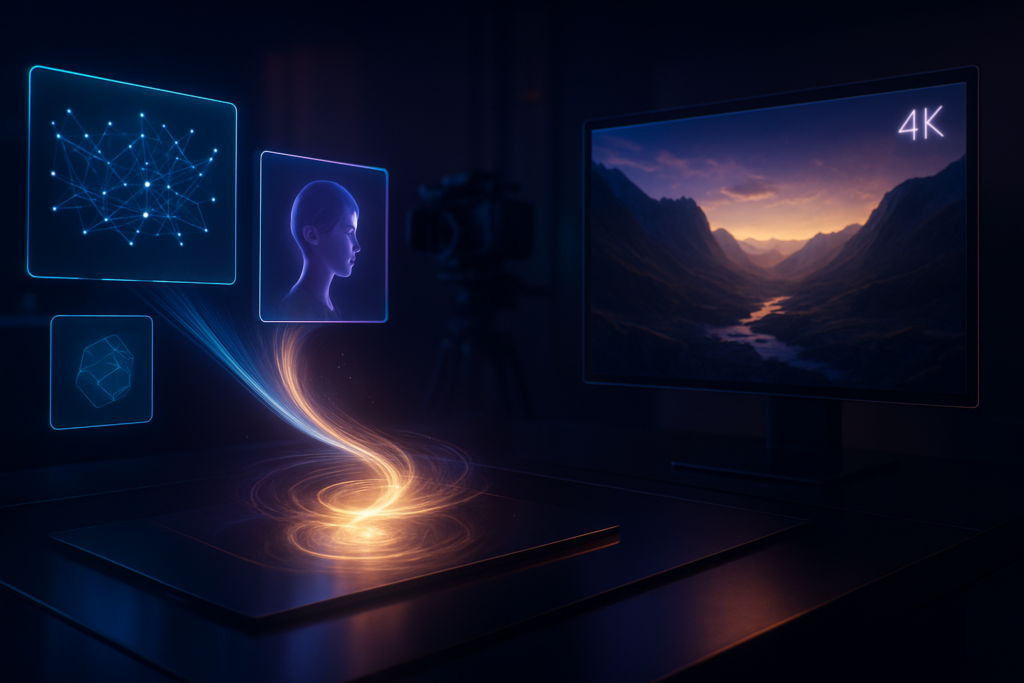
The headline feature of Veo 3.1 is "Ingredients to Video," a tool that allows creators to upload up to three reference images—be they specific characters, complex objects, or abstract style guides. The model uses these "ingredients" to anchor the generation process, ensuring that a character’s face, clothing, and the environment remain identical across different scenes. This solves the "identity drift" problem that has long plagued AI video, where a character might look like a different person from one shot to the next. Additionally, a new "Frames to Video" interpolation tool allows users to provide a starting and ending image, with the AI generating a cinematic transition that adheres to the lighting and physics of both frames.
Technical specifications reveal a massive leap in accessibility and quality. Veo 3.1 supports native 1080p HD, with an enterprise-tier 4K upscaling option available via Google Flow and Vertex AI. It also addresses the rise of short-form content by offering native 9:16 vertical output, eliminating the quality degradation usually associated with cropping landscape footage. Initial reactions from the AI research community have been overwhelmingly positive, with experts noting that while OpenAI’s Sora 2 might hold a slight edge in raw physics simulation (such as water dynamics), Veo 3.1 is the superior "utilitarian" tool for filmmakers who need control and resolution over sheer randomness.
The Battle for the Studio: Competitive Implications
The release of Veo 3.1 creates a significant challenge for rivals like Microsoft (NASDAQ: MSFT)-backed OpenAI and startups like Runway and Kling AI. By integrating Veo 3.1 directly into the Gemini app, YouTube Shorts, and the Google Vids productivity suite, Alphabet Inc. (NASDAQ: GOOGL) is leveraging its massive distribution network to reach millions of creators instantly. This ecosystem advantage makes it difficult for standalone video startups to compete, as Google can offer a unified workflow—from scriptwriting in Gemini to video generation in Veo and distribution on YouTube.
In the enterprise sector, Google’s strategic partnerships are already bearing fruit. Advertising giant WPP (NYSE: WPP) has reportedly begun integrating Veo 3.1 into its production workflows, aiming to slash the time and cost of creating hyper-localized global ad campaigns. Similarly, the storytelling platform Pocket FM noted a significant increase in user engagement by using the model to create promotional trailers with realistic lip-sync. For major AI labs, the pressure is now on to match Google’s "Ingredients" approach, as creators increasingly demand tools that function like digital puppets rather than unpredictable slot machines.
Market positioning for Veo 3.1 is clear: it is the "Pro" option. While Meta Platforms (NASDAQ: META) continues to refine its Movie Gen for social media users, Google is targeting the middle-to-high end of the creative market. By focusing on 4K output and character consistency, Google is making a play for the pre-visualization and B-roll markets, potentially disrupting traditional stock footage companies and visual effects (VFX) houses that handle repetitive, high-volume content.
A New Era for Digital Storytelling and Its Ethical Shadow
The significance of Veo 3.1 extends far beyond technical benchmarks; it represents the "professionalization" of synthetic media. We are moving away from the era of "AI-generated video" as a genre itself and into an era where AI is a transparent part of the production pipeline. This transition mirrors the shift from traditional cell animation to CGI in the late 20th century. By lowering the barrier to entry for cinematic-quality visuals, Google is democratizing high-end storytelling, allowing small independent creators to produce visuals that were once the exclusive domain of major studios.
However, this breakthrough brings intensified concerns regarding digital authenticity. To combat the potential for deepfakes and misinformation, Google has integrated its SynthID watermarking technology directly into the Veo 3.1 metadata. This invisible digital watermark persists even after video editing or compression, a critical safety feature as the world approaches the 2026 election cycles in several major democracies. Critics, however, argue that watermarking is only a partial solution and that the "uncanny valley"—while narrower than ever—still poses risks for psychological manipulation when combined with the model's high-fidelity audio capabilities.
Comparing Veo 3.1 to previous milestones, it is being hailed as the "GPT-4 moment" for video. Just as large language models shifted from generating coherent sentences to solving complex reasoning tasks, Veo 3.1 has shifted from generating "dreamlike" sequences to generating logically consistent, high-resolution cinema. It marks the end of the "primitive" phase of generative video and the beginning of the "utility" phase.
The Horizon: Real-Time Generation and Beyond
Looking ahead, the next frontier for the Veo lineage is real-time interaction. Experts predict that by 2027, iterations of this technology will allow for "live-prompting," where a user can change the lighting or camera angle of a scene in real-time as the video plays. This has massive implications for the gaming industry and virtual reality. Imagine a game where the environment isn't pre-rendered but is generated on-the-fly based on the player's unique story choices, powered by hardware from the likes of NVIDIA (NASDAQ: NVDA).
The immediate challenge for Google and its peers remains "perfect physics." While Veo 3.1 excels at texture and style, complex multi-object collisions—such as a glass shattering or a person walking through a crowd—still occasionally produce visual artifacts. Solving these high-complexity physical interactions will likely be the focus of the rumored "Veo 4" project. Furthermore, as the model moves into more hands, the demand for longer-form native generation (beyond the current 60-second limit) will necessitate even more efficient compute strategies and memory-augmented architectures.
Wrapping Up: The New Standard for Synthetic Cinema
Google Veo 3.1 is more than just a software update; it is a declaration of intent. By prioritizing consistency, resolution, and audio-visual unity, Google has provided a blueprint for how AI will integrate into the professional creative world. The model successfully bridges the gap between the creative vision in a director's head and the final pixels on the screen, reducing the "friction" of production to an unprecedented degree.
As we move into the early months of 2026, the tech industry will be watching closely to see how OpenAI responds and how YouTube's creator base adopts these tools. The long-term impact of Veo 3.1 may very well be a surge in high-quality independent cinema and a complete restructuring of the advertising industry. For now, the "Ingredients to Video" feature stands as a benchmark of what happens when AI moves from being a toy to being a tool.
This content is intended for informational purposes only and represents analysis of current AI developments.
TokenRing AI delivers enterprise-grade solutions for multi-agent AI workflow orchestration, AI-powered development tools, and seamless remote collaboration platforms.
For more information, visit https://www.tokenring.ai/.