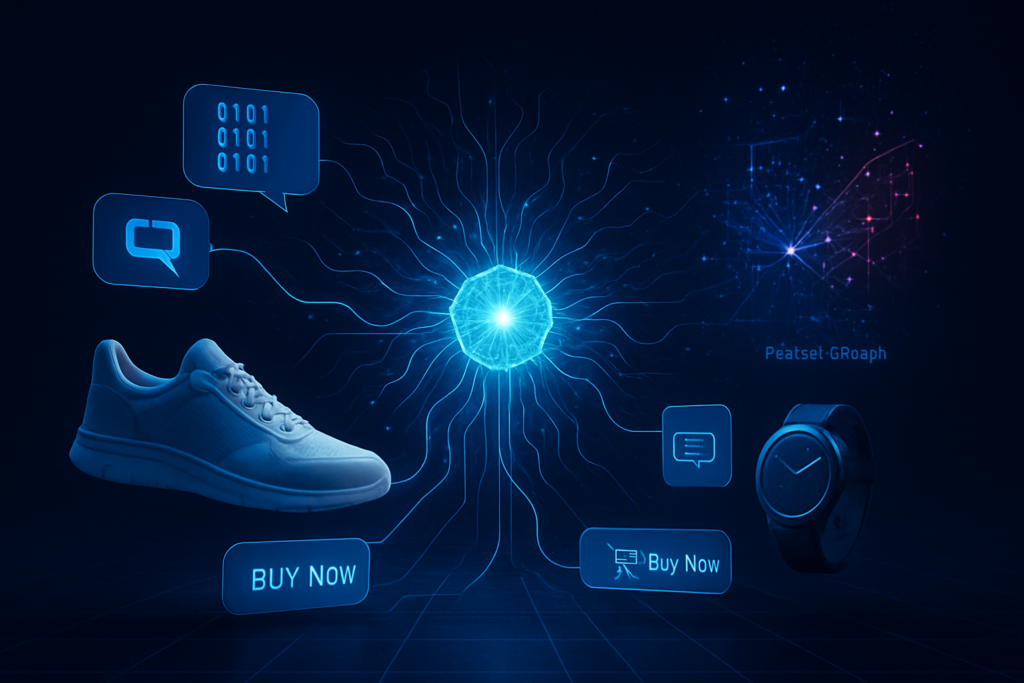
In a move that signals the end of the web browser’s monopoly on digital retail, Shopify Inc. (NYSE: SHOP) has officially launched its Winter ’26 ‘Renaissance’ Edition. The centerpiece of this semi-annual release is a radical new infrastructure known as "Agentic Storefronts," which allows products to be discovered, negotiated, and purchased entirely within AI-native environments. By decoupling the checkout process from traditional websites and embedding it directly into platforms like ChatGPT and Perplexity, Shopify is positioning itself as the underlying "commerce operating system" for a world where AI agents, not humans, do the window shopping.
The "Renaissance" branding is no accident; Shopify is pitching this as a rebirth of commerce for the post-SaaS era. As of late January 2026, the company has successfully transitioned from a platform that hosts websites to a decentralized product graph. This allows merchants to meet consumers wherever a conversation is happening—be it a voice-activated smart assistant, a research-heavy session on Perplexity, or a creative brainstorming thread in OpenAI’s latest models. The immediate significance is clear: the "destination URL" is no longer the primary goal of digital marketing; instead, "presence" within the latent space of Large Language Models (LLMs) has become the new retail frontier.
Breaking the Browser: The Technical Architecture of Agentic Commerce
The technical backbone of the Winter ’26 Edition is the Universal Commerce Protocol (UCP), an open-source standard co-developed by Shopify and Google (NASDAQ: GOOGL). UCP replaces traditional web-scraping methods with a standardized language that allows AI agents to interact directly with a merchant’s backend. This allows an AI to perform complex tasks that were previously impossible without a visual interface, such as checking real-time inventory, applying dynamic loyalty discounts, and validating shipping constraints in sub-100ms response times. This shifts the merchant’s priority from Search Engine Optimization (SEO) to Generative Engine Optimization (GEO), where the goal is to provide high-fidelity, machine-readable data that an AI agent can trust and recommend.
Alongside UCP, Shopify has introduced Storefront Model Context Protocol (MCP) servers. This implementation allows developers to connect any LLM—whether it’s a massive model from Anthropic or a nimble, local Llama variant—directly to a store’s live commerce data. This is supported by SimGym, a high-fidelity simulation environment where merchants can stress-test their "agentic logic." In SimGym, brands can run millions of simulated interactions with autonomous shoppers to see how their pricing strategies and discount codes perform when negotiated by AI agents before these features ever touch a real customer.
The move marks a departure from the "headless" commerce trends of the early 2020s. While headless commerce focused on decoupling the frontend from the backend, Agentic Storefronts effectively remove the human-facing frontend entirely for a segment of the buyer journey. Industry experts have lauded this as a breakthrough in reducing friction, noting that it solves the "last mile" problem of AI discovery—the transition from talking about a product to actually owning it.
The Battle for the 'Product Graph': Strategic Implications for Big Tech
This development reshapes the competitive landscape for tech giants and AI startups alike. By partnering with OpenAI and Perplexity, Shopify has secured a "Day 1" advantage for its merchants. In ChatGPT, a new "Instant Checkout" feature allows users to buy products directly within the chat interface, with Shopify acting as the silent merchant of record. Similarly, Perplexity’s "Buy with Pro" integration uses Shopify’s specialized LLMs to enrich product data, ensuring that conversational search results are not only accurate but also actionable.
This puts significant pressure on Amazon.com, Inc. (NASDAQ: AMZN), which has traditionally relied on being the starting point for product searches. As more consumers turn to general-purpose AI assistants for discovery, Amazon’s "walled garden" approach faces a structural threat. If Shopify can successfully aggregate enough merchant data into a "Master Product Graph of the Internet," it effectively turns every AI interface into a Shopify-powered storefront, bypassing the need for a central marketplace. Meanwhile, Microsoft Corp. (NASDAQ: MSFT) has also joined the fray, integrating Shopify’s Agentic Storefronts into Copilot, allowing enterprise users to handle procurement and office supply restocks via simple natural language commands.
For startups, the "Agentic Plan" is a potential game-changer. Shopify is now offering its AI distribution network to brands on competing platforms like Magento or BigCommerce (NASDAQ: BIGC). This "Trojan Horse" strategy allows Shopify to capture transaction volume even from merchants who don’t use their core website builder, further solidifying their grip on the global commerce infrastructure.
A New AI Milestone: From Information to Transaction
The Winter ’26 Edition represents a wider shift in the AI landscape: the transition from "Information AI" to "Action AI." For years, AI was limited to summarizing text or generating images; now, it is capable of executing financial transactions and managing logistics. This follows the broader industry trend of "Distributed Presence," where a brand’s value is no longer tied to its physical or digital real estate, but to its ability to be correctly represented in the "mind" of an AI.
However, this transition is not without its concerns. Marketing agencies have already begun to point out the "post-purchase gap." While Agentic Storefronts are excellent for discovery and the initial sale, the customer service journey—returns, tracking, and nuanced troubleshooting—still often requires a hand-off to human-centric web portals or support agents. There is also the "hallucination risk"; if an AI agent misrepresents a product's capabilities or promises a discount that the UCP doesn't recognize, the merchant faces a potential branding and legal nightmare.
Comparatively, this milestone is being likened to the launch of the original iPhone App Store. Just as that event forced every business to have a mobile strategy, the Winter ’26 Edition is forcing every retailer to have an "agentic strategy." The focus is shifting from "how does my website look?" to "how does my brand behave when interrogated by an AI?"
The Horizon: Fully Autonomous Shopping Agents
Looking ahead, the next phase of this evolution will likely involve "Fully Autonomous Agents"—software entities that have their own budgets and the authority to make purchases without human intervention. Imagine a home maintenance agent that realizes a dishwasher part is failing and autonomously shops for the best price, checks compatibility via the UCP, and handles the checkout through a Shopify Agentic Storefront, all while the homeowner is at work.
Near-term developments will likely focus on closing the post-purchase loop, bringing returns and tracking into the same AI conversation. Developers are already using Shopify’s "Hydrogen" framework to build custom, brand-specific agents that act as personal shoppers with a deep understanding of a customer’s specific tastes and past purchase history. The challenge remains in standardization; while UCP is a strong start, universal adoption across all AI labs will be necessary to prevent a fragmented experience where some products are "AI-buyable" and others are not.
Final Reflections: The Renaissance of Retail
Shopify’s Winter ’26 'Renaissance' Edition is more than a software update; it is a declaration that the era of the static storefront is over. By providing the tools for Agentic Storefronts, Shopify (NYSE: SHOP) has successfully pivoted from being a tool for building websites to being the essential protocol for the future of trade. The integration with ChatGPT and Perplexity proves that the most valuable real estate in 2026 is no longer a URL, but the conversational interface.
The key takeaway for the industry is that the barrier between "finding" and "buying" has been permanently lowered. In the coming months, watch for a surge in "AI-first" brands—companies that launch without a traditional website, opting instead to exist solely as a data feed within the agentic ecosystem. As we move further into 2026, the success of this development will be measured not by web traffic, but by how seamlessly AI agents can navigate the complexities of human commerce.
This content is intended for informational purposes only and represents analysis of current AI developments.
TokenRing AI delivers enterprise-grade solutions for multi-agent AI workflow orchestration, AI-powered development tools, and seamless remote collaboration platforms.
For more information, visit https://www.tokenring.ai/.