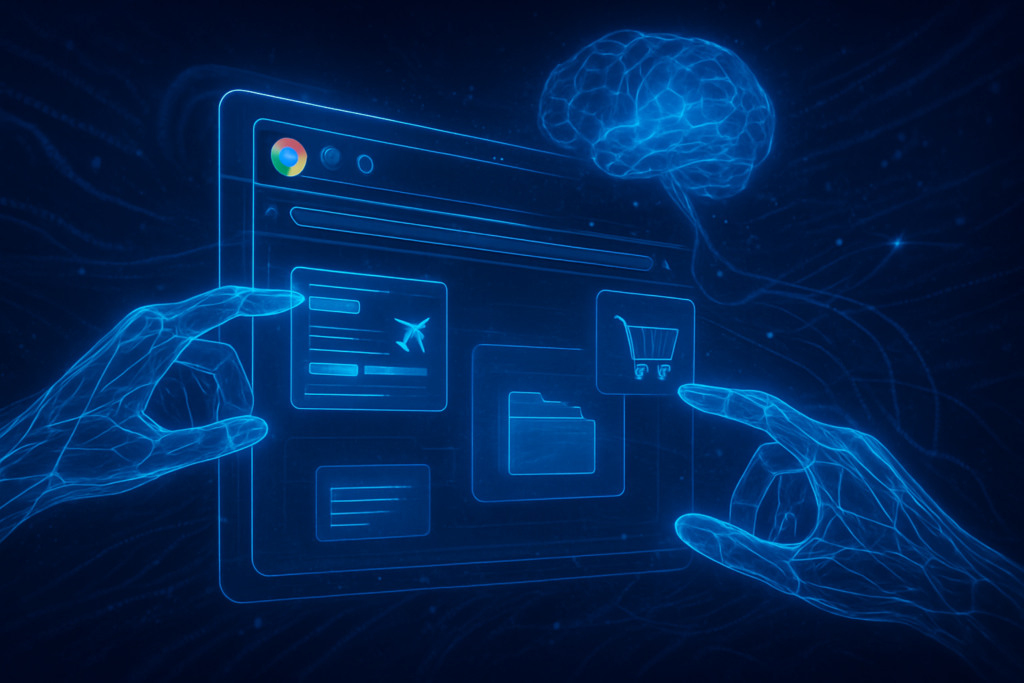
In a move that signals the end of the "Chatbot Era" and the definitive arrival of "Agentic AI," Alphabet Inc. (NASDAQ: GOOGL) has officially moved its highly anticipated 'Project Jarvis' into a full-scale rollout within the Chrome browser. No longer just a window to the internet, Chrome has been transformed into an autonomous entity—a proactive digital butler capable of navigating the web, purchasing products, booking complex travel itineraries, and even organizing a user's local and cloud-based file systems without step-by-step human intervention.
This shift represents a fundamental pivot in human-computer interaction. While the last three years were defined by AI that could talk about tasks, Google’s latest advancement is defined by an AI that can execute them. By integrating the multimodal power of the Gemini 3 engine directly into the browser's source code, Google is betting that the future of the internet isn't just a series of visited pages, but a series of accomplished goals, potentially rendering the concept of manual navigation obsolete for millions of users.
The Vision-Action Loop: How Jarvis Operates
Technically known within Google as Project Mariner, Jarvis functions through what researchers call a "vision-action loop." Unlike previous automation tools that relied on brittle API integrations or fragile "screen scraping" techniques, Jarvis utilizes the native multimodal capabilities of Gemini to "see" the browser in real-time. It takes high-frequency screenshots of the active window—processing these images at sub-second intervals—to identify UI elements like buttons, text fields, and dropdown menus. It then maps these visual cues to a set of logical actions, simulating mouse clicks and keyboard inputs with a level of precision that mimics human behavior.
This "vision-first" approach allows Jarvis to interact with virtually any website, regardless of whether that site has been optimized for AI. In practice, a user can provide a high-level prompt such as, "Find me a direct flight to Zurich under $1,200 for the first week of June and book the window seat," and Jarvis will proceed to open tabs, compare airlines, navigate checkout screens, and pause only when biometric verification is required for payment. This differs significantly from "macros" or "scripts" of the past; Jarvis possesses the reasoning capability to handle unexpected pop-ups, captcha challenges, and price fluctuations in real-time.
The initial reaction from the AI research community has been a mix of awe and caution. Dr. Aris Xanthos, a senior researcher at the Open AI Ethics Institute, noted that "Google has successfully bridged the gap between intent and action." However, critics have pointed out the inherent latency of the vision-action model—which still experiences a 2-3 second "reasoning delay" between clicks—and the massive compute requirements of running a multimodal vision model continuously during a browsing session.
The Battle for the Desktop: Google vs. Anthropic vs. OpenAI
The emergence of Project Jarvis has ignited a fierce "Agent War" among tech giants. While Google’s strategy focuses on the browser as the primary workspace, Anthropic—backed heavily by Amazon (NASDAQ: AMZN)—has taken a broader, system-wide approach with its "Computer Use" capability. Launched as part of the Claude 4.5 Opus ecosystem, Anthropic’s solution is not confined to Chrome; it can control an entire desktop, moving between Excel, Photoshop, and Slack. This positions Anthropic as the preferred choice for developers and power users who need cross-application automation, whereas Google targets the massive consumer market of 3 billion Chrome users.
Microsoft (NASDAQ: MSFT) has also entered the fray, integrating similar "Operator" capabilities into Windows 11 and its Edge browser, leveraging its partnership with OpenAI. The competitive landscape is now divided: Google owns the web agent, Microsoft owns the OS agent, and Anthropic owns the "universal" agent. For startups, this development is disruptive; many third-party travel booking and personal assistant apps now find their core value proposition subsumed by the browser itself. Market analysts suggest that Google’s strategic advantage lies in its vertical integration; because Google owns the browser, the OS (Android), and the underlying AI model, it can offer a more seamless, lower-latency experience than competitors who must operate as an "overlay" on other systems.
The Risks of Autonomy: Privacy and 'Hallucination in Action'
As AI moves from generating text to spending money and moving files, the stakes of "hallucination" have shifted from embarrassing to expensive. The industry is now grappling with "Hallucination in Action," where an agent correctly perceives a UI but executes an incorrect command—such as booking a non-refundable flight on the wrong date. To mitigate this, Google has implemented mandatory "Verification Loops" for all financial transactions, requiring a thumbprint or FaceID check before an AI can finalize a purchase.
Furthermore, the privacy implications of a system that "watches" your screen 24/7 are staggering. Project Jarvis requires constant screenshots to function, raising alarms among privacy advocates who compare it to a more invasive version of Microsoft’s controversial "Recall" feature. While Google insists that all vision processing is handled via "Privacy-Preserving Compute" and that screenshots are deleted immediately after a task is completed, the potential for "Screen-based Prompt Injection"—where a malicious website hides invisible text that "tricks" the AI into stealing data—remains a significant cybersecurity frontier.
This has prompted a swift response from regulators. In early 2026, the European Commission issued new guidelines under the EU AI Act, classifying autonomous "vision-action" agents as High-Risk systems. These regulations mandate "Kill Switches" and tamper-proof audit logs for every action an agent takes, ensuring that if an AI goes rogue, there is a clear digital trail of its "reasoning."
The Near Future: From Browsers to 'Ambient Agents'
Looking ahead, the next 12 to 18 months will likely see Jarvis move beyond the desktop and into the "Ambient Computing" space. Experts predict that Jarvis will soon be the primary interface for Android devices, allowing users to control their phones entirely through voice-to-action commands. Instead of opening five different apps to coordinate a dinner date, a user might simply say, "Jarvis, find a table for four at an Italian spot near the theater and send the calendar invite to the group," and the AI will handle the rest across OpenTable, Google Maps, and Gmail.
The challenge remains in refining the "Model Context Protocol" (MCP)—a standard pioneered by Anthropic that Google is now reportedly exploring to allow Jarvis to talk to local software. If Google can successfully bridge the gap between web-based actions and local system commands, the traditional "Desktop" interface of icons and folders may soon give way to a single, conversational command line.
Conclusion: A New Chapter in AI History
The rollout of Project Jarvis marks a definitive milestone: the moment the internet became an "executable" environment rather than a "readable" one. By transforming Chrome into an autonomous agent, Google is not just updating a browser; it is redefining the role of the computer in daily life. The shift from "searching" for information to "delegating" tasks represents the most significant change to the consumer internet since the introduction of the search engine itself.
In the coming weeks, the industry will be watching closely to see how Jarvis handles the complexities of the "Wild West" web—dealing with broken links, varying UI designs, and the inevitable attempts by bad actors to exploit its vision-action loop. For now, one thing is certain: the era of clicking, scrolling, and manual form-filling is beginning its long, slow sunset.
This content is intended for informational purposes only and represents analysis of current AI developments.
TokenRing AI delivers enterprise-grade solutions for multi-agent AI workflow orchestration, AI-powered development tools, and seamless remote collaboration platforms.
For more information, visit https://www.tokenring.ai/.