On the first anniversary of the second Trump administration, the White House Council of Economic Advisers (CEA) has released a landmark report titled "Artificial Intelligence and the Great Divergence." The document, published today, January 21, 2026, frames the current era of artificial intelligence as a pivotal historical moment—a "Second Great Divergence"—that mirrors the 19th-century Industrial Revolution. The report argues that just as steam power and coal enabled a handful of nations to achieve multi-generational economic dominance two centuries ago, the rapid deployment of massive compute and energy infrastructure will now determine the next century’s global power structure.
This release marks a definitive shift in U.S. policy, moving away from the safety-centric frameworks of the previous decade toward an unapologetic pursuit of technological hegemony. By prioritizing domestic infrastructure, drastic deregulation, and the "Stargate" mega-project, the administration aims to ensure that the economic gap between AI "leaders" and "laggards" leaves the United States firmly at the head of the global order. The immediate significance lies in the administration's declaration that AI is a zero-sum race for national security, where speed and scale are the only metrics that matter.
Scaling at the Speed of Light: The Stargate Blueprint
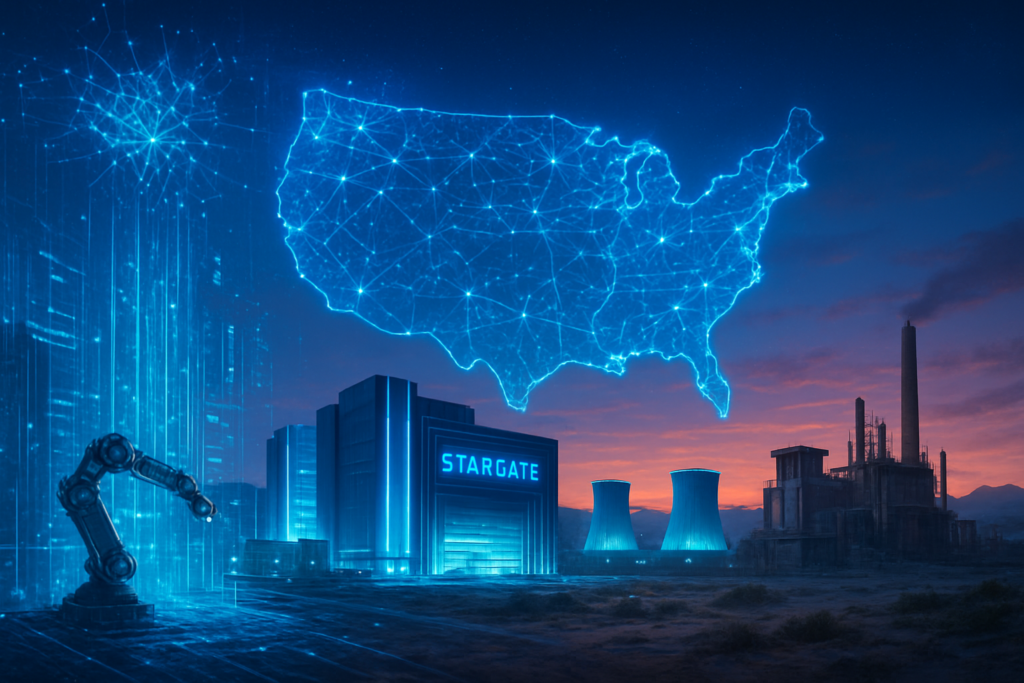
The report provides the most detailed technical roadmap to date for the "Stargate" project, a $500 billion joint venture between OpenAI, Oracle Corporation (NYSE: ORCL), and SoftBank Group Corp. (OTC: SFTBY). Stargate is not merely a single facility but a planned network of 20 advanced AI data centers across the continental United States. The flagship site in Abilene, Texas, has already broken ground and is designed to consume 1.2 gigawatts of power—enough to support the training of next-generation artificial general intelligence (AGI) models that require compute power far beyond current commercial limits.
Technically, the administration’s plan diverges from previous approaches by treating data centers as critical national security infrastructure. Under Executive Order 14156, the President has utilized emergency energy declarations to bypass traditional environmental reviews and permitting delays. This allows for the rapid construction of dedicated nuclear and natural gas power plants to fuel these "compute hubs." While previous administrations focused on the algorithmic "black box" and safety alignment, the current White House is focused on the physical "stack"—land, power, and silicon—to maintain an insurmountable lead over international rivals.
Initial reactions from the AI research community have been sharply divided. Prominent figures in the "accelerationist" camp have praised the move, noting that removing the "red tape" of the Biden-era AI Executive Order 14110 allows American firms to innovate without the fear of preemptive litigation or "woke" bias constraints. However, safety advocates warn that the complete removal of guardrails in the pursuit of raw capability could lead to unpredictable catastrophic risks as models reach AGI-level complexity.
Market Winners and the End of Regulatory Parity
The "Great Divergence" report explicitly identifies the companies that stand to benefit from this new era of deregulation. By establishing a "minimally burdensome national policy framework," the administration is effectively preempting state-level regulations, such as those attempted in California. This is a massive strategic advantage for "Big Tech" giants and infrastructure providers like NVIDIA Corporation (NASDAQ: NVDA), which provides the essential H200 and Blackwell-class GPUs, and Microsoft Corporation (NASDAQ: MSFT), which continues to integrate these advancements into its global cloud footprint.
Competitive implications are stark: the administration’s focus on "capability-first" development favors large-scale labs that can afford the multi-billion-dollar entry fee for the Stargate ecosystem. Startups that align with the administration’s "Anti-Woke" AI criteria are being courted with federal procurement promises, while those focused on safety and ethics-first frameworks may find themselves marginalized in the new "American AI Action Plan." This creates a "winner-take-all" market positioning where the primary competitive advantage is no longer just the algorithm, but the ability to tap into the government-backed energy and compute grid.
The disruption to existing products is already visible. As the "Divergence" widens, the report predicts that companies failing to integrate AGI-level tools will see their productivity stagnate, while AI-leaders will experience "breakneck" growth. This economic chasm is expected to consolidate the tech industry further, with the "Stargate" partners forming a new technological aristocracy that controls the fundamental utilities of the 21st-century economy.
A Global Chasm: AI as the New Geopolitical Fault Line
The wider significance of the White House report cannot be overstated. It represents a total rejection of the "global cooperation" model favored by international bodies. While the United Nations recently issued warnings about AI worsening global inequality, the Trump administration’s report leans into this disparity as a tool of statecraft. By deliberately creating a "Great Divergence," the U.S. intends to make its technology the "reserve currency" of the digital age, forcing other nations to choose between American infrastructure or falling into the "laggard" category.
This fits into a broader trend of technological nationalism. Unlike the early internet era, which was characterized by open standards and global connectivity, the AI era is being defined by "Sovereign AI" and closed, high-performance silos. The report makes frequent comparisons to the space race, but with a more aggressive economic component. The goal is "unquestioned and unchallenged" dominance, positioning the U.S. as the sole gatekeeper of AGI.
Potential concerns regarding this strategy include the risk of a "race to the bottom" in AI safety and the potential for increased domestic inequality. As AI leaders pull away from laggards, the workforce displacement in traditional sectors may accelerate. However, the CEA argues that the risk of losing the race to China is the only existential threat that truly matters, viewing any domestic or global "divergence" as a necessary side effect of maintaining the American way of life.
The Horizon: Nuclear SMRs and the Road to 10 Gigawatts
Looking ahead, the administration is expected to pivot toward even more radical energy solutions to sustain the AI boom. Expected near-term developments include the mass deployment of Small Modular Reactors (SMRs) directly adjacent to data center sites. Experts predict that by 2028, the "Stargate" network will attempt to reach a total capacity of 10 gigawatts, a scale of energy consumption that would have been unthinkable for a single industry just a few years ago.
Potential applications on the horizon include the total automation of federal logistics, advanced predictive defense systems, and a new "Sovereign AI Fund" that could theoretically distribute the dividends of AI-driven productivity to American citizens—or at least to those in the "leader" sector. The primary challenge remains the physical limitation of the power grid and the potential for social unrest as the economic gap widens.
What experts predict next is a series of "compute-diplomacy" deals, where the U.S. offers access to its AGI resources to allied nations in exchange for raw materials or strategic concessions. The "Great Divergence" is not just an economic forecast; it is the blueprint for a new American-led world order where compute is the ultimate form of power.
Conclusion: A New Chapter in Technological History
The "Great Divergence" report will likely be remembered as the moment the United States officially abandoned the quest for a global AI consensus in favor of a unilateral sprint for dominance. By framing the gap between AI leaders and laggards as an inevitable and desirable outcome of American innovation, the Trump administration has set the stage for a period of unprecedented technological acceleration—and profound social and economic volatility.
The key takeaway is that the "Stargate" project and the accompanying deregulation are now the central pillars of U.S. economic policy. This development marks a transition from AI being a tool for productivity to AI being the foundation of national sovereignty. In the coming weeks and months, watch for the first "Stargate" data centers to come online and for the inevitable legal battles as the administration continues to dismantle the regulatory frameworks of the past decade. The gap is widening, and for the White House, that is exactly the point.
This content is intended for informational purposes only and represents analysis of current AI developments.
TokenRing AI delivers enterprise-grade solutions for multi-agent AI workflow orchestration, AI-powered development tools, and seamless remote collaboration platforms.
For more information, visit https://www.tokenring.ai/.