The landscape of digital commerce has shifted from simple transactions to intelligent, agent-led experiences. On January 11, 2026, during the National Retail Federation’s "Big Show" in New York, Papa John’s International, Inc. (NASDAQ: PZZA) and Google Cloud, a division of Alphabet Inc. (NASDAQ: GOOGL), announced the nationwide deployment of their new "Food Ordering Agent." This generative AI-powered system marks a pivotal moment in the fast-food industry, moving beyond the frustration of early chatbots to a sophisticated, multi-channel assistant capable of handling the messy reality of human pizza preferences.
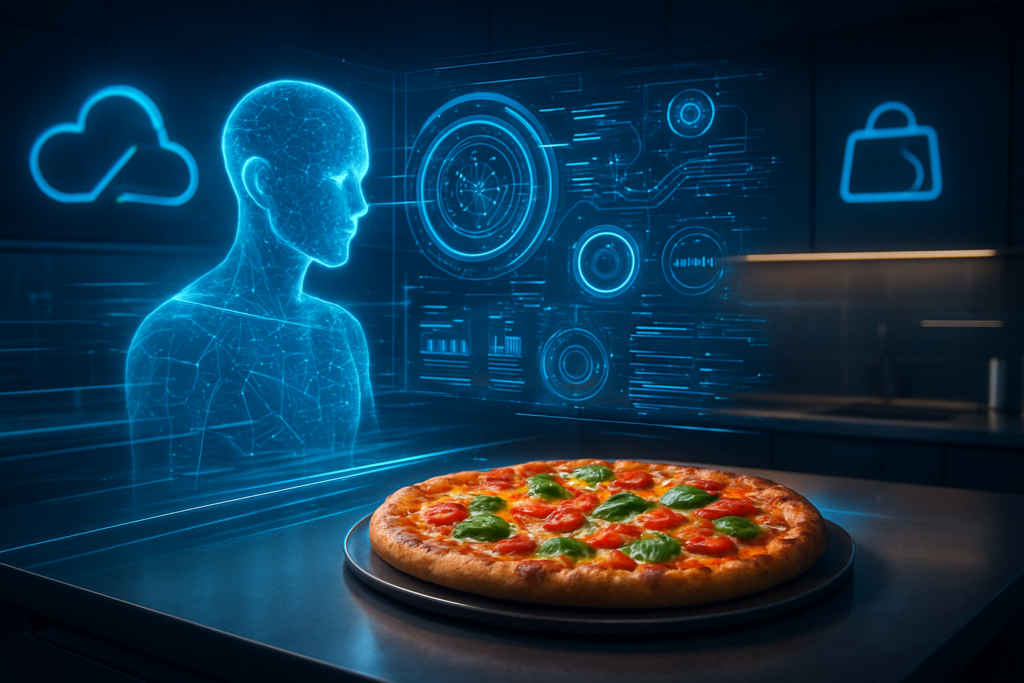
The significance of this partnership lies in its focus on "agentic commerce"—a term used by Google Cloud to describe AI that doesn't just talk, but acts. By integrating the most advanced Gemini models into Papa John’s digital ecosystem, the two companies have created a system that manages complex customizations, identifies the best available discounts, and facilitates group orders without the need for human intervention. For the first time, a major retail chain is demonstrating that generative AI is not just a novelty for customer support, but a direct driver of conversion rates and operational efficiency.
The Technical Leap: Gemini Enterprise and the End of the Decision Tree
At the heart of the Food Ordering Agent is the Gemini Enterprise for Customer Experience framework, running on Google’s Vertex AI platform. Unlike previous-generation automated systems that relied on rigid "decision trees"—where a customer had to follow a specific script or risk confusing the machine—the new agent utilizes Gemini 3 Flash to process natural language with sub-second latency. This allows the system to understand nuanced requests such as, "Give me a large thin crust, half-pepperoni, half-sausage, but go light on the cheese and add extra sauce on the whole thing." The agent’s ability to parse these multi-part instructions represents a massive leap over the "keyword-based" systems of 2024.
The technical architecture also leverages BigQuery for real-time data analysis, allowing the agent to access a customer’s Papa Rewards history and current local store inventory simultaneously. This deep integration enables the "Intelligent Deal Wizard" feature, which proactively scans thousands of possible coupon combinations to find the best value for the customer’s specific cart. Initial feedback from the AI research community has noted that the agent’s "reasoning" capabilities—where it can explain why it applied a certain discount—sets a new bar for transparency in consumer AI.
Initial industry reactions have been overwhelmingly positive, particularly regarding the system’s multimodal capabilities. The Food Ordering Agent is unified across mobile apps, web browsers, and phone lines, maintaining a consistent context as a user moves between devices. Experts at NRF 2026 highlighted that this "omnichannel persistence" is a significant departure from existing technologies, where a customer might have to restart their order if they moved from a phone call to a mobile app. By keeping the "state" of the order alive in the cloud, Papa John's has effectively eliminated the friction that typically leads to cart abandonment.
Strategic Moves: Why Google Cloud and Papa John’s are Winning the AI Race
This development places Google Cloud in a strong position against competitors like Microsoft (NASDAQ: MSFT), which has historically partnered with Domino’s for similar initiatives. While Microsoft’s 2023 collaboration focused heavily on internal store operations and voice ordering, the Google-Papa John’s approach is more aggressively focused on the "front-end" customer agent. By successfully deploying a system that handles 150 million loyalty members, Google is proving that its Vertex AI and Gemini ecosystem can scale to the demands of global enterprise retail, potentially siphoning away market share from other cloud providers looking to lead in the generative AI space.
For Papa John’s, the strategic advantage is clear: ROI through friction reduction. During the pilot phase in late 2025, the company reported a significant increase in mobile conversion rates. By automating the most complex parts of the ordering process—group orders and deal-hunting—the AI reduces the "cognitive load" on the consumer. This not only increases order frequency but also allows restaurant staff to focus entirely on food preparation rather than answering phones or managing digital errors.
Smaller startups in the food-tech space may find themselves disrupted by this development. Until recently, niche AI companies specialized in voice-to-text ordering for local pizzerias. However, the sheer scale and integration of the Gemini-powered agent make it difficult for standalone products to compete. As Papa John’s PJX innovation team continues to refine the "Food Ordering Agent," we are likely to see a consolidation in the industry where large chains lean on the "big tech" AI stacks to provide a level of personalization that smaller players simply cannot afford to build from scratch.
The Broader AI Landscape: From Reactive Bots to Proactive Partners
The rollout of the Food Ordering Agent fits into a broader trend toward "agentic" AI, where models are given the agency to complete end-to-end workflows. This is a significant milestone in the AI timeline, comparable to the first successful deployments of automated customer service, but with a crucial difference: the AI is now generating revenue rather than just cutting costs. In the wider retail landscape, this sets a precedent for other sectors—such as apparel or travel—to implement agents that can reason through complex bookings or outfit configurations.
However, the move toward total automation is not without its concerns. Societal impacts on entry-level labor in the fast-food industry are a primary point of discussion. While Papa John’s emphasizes that the AI "frees up" employees to focus on quality control, critics argue that the long-term goal is a significant reduction in headcount. Additionally, the shift toward proactive ordering—where the AI might suggest a pizza based on a customer's calendar or a major sporting event—raises questions about data privacy and the psychological effects of "predictive consumption."
Despite these concerns, the milestone achieved here is undeniable. We have moved from the era of "hallucinating chatbots" to "reliable agents." Unlike the early experiments with ChatGPT-style interfaces that often stumbled over specific menu items, the Food Ordering Agent’s grounding in real-time store data ensures a level of accuracy that was previously impossible. This transition from "creative" generative AI to "functional" generative AI is the defining trend of 2026.
The Horizon: Predictive Pizzas and In-Car Integration
Looking ahead, the next step for the Google and Papa John's partnership is deeper hardware integration. Near-term plans include the deployment of the Food Ordering Agent into connected vehicle systems. Imagine a scenario where a car’s infotainment system, aware of a long commute and the driver's preferences, asks if they would like their "usual" order ready at the store they are about to pass. This "no-tap" reordering is expected to be a major focus for the 2026 holiday season.
Challenges remain, particularly in the realm of global expansion. The current agent is highly optimized for English and Spanish nuances in the North American market. Localizing the agent’s "reasoning" for international markets, where cultural tastes and ordering habits vary wildly, will be the next technical hurdle for the PJX team. Furthermore, as AI agents become more prevalent, maintaining a "brand voice" that doesn't feel generic or overly "robotic" will be essential for staying competitive in a crowded market.
Experts predict that by the end of 2027, the concept of a "digital menu" will be obsolete, replaced entirely by conversational agents that dynamically build menus based on the user's dietary needs, budget, and past behavior. The Papa John’s rollout is the first major proof of concept for this vision. As the technology matures, we can expect the agent to handle even more complex tasks, such as coordinating delivery timing with third-party logistics or managing real-time price fluctuations based on ingredient availability.
Conclusion: A New Standard for Enterprise AI
The partnership between Google Cloud and Papa John’s is more than just a tech upgrade; it is a blueprint for how legacy brands can successfully integrate generative AI to produce tangible financial results. By focusing on the specific pain points of the pizza ordering process—customization and couponing—the Food Ordering Agent has moved AI out of the research lab and into the kitchens of millions of Americans. It stands as a significant marker in AI history, proving that "agentic" systems are ready for the stresses of high-volume, real-world commerce.
As we move through 2026, the key takeaway for the tech industry is that the "chatbot" era is officially over. The expectation now is for agents that can reason, plan, and execute. For Papa John’s, the long-term impact will likely be measured in loyalty and "share of stomach" as they provide a digital experience that is faster and more intuitive than their competitors. In the coming weeks, keep a close watch on conversion data from Papa John’s quarterly earnings; it will likely serve as the first concrete evidence of the generative AI ROI that the industry has been promising for years.
This content is intended for informational purposes only and represents analysis of current AI developments.
TokenRing AI delivers enterprise-grade solutions for multi-agent AI workflow orchestration, AI-powered development tools, and seamless remote collaboration platforms.
For more information, visit https://www.tokenring.ai/.