In a move that many industry analysts are calling the "ChatGPT moment for physical AI," NVIDIA (NASDAQ: NVDA) has officially launched its Alpamayo model family, a groundbreaking Vision-Language-Action (VLA) architecture designed to bring human-like logic to the world of autonomous vehicles. Announced at the 2026 Consumer Electronics Show (CES) following a technical preview at NeurIPS in late 2025, Alpamayo represents a radical departure from traditional "black box" self-driving stacks. By integrating a deep reasoning backbone, the system can "think" through complex traffic scenarios, moving beyond simple pattern matching to genuine causal understanding.
The immediate significance of Alpamayo lies in its ability to solve the "long-tail" problem—the infinite variety of rare and unpredictable events that have historically confounded autonomous systems. Unlike previous iterations of self-driving software that rely on massive libraries of pre-recorded data to dictate behavior, Alpamayo uses its internal reasoning engine to navigate situations it has never encountered before. This development marks the shift from narrow AI perception to a more generalized "Physical AI" capable of interacting with the real world with the same cognitive flexibility as a human driver.
The technical foundation of Alpamayo is its unique 10-billion-parameter VLA architecture, which merges high-level semantic reasoning with low-level vehicle control. At its core is the "Cosmos Reason" backbone, an 8.2-billion-parameter vision-language model post-trained on millions of visual samples to develop what NVIDIA engineers call "physical common sense." This is paired with a 2.3-billion-parameter "Action Expert" that translates logical conclusions into precise driving commands. To handle the massive data flow from 360-degree camera arrays in real-time, NVIDIA utilizes a "Flex video tokenizer," which compresses visual input into a fraction of the usual tokens, allowing for end-to-end processing latency of just 99 milliseconds on NVIDIA’s DRIVE AGX Thor hardware.
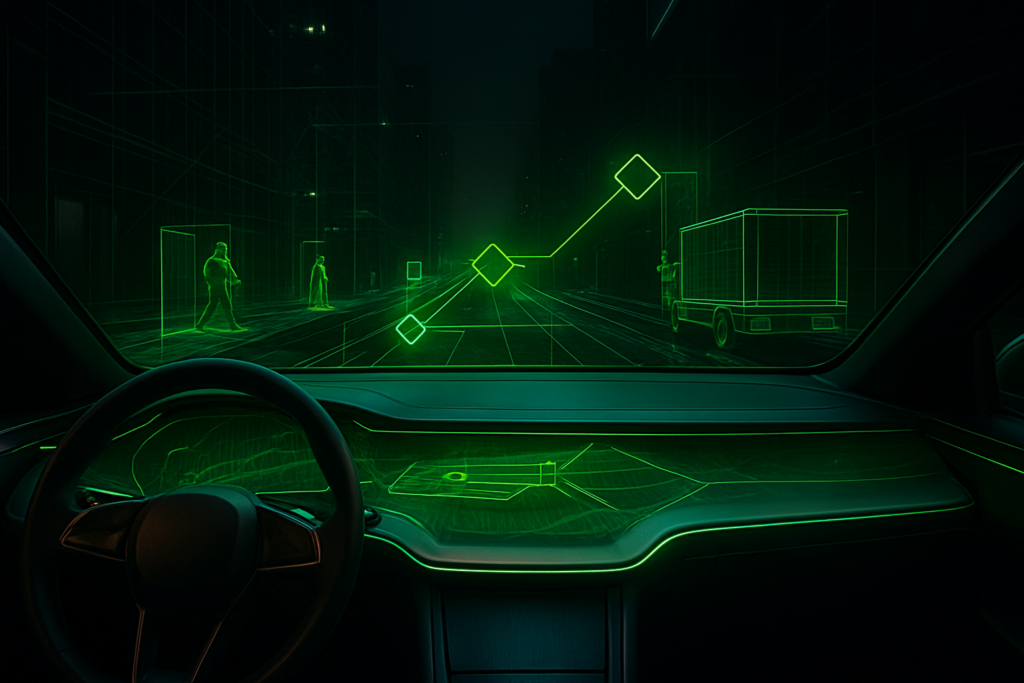
What sets Alpamayo apart from existing technology is its implementation of "Chain of Causation" (CoC) reasoning. This is a specialized form of the "Chain-of-Thought" (CoT) prompting used in large language models like GPT-4, adapted specifically for physical environments. Instead of outputting a simple steering angle, the model generates structured reasoning traces. For instance, when encountering a double-parked delivery truck, the model might internally reason: "I see a truck blocking my lane. I observe no oncoming traffic and a dashed yellow line. I will check the left blind spot and initiate a lane change to maintain progress." This transparency is a massive leap forward from the opaque decision-making of previous end-to-end systems.
Initial reactions from the AI research community have been overwhelmingly positive, with experts praising the model's "explainability." Dr. Sarah Chen of the Stanford AI Lab noted that Alpamayo’s ability to articulate its intent provides a much-needed bridge between neural network performance and regulatory safety requirements. Early performance benchmarks released by NVIDIA show a 35% reduction in off-road incidents and a 25% decrease in "close encounter" safety risks compared to traditional trajectory-only models. Furthermore, the model achieved a 97% rating on NVIDIA’s "Comfort Excel" metric, indicating a significantly smoother, more human-like driving experience that minimizes the jerky movements often associated with AI drivers.
The rollout of Alpamayo is set to disrupt the competitive landscape of the automotive and AI sectors. By offering Alpamayo as part of an open-source ecosystem—including the AlpaSim simulation framework and Physical AI Open Datasets—NVIDIA is positioning itself as the "Android of Autonomy." This strategy stands in direct contrast to the closed, vertically integrated approach of companies like Tesla (NASDAQ: TSLA), which keeps its Full Self-Driving (FSD) stack entirely proprietary. NVIDIA’s move empowers a wide range of manufacturers to deploy high-level autonomy without having to build their own multi-billion-dollar AI models from scratch.
Major automotive players are already lining up to integrate the technology. Mercedes-Benz (OTC:MBGYY) has announced that its upcoming 2026 CLA sedan will be the first production vehicle to feature Alpamayo-enhanced driving capabilities under its "MB.Drive Assist Pro" branding. Similarly, Uber (NYSE: UBER) and Lucid (NASDAQ: LCID) have confirmed they are leveraging the Alpamayo architecture to accelerate their respective robotaxi and luxury consumer vehicle roadmaps. For these companies, Alpamayo provides a strategic shortcut to Level 4 autonomy, reducing R&D costs while significantly improving the safety profile of their vehicles.
The market positioning here is clear: NVIDIA is moving up the value chain from providing the silicon for AI to providing the intelligence itself. For startups in the autonomous delivery and robotics space, Alpamayo serves as a foundational layer that can be fine-tuned for specific tasks, such as sidewalk delivery or warehouse logistics. This democratization of high-end VLA models could lead to a surge in AI-driven physical products, potentially making specialized autonomous software companies redundant if they cannot compete with the generalized reasoning power of the Alpamayo framework.
The broader significance of Alpamayo extends far beyond the automotive industry. It represents the successful convergence of Large Language Models (LLMs) and physical robotics, a trend that is rapidly becoming the defining frontier of the 2026 AI landscape. For years, AI was confined to digital spaces—processing text, code, and images. With Alpamayo, we are seeing the birth of "General Purpose Physical AI," where the same reasoning capabilities that allow a model to write an essay are applied to the physics of moving a multi-ton vehicle through a crowded city street.
However, this transition is not without its concerns. The primary debate centers on the reliability of the "Chain of Causation" traces. While they provide an explanation for the AI's behavior, critics argue that there is a risk of "hallucinated reasoning," where the model’s linguistic explanation might not perfectly match the underlying neural activations that drive the physical action. NVIDIA has attempted to mitigate this through "consistency training" using Reinforcement Learning, but ensuring that a machine's "words" and "actions" are always in sync remains a critical hurdle for widespread public trust and regulatory certification.
Comparing this to previous breakthroughs, Alpamayo is to autonomous driving what AlexNet was to computer vision or what the Transformer was to natural language processing. It provides a new architectural template that others will inevitably follow. By moving the goalpost from "driving by sight" to "driving by thinking," NVIDIA has effectively moved the industry into a new epoch of cognitive robotics. The impact will likely be felt in urban planning, insurance models, and even labor markets, as the reliability of autonomous transport reaches parity with human operators.
Looking ahead, the near-term evolution of Alpamayo will likely focus on multi-modal expansion. Industry insiders predict that the next iteration, potentially titled Alpamayo-V2, will incorporate audio processing to allow vehicles to respond to sirens, verbal commands from traffic officers, or even the sound of a nearby bicycle bell. In the long term, the VLA architecture is expected to migrate from cars into a diverse array of form factors, including humanoid robots and industrial manipulators, creating a unified reasoning framework for all "thinking" hardware.
The primary challenges remaining involve scaling the reasoning capabilities to even more complex, low-visibility environments—such as heavy snowstorms or unmapped rural roads—where visual data is sparse and the model must rely almost entirely on physical intuition. Experts predict that the next two years will see an "arms race" in reasoning-based data collection, as companies scramble to find the most challenging edge cases to further refine their models’ causal logic.
What happens next will be a critical test of the "open" vs. "closed" AI models. As Alpamayo-based vehicles hit the streets in large numbers throughout 2026, the real-world data will determine if a generalized reasoning model can truly outperform a specialized, proprietary system. If NVIDIA’s approach succeeds, it could set a standard for all future human-robot interactions, where the ability to explain "why" a machine acted is just as important as the action itself.
NVIDIA's Alpamayo model represents a pivotal shift in the trajectory of artificial intelligence. By successfully marrying Vision-Language-Action architectures with Chain-of-Thought reasoning, the company has addressed the two biggest hurdles in autonomous technology: safety in unpredictable scenarios and the need for explainable decision-making. The transition from perception-based systems to reasoning-based "Physical AI" is no longer a theoretical goal; it is a commercially available reality.
The significance of this development in AI history cannot be overstated. It marks the moment when machines began to navigate our world not just by recognizing patterns, but by understanding the causal rules that govern it. As we look toward the final months of 2026, the focus will shift from the laboratory to the road, as the first Alpamayo-powered consumer vehicles begin to demonstrate whether silicon-based reasoning can truly match the intuition and safety of the human mind.
For the tech industry and society at large, the message is clear: the age of the "thinking machine" has arrived, and it is behind the wheel. Watch for further announcements regarding "AlpaSim" updates and the performance of the first Mercedes-Benz CLA models hitting the market this quarter, as these will be the first true barometers of Alpamayo’s success in the wild.
This content is intended for informational purposes only and represents analysis of current AI developments.
TokenRing AI delivers enterprise-grade solutions for multi-agent AI workflow orchestration, AI-powered development tools, and seamless remote collaboration platforms.
For more information, visit https://www.tokenring.ai/.