Rising Smart Factory Investments and Edge-to-Cloud Data Integration Accelerate Industrial DataOps Adoption Worldwide
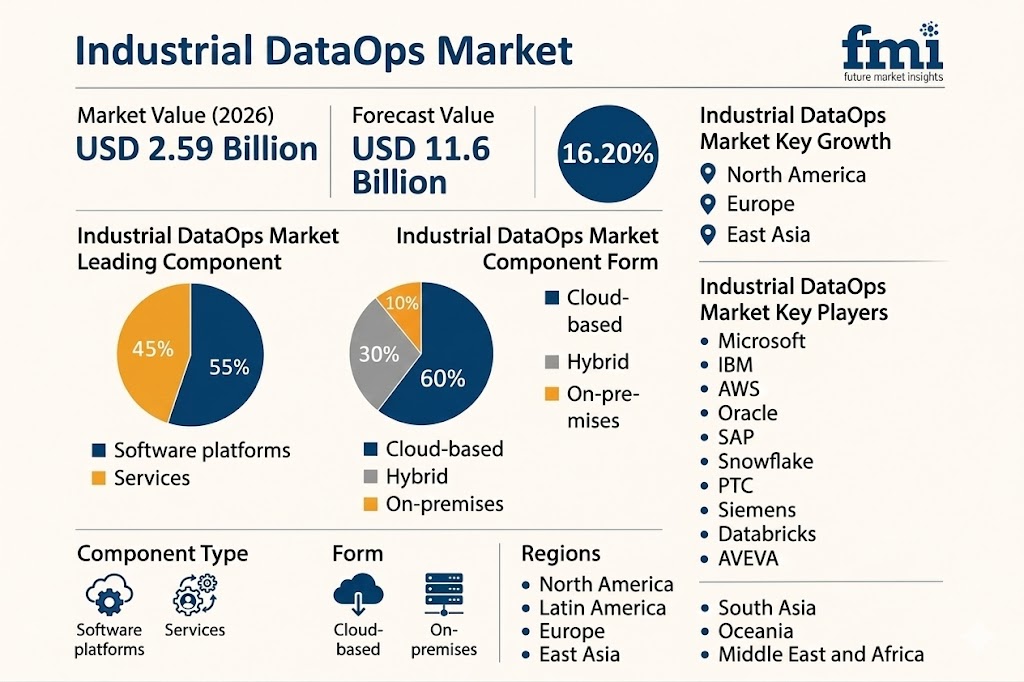
NEWARK, DE / ACCESS Newswire / March 6, 2026 / The global Industrial DataOps market is entering a transformative growth phase as manufacturers accelerate digital modernization and adopt unified industrial data frameworks. According to the latest analysis by Future Market Insights (FMI), the market reached USD 2.23 billion in 2025 and is projected to grow to USD 2.59 billion in 2026, eventually expanding to USD 11.6 billion by 2036, reflecting a strong CAGR of 16.2% during the forecast period.
The rapid expansion of industrial automation, rising adoption of AI-driven manufacturing systems, and stricter global data governance regulations are fundamentally reshaping how factories manage operational data. Industrial organizations are increasingly transitioning away from fragmented legacy systems toward automated data pipelines and unified edge-to-cloud infrastructures capable of delivering real-time insights.
Get Access of Report Sample: https://www.futuremarketinsights.com/reports/sample/rep-gb-32168
Market Snapshot (2026-2036)
Metric |
Details |
|---|---|
Market Value (2026) |
USD 2.59 Billion |
Forecast Value (2036) |
USD 11.6 Billion |
Projected CAGR |
16.2% |
Dominant Component |
Software Platforms (64% Share) |
Leading End-Use Sector |
Manufacturing (48% Share) |
AI Governance Mandates Accelerate Data Infrastructure Modernization
Industrial enterprises are increasingly investing in Industrial DataOps platforms to maintain compliance with evolving AI governance frameworks and operational traceability requirements. Governments and industry regulators worldwide are demanding greater transparency in algorithmic decision-making, pushing manufacturers to upgrade legacy data systems.
Modern manufacturing environments generate enormous volumes of machine telemetry from sensors, PLCs, and SCADA systems. Without centralized data orchestration platforms, these datasets remain fragmented and underutilized. DataOps platforms enable manufacturers to consolidate these streams into structured pipelines that can power predictive maintenance, quality monitoring, and advanced analytics.
Roland Busch, CEO of Siemens AG, emphasized the importance of cross-manufacturer data integration, stating that access to high-quality machine data is essential for developing AI systems capable of addressing the complexity of industrial production environments.
Manufacturing Sector Leads Adoption
The manufacturing industry dominates the Industrial DataOps market, accounting for 48% of total deployment volume. Smart factory initiatives, predictive maintenance programs, and digital twin technologies require continuous data flow from industrial assets, driving demand for automated data orchestration frameworks.
Several factors are accelerating adoption within manufacturing facilities:
Predictive Maintenance: Real-time monitoring of machine performance reduces downtime and operational disruptions.
Operational Equipment Effectiveness (OEE): Data pipelines enable continuous monitoring and optimization of factory productivity.
Quality Assurance: Digital twin systems analyze production data to detect microscopic defects before assembly is completed.
Energy Optimization: Industrial data platforms help manufacturers identify and reduce energy waste across complex operations.
These capabilities are transforming Industrial DataOps from an experimental technology into an essential infrastructure layer for modern manufacturing ecosystems.
Software Platforms Capture Majority Market Share
Software platforms represent the largest component segment, accounting for 64% of total market share in 2026. Organizations increasingly prioritize scalable enterprise data management solutions capable of integrating multiple operational technology (OT) protocols into unified enterprise datasets.
Key advantages driving software platform adoption include:
Automated Data Pipelines: Continuous data ingestion from factory assets.
Native Observability Tools: Real-time monitoring of pipeline performance and data integrity.
Pre-built Connectors: Integration with diverse industrial protocols and legacy PLC systems.
Enterprise Data Governance: Standardized data architecture for AI and analytics applications.
These capabilities significantly reduce integration complexity and allow enterprises to deploy AI applications faster across distributed manufacturing facilities.
Hybrid Deployment Becomes the Preferred Architecture
Hybrid deployment models dominate the Industrial DataOps ecosystem, capturing 52% of market share in 2026. Industrial organizations must balance the low-latency requirements of factory floor operations with the massive computational capabilities offered by cloud infrastructure.
Hybrid architectures deliver several strategic advantages:
Edge Processing: High-frequency machine data is analyzed locally to reduce latency.
Cloud Scalability: Complex analytics workloads run on hyperscale computing platforms.
Regulatory Compliance: Sensitive operational data can remain on-premise while non-critical datasets move to the cloud.
This architecture ensures operational reliability while supporting the growing demand for advanced analytics and AI-driven decision-making.
Asia-Pacific Emerges as Fastest-Growing Region
Asia-Pacific is expected to lead global growth as governments and manufacturers invest heavily in digital industrial infrastructure. Rapid industrialization and localization policies are accelerating adoption of industrial data platforms across emerging manufacturing hubs.
Country-level growth projections highlight this momentum:
India: 20.0%
China: 19.0%
United States: 17.0%
Germany: 15.0%
South Korea: 15.0%
United Kingdom: 14.0%
Japan: 13.0%
India and China are particularly strong growth drivers, supported by large-scale automation initiatives, smart factory investments, and aggressive government digitalization policies.
Market Challenges: Skills Gap and Integration Complexity
Despite strong growth potential, the Industrial DataOps market faces several structural challenges. Integrating legacy industrial systems with modern data architectures remains complex and resource-intensive.
Key constraints affecting adoption include:
Shortage of specialized OT-IT integration professionals
Complex migration from legacy SCADA systems
High upfront implementation costs for mid-sized manufacturers
Organizational resistance to digital transformation
Additionally, global surveys indicate that nearly 97% of businesses report at least one AI-related skills gap, highlighting the talent shortage required to manage advanced data engineering infrastructures.
Competitive Landscape: Innovation and Strategic Partnerships
The Industrial DataOps market is highly competitive, with leading technology companies focusing on advanced data orchestration platforms, automated data catalogs, and industrial AI integration capabilities.
Major companies operating in the market include:
Microsoft
IBM
AWS
Oracle
SAP
Snowflake
PTC
Siemens
Databricks
AVEVA
Schneider Electric
Rockwell Automation
Technology alliances and acquisitions are increasingly shaping the competitive landscape. For example, several major platform providers have recently expanded partnerships to integrate industrial data systems with advanced AI and analytics frameworks.
Future Outlook: DataOps Becomes the Backbone of Industrial AI
Looking ahead, Industrial DataOps is expected to become a foundational layer for AI-driven manufacturing ecosystems. As factories deploy digital twins, autonomous optimization systems, and predictive maintenance platforms, the demand for reliable, real-time industrial data pipelines will continue to grow.
By 2036, Industrial DataOps platforms are likely to evolve into mission-critical infrastructure for global manufacturing, enabling companies to transform raw machine telemetry into actionable insights that drive efficiency, sustainability, and operational resilience.
For an in-depth analysis of evolving formulation trends and to access the complete strategic outlook for the Industrial DataOps Market through 2036, Full Report Request: https://www.futuremarketinsights.com/reports/industrial-dataops-market
Related Reports:
Industrial Foundation Models Market- https://www.futuremarketinsights.com/reports/industrial-foundation-models-market
Industrial Copilot Market- https://www.futuremarketinsights.com/reports/industrial-copilot-market
Industrial AI Agents Market- https://www.futuremarketinsights.com/reports/industrial-ai-agents-market
About Future Market Insights (FMI)
Future Market Insights (FMI) is a leading provider of market intelligence and consulting services, serving clients in over 150 countries. Headquartered in Delaware, USA, with a global delivery center in India and offices in the UK and UAE, FMI delivers actionable insights to businesses across industries including automotive, technology, consumer products, manufacturing, energy, and chemicals.
An ESOMAR-certified research organization, FMI provides custom and syndicated market reports and consulting services, supporting both Fortune 1,000 companies and SMEs. Its team of 300+ experienced analysts ensures credible, data-driven insights to help clients navigate global markets and identify growth opportunities.
For Press & Corporate Inquiries
Rahul Singh
AVP - Marketing and Growth Strategy
Future Market Insights, Inc.
+91 8600020075
For Sales - sales@futuremarketinsights.com
For Media - Rahul.singh@futuremarketinsights.com
For web - https://www.futuremarketinsights.com/
SOURCE: Future Market Insights, Inc.
View the original press release on ACCESS Newswire