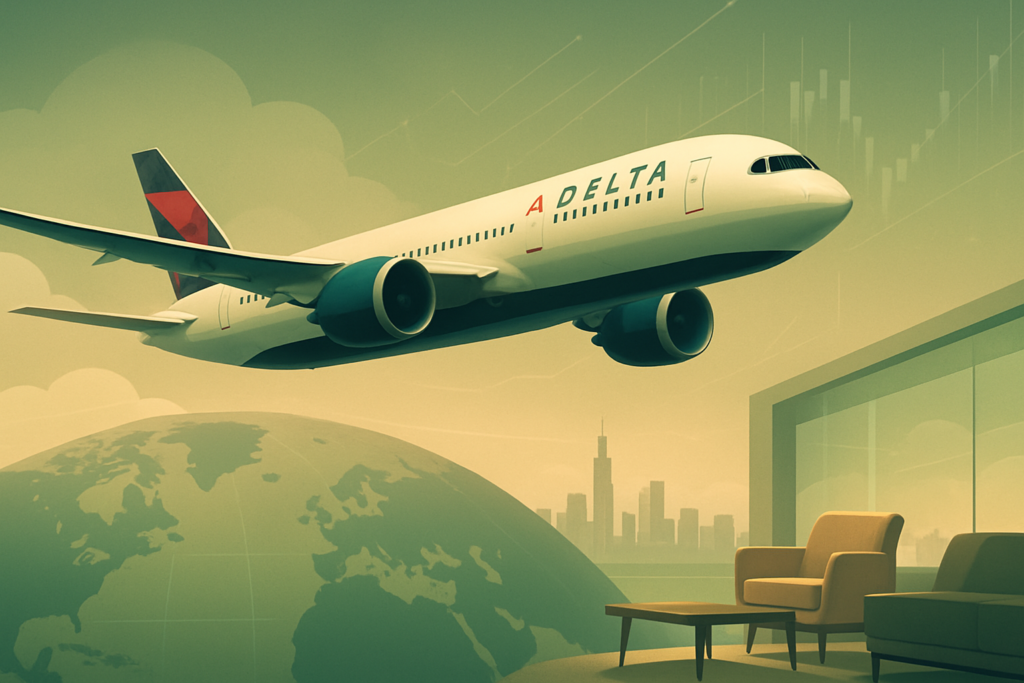
As of January 22, 2026, Delta Air Lines (NYSE: DAL) stands at a pivotal juncture in its century-long history. Having just concluded its centennial year in 2025, the Atlanta-based carrier has transformed from a traditional transportation company into a diversified "premium lifestyle" brand. While the broader airline industry has historically been plagued by razor-thin margins and hyper-cyclicality, Delta has managed to decouple its performance from the pack. Today, the company is in focus not just for its operational reliability, but for its aggressive move to capture the "K-shaped" recovery, targeting affluent travelers whose demand for luxury and connectivity remains resilient even in the face of macroeconomic headwinds.
Historical Background
Delta's journey began far from the international hubs it dominates today. Founded in 1925 as Huff Daland Dusters, a crop-dusting operation in Macon, Georgia, it moved to Monroe, Louisiana, before settling in its iconic Atlanta headquarters in 1941. The company's modern era was defined by the 2008 merger with Northwest Airlines, a move that gave Delta the scale and the trans-Pacific reach needed to compete globally.
Perhaps the most unconventional move in its history was the 2012 acquisition of the Trainer refinery in Pennsylvania. Critics at the time called it a distraction; today, it is viewed as a masterstroke of vertical integration that provides a unique hedge against volatile jet fuel prices. Over the last decade, Delta has focused on "premiumization"—systematically removing commodity-class seats in favor of high-margin Delta One and Premium Select cabins.
Business Model
Delta’s business model is no longer built solely on moving passengers from Point A to Point B. It is a three-pronged revenue engine:
- Premium Travel: As of early 2026, premium cabin revenue (Delta One, First Class, Delta Premium Select, and Delta Comfort+) has officially overtaken main cabin revenue as the primary driver of the top line.
- Loyalty and Services: The SkyMiles program, anchored by an exclusive multi-year partnership with American Express (NYSE: AXP), has become a high-margin cash cow. Delta also generates significant revenue through its MRO (Maintenance, Repair, and Overhaul) business, servicing engines for other airlines.
- Vertical Integration: The Monroe Energy refinery and a growing portfolio of international equity stakes (LATAM, Virgin Atlantic, Hanjin-KAL/Korean Air) create a global ecosystem that captures value at every stage of the travel journey.
Stock Performance Overview
Over the last decade, DAL has consistently outperformed the NYSE Arca Airline Index (XAL).
- 1-Year Performance: The stock has seen a 22% rise over the past 12 months, fueled by record international demand and the successful rollout of free gate-to-gate Wi-Fi across its entire fleet.
- 5-Year Performance: Looking back to the 2021 recovery period, Delta’s stock has nearly doubled, significantly outpacing peers like American Airlines (NASDAQ: AAL) as it aggressively repaired its balance sheet.
- 10-Year Performance: Long-term investors have seen a CAGR of approximately 9%, excluding dividends. While the 2024 CrowdStrike tech outage caused a temporary 10% dip, the stock recovered fully within 120 days, showcasing the market’s confidence in Delta’s operational resilience.
Financial Performance
Delta’s 2025 fiscal year, which closed just weeks ago, was a record-breaker. The airline reported total operating revenue of $63.4 billion, a 3% increase over 2024.
- Profitability: Pre-tax profit reached $5 billion, with an operating margin of 10.5%, the highest among legacy carriers.
- Cash Flow: Free cash flow for 2025 was a robust $4.6 billion, allowing management to reduce net debt to $14 billion.
- Valuation: Despite its premium performance, Delta trades at a forward P/E ratio of 7.8x, which many analysts argue is a significant discount compared to its non-airline loyalty peers like American Express.
Leadership and Management
CEO Ed Bastian, who has led the company since 2016, remains one of the most respected figures in aviation. His strategy focuses on "the three pillars": people, reliability, and brand. Under Bastian, Delta has maintained a culture of profit-sharing, distributing over $1 billion annually to employees in most years, which has historically helped the company stave off the same level of labor unrest seen at its competitors. In 2026, Bastian’s focus has shifted toward "The Digital Delta," integrating AI-driven scheduling and predictive maintenance to further widen the operational "moat."
Products, Services, and Innovations
Delta’s competitive edge in 2026 is driven by its technology and fleet investments:
- The Connected Cabin: Delta now offers free, high-speed Viasat Wi-Fi on 100% of its active fleet, a move that has significantly increased SkyMiles registrations.
- Biometric Boarding: "Delta Digital ID" has expanded to all major hubs, allowing passengers to check bags and clear security using only facial recognition.
- Fleet Modernization: Just this month, Delta confirmed a landmark order for 30 Boeing 787-10 Dreamliners, signaling a strategic return to Boeing for its long-haul needs, while continuing to take delivery of the fuel-efficient Airbus A321neo.
Competitive Landscape
The U.S. "Big Three" have diverged in strategy.
- United Airlines (NASDAQ: UAL): Delta’s fiercest competitor, United has also pivoted to a premium strategy and currently leads in international seat capacity.
- American Airlines (NASDAQ: AAL): While American has the largest domestic network, its margins continue to lag behind Delta’s due to a higher debt load and less mature loyalty-driven revenue.
- Southwest Airlines (NYSE: LUV): Once a major threat, the low-cost carrier model has struggled in the high-cost environment of 2025-2026, as travelers increasingly prefer the "bundled" amenities offered by Delta.
Industry and Market Trends
The aviation sector in 2026 is defined by three major trends:
- Premiumization: Travelers are increasingly willing to pay for "space and grace," a trend Delta pioneered.
- Sustainability: The industry is under immense pressure to adopt Sustainable Aviation Fuel (SAF). Delta has committed to replacing 10% of its jet fuel with SAF by 2030, though supply remains a challenge.
- Labor Costs: Pilot and flight attendant contracts reached record highs in 2024-2025, permanently elevating the industry's cost floor.
Risks and Challenges
Despite its strengths, Delta faces significant risks:
- Fuel Volatility: While the Trainer refinery helps, a geopolitical spike in oil prices remains the greatest threat to earnings.
- Labor Relations: As of early 2026, Delta's flight attendants remain a target for unionization efforts. A successful union drive could disrupt Bastian’s direct-relationship management model and increase operating costs.
- Economic Sensitivity: While premium travelers are more resilient, a severe global recession would inevitably dent Delta’s $8.2 billion American Express revenue stream as consumer spending cools.
Opportunities and Catalysts
- The $10 Billion Goal: Delta’s management has set a target of $10 billion in annual remuneration from American Express by 2027. Reaching this milestone would provide a massive, high-margin cushion against economic downturns.
- International Joint Ventures: The full integration of the LATAM joint venture is expected to yield significant synergies in 2026, as Delta captures a larger share of the growing South American business class market.
- MRO Growth: Delta’s TechOps division is expanding into third-party maintenance for next-generation engines, a business that enjoys higher margins than flying.
Investor Sentiment and Analyst Coverage
Wall Street remains largely bullish on DAL. Of the 22 analysts covering the stock as of January 2026, 18 hold a "Strong Buy" or "Buy" rating. Institutional ownership remains high at over 70%, with major positions held by Vanguard and BlackRock. The prevailing sentiment is that Delta is "no longer just an airline," but a high-performance logistics and loyalty platform. However, some retail investors remain cautious about the cyclical nature of the industry and the high capital expenditures required for fleet renewal.
Regulatory, Policy, and Geopolitical Factors
The regulatory environment is tightening. The FAA has increased oversight following several industry-wide safety incidents in 2024. Additionally, new DOT (Department of Transportation) rules regarding passenger refunds and fee transparency have increased the administrative burden on airlines. Geopolitically, the closure of Russian airspace and tensions in the Middle East continue to add flight hours and fuel burn to certain international routes, though Delta’s diversified network has mitigated the impact compared to European carriers.
Conclusion
Delta Air Lines enters 2026 as the gold standard of the American aviation industry. By pivoting toward a premium-heavy business model and leveraging its massive loyalty partnership with American Express, the company has built a financial profile that looks more like a high-end retailer than a traditional airline.
Investors should watch two key metrics in the coming months: the progress toward the $10 billion Amex revenue target and the successful integration of the new Boeing 787-10s into the fleet. While the airline industry will always be subject to the whims of the global economy and fuel prices, Delta’s "operational moat" and premium focus provide a level of safety rarely seen in this sector. For those looking for exposure to the travel and leisure space, Delta remains the most disciplined and strategically sound play on the board.
This content is intended for informational purposes only and is not financial advice.