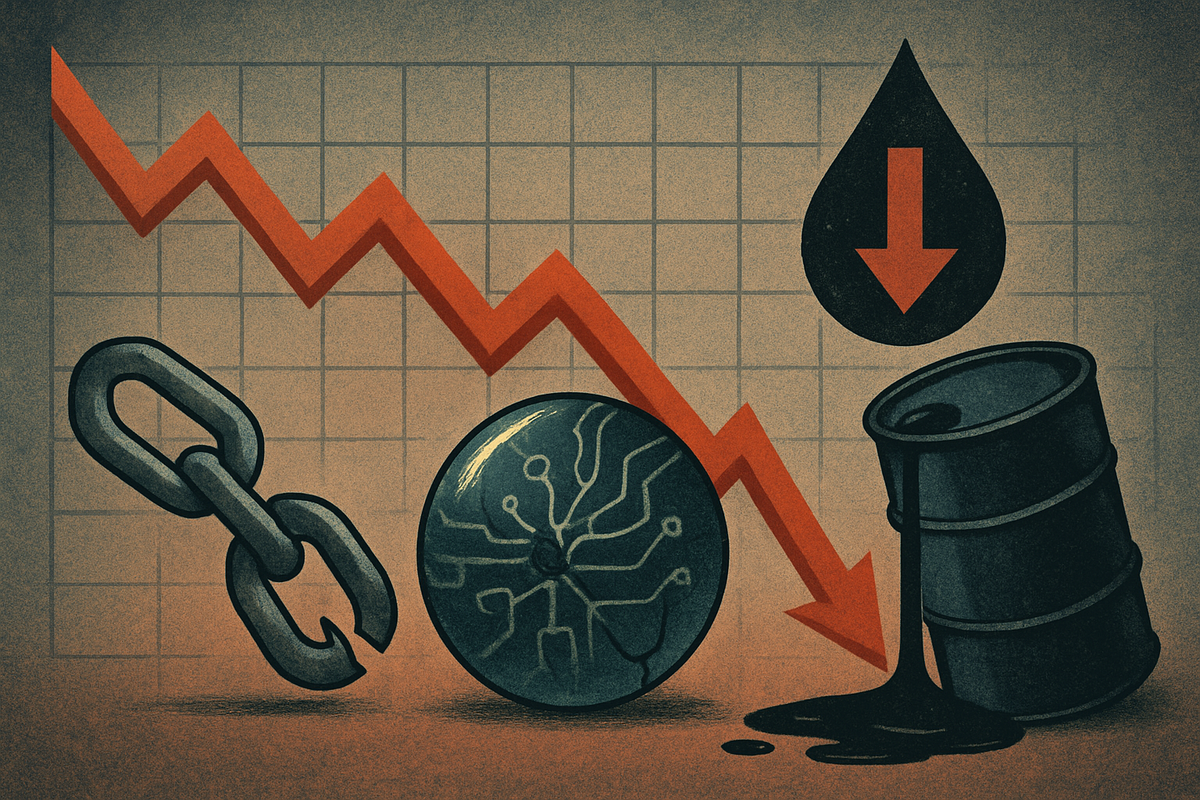
The global financial markets are navigating a tumultuous period as of December 16, 2025, grappling with a trifecta of significant headwinds: a rapidly weakening labor market, escalating concerns over an "AI bubble," and a dramatic freefall in oil prices. These interconnected factors are collectively reshaping investor sentiment, prompting a reevaluation of asset allocations, and signaling potential shifts in monetary policy. The immediate implications point to increased volatility and uncertainty, as market participants attempt to decipher the long-term impact on corporate profitability, economic growth, and inflation trajectories.
The convergence of these powerful drivers suggests a challenging landscape ahead, where traditional market assumptions are being tested. Investors are becoming increasingly discerning, moving away from speculative growth assets towards more stable, value-oriented sectors, while central banks, particularly the Federal Reserve, face renewed pressure to adjust their monetary policy stance in response to the evolving economic data.
Economic Headwinds Mount: Labor Market Softens, AI Hype Cools, and Crude Craters
The latest U.S. jobs report, released by the Bureau of Labor Statistics (BLS) after a period of federal government shutdown-induced delays, paints a stark picture of a softening labor market. Combining data for October and November 2025, the report revealed a net decline of 41,000 jobs over the two-month period, with 64,000 jobs added in November largely offset by a loss of 105,000 jobs in October. Consequently, the unemployment rate climbed to 4.6% in November, its highest level since September 2021 and surpassing economist expectations. Adding to the concern, wage growth has decelerated to 3.5%. This weakening labor data is intensifying calls for the Federal Reserve to consider further interest rate cuts, potentially as early as January 2026, to stimulate economic activity. Globally, the UK labor market also mirrors this trend, showing rising unemployment and redundancies in the three months leading up to October 2025.
Meanwhile, the once-unbridled optimism surrounding Artificial Intelligence (AI) in financial markets is giving way to growing concerns of an "AI bubble." While AI remains a critical driver of economic growth, with significant investment pouring into the sector (reaching $252.3 billion in 2024), investors are increasingly worried that the massive capital expenditure required for AI infrastructure is compressing profit margins rather than expanding them. This sentiment was highlighted by recent disappointing earnings reports from tech giants. For instance, Oracle Corporation (NYSE: ORCL) saw its shares tumble after reporting weaker-than-expected revenues and significantly increasing its AI investment forecasts, which contributed to a surge in its long-term debt. Similarly, Broadcom Inc. (NASDAQ: AVGO), despite strong earnings, experienced a stock decline due to a guided decrease in gross margins related to increased AI system sales. These developments have triggered a "sell-off" in AI-related equities, putting pressure on tech-heavy indices like the Nasdaq, as investors rotate into more stable sectors.
Concurrently, global oil prices have experienced a dramatic and sustained decline, reaching multi-year lows. As of December 16, 2025, West Texas Intermediate (WTI) crude futures plummeted to approximately $56.82 per barrel, marking its lowest point since February 2021. Brent crude settled around $60.56 per barrel, a level not seen since May of the same year, with some reports indicating WTI briefly dipping below $55 a barrel. This downturn is primarily driven by a substantial global supply glut, particularly from non-OPEC+ producers, coupled with persistently weakening global demand. Geopolitical factors also play a role; renewed optimism for a potential Russia-Ukraine peace deal could lead to the lifting of sanctions on Russian oil, further increasing global supply. Weak economic data from China, the world's largest crude importer, has exacerbated concerns about slowing energy demand, contributing to the bearish market sentiment.
Corporate Fortunes in Flux: Winners and Losers Emerge
The current market dynamics will undoubtedly create a distinct divide between winning and losing companies across various sectors. The softening labor market, characterized by rising unemployment and decelerating wage growth, poses challenges for businesses reliant on robust consumer spending. Retailers, hospitality, and discretionary consumer goods companies may face reduced demand. However, companies with efficient labor management and automation strategies might see some relief in labor costs. For instance, companies like Walmart Inc. (NYSE: WMT) or Amazon.com Inc. (NASDAQ: AMZN), with their vast workforces, could potentially benefit from slower wage inflation, though overall consumer spending trends remain a larger factor.
The "AI bubble" concerns are creating a more selective environment within the technology sector. Companies that genuinely leverage AI to enhance productivity and generate tangible profits, rather than merely investing heavily in infrastructure, are likely to thrive. AI software and service providers that deliver clear return on investment to their clients, such as Microsoft Corporation (NASDAQ: MSFT) with its Azure AI services, or Alphabet Inc. (NASDAQ: GOOGL) through its cloud and AI offerings, might continue to see growth. Conversely, companies like Oracle and Broadcom, which are facing margin compression due to high AI capital expenditure, highlight the risks for hardware providers or those with less clear monetization strategies for their AI investments. Smaller, highly speculative AI startups with unproven business models could face significant funding challenges as investor sentiment shifts away from pure hype.
The dramatic fall in oil prices presents a clear dichotomy. Upstream exploration and production (E&P) companies, such as Exxon Mobil Corporation (NYSE: XOM) and Chevron Corporation (NYSE: CVX), will undoubtedly see significant pressure on their profitability and investment plans due as revenue per barrel declines. Their stock prices have already reflected this downturn. Conversely, oil-importing economies and sectors with high energy input costs stand to benefit substantially. Airlines, such as Delta Air Lines Inc. (NYSE: DAL) and Southwest Airlines Co. (NYSE: LUV), will see their fuel costs, a major operating expense, significantly reduced, potentially boosting their margins. Similarly, fast-moving consumer goods (FMCG), paints, chemicals, cement, and oil marketing companies could experience improved profitability due to lower energy and raw material costs. This could provide a tailwind for companies like Procter & Gamble Co. (NYSE: PG) or major chemical producers.
Wider Significance: A Shift in the Economic Paradigm
These market drivers are not isolated events but rather integral components of broader economic and industry trends. The weakening labor market signals a potential end to a prolonged period of tight employment and robust wage growth, hinting at a broader economic slowdown or even a recession. This trend fits into the ongoing narrative of central banks attempting to cool inflation, and the current data suggests their efforts may be taking hold, albeit with the cost of increased unemployment. The Federal Reserve's policy decisions will be under intense scrutiny, as they weigh the need to support employment against the objective of price stability.
The AI narrative, while still fundamentally transformative, is undergoing a crucial re-evaluation. The shift from unbridled enthusiasm to a more critical assessment of profitability and sustainable growth mirrors historical tech bubbles. It underscores the importance of fundamental analysis over speculative fervor, reminding investors that even revolutionary technologies must eventually demonstrate tangible returns. This pivot could lead to a more mature and sustainable development phase for AI, albeit with significant short-term volatility for related equities. Regulatory bodies worldwide are also increasingly looking at AI, with potential policy implications around data privacy, algorithmic bias, and market concentration, which could affect the operational frameworks of major tech players.
The plummeting oil prices have wide-ranging ripple effects. While beneficial for consumers and oil-importing nations, they pose significant challenges for oil-dependent economies and the energy sector. This trend could accelerate the global transition towards renewable energy sources as traditional fossil fuel investments become less attractive. Geopolitical stability could also be impacted, especially in regions reliant on oil revenues. Historically, sharp declines in oil prices have often preceded or accompanied economic slowdowns, acting as both a symptom of weakening demand and a potential stimulant for consumer spending in importing countries. The current situation draws parallels to the oil price crashes of 2014-2016 and 2020, both of which had profound impacts on global markets and energy policy.
The Path Forward: Navigating Uncertainty and Opportunity
Looking ahead, the short-term outlook is likely to be characterized by continued market volatility as investors digest the implications of a softening economy, an evolving AI landscape, and cheap oil. In the immediate future, the market will keenly watch upcoming inflation data and the Federal Reserve's next policy meetings for cues on interest rate trajectories. Should the labor market continue to weaken, further rate cuts in early 2026 become a strong possibility, which could provide some support to equity markets, albeit reflecting underlying economic fragility. Companies will need to implement strategic pivots, focusing on cost efficiencies, supply chain resilience, and diversified revenue streams to weather potential economic headwinds.
In the long term, the dynamics are more nuanced. The AI sector, despite current "bubble" concerns, is poised for sustained growth, but the winners will be those with robust business models and clear pathways to profitability. This could lead to consolidation in the AI industry, with larger, well-capitalized tech firms acquiring promising startups. For the energy sector, sustained low oil prices will necessitate a re-evaluation of capital expenditure and accelerate the shift towards renewable energy investments. This presents significant opportunities for companies in the clean energy space, such as NextEra Energy Inc. (NYSE: NEE) or Brookfield Renewable Corporation (NYSE: BEPC), as well as challenges for traditional oil and gas producers who must adapt or risk obsolescence.
Market opportunities may emerge in sectors that benefit from lower energy costs, such as transportation, manufacturing, and consumer discretionary, provided consumer confidence doesn't erode too severely due to job losses. Defensive sectors like healthcare and utilities might also see increased investor interest during periods of uncertainty. Potential scenarios range from a "soft landing" where the Fed successfully engineers a slowdown without a deep recession, to a more challenging downturn if the labor market deteriorates rapidly and corporate earnings are significantly impacted. Investors should prepare for a period of heightened selectivity and strategic repositioning, favoring quality companies with strong balance sheets and resilient business models.
Wrap-Up: A Market in Transition
In summary, the confluence of a weakening labor market, growing skepticism around AI valuations, and plummeting oil prices marks a significant inflection point for financial markets as of December 16, 2025. Key takeaways include the increasing likelihood of further Federal Reserve interest rate cuts, a necessary recalibration of expectations within the AI sector, and a profound shift in fortunes for energy producers versus energy consumers. These drivers collectively paint a picture of an economy in transition, moving away from the post-pandemic boom towards a more measured, and potentially more challenging, growth environment.
Moving forward, the market will be characterized by increased discernment. Investors should closely monitor economic indicators, particularly unemployment figures and inflation reports, as well as corporate earnings reports from key tech and energy players. The lasting impact of these events will likely be a more cautious investment landscape, where capital flows increasingly towards demonstrated value and sustainable growth, rather than speculative ventures. The coming months will be crucial in determining whether the global economy can navigate these powerful headwinds towards a stable path or if a more significant downturn awaits.
This content is intended for informational purposes only and is not financial advice