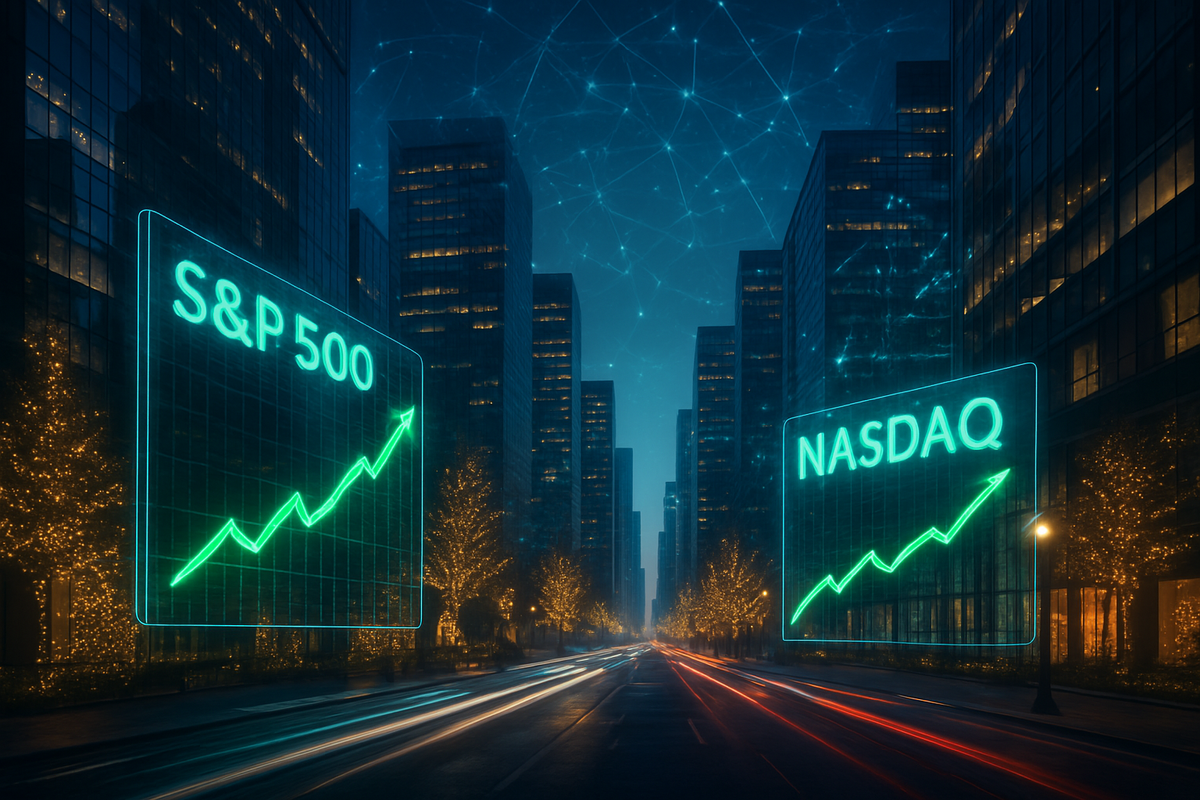
As the final full week of 2025 begins, investors are finding plenty of reason for holiday cheer. On Monday, December 22, 2025, the S&P 500 and the Nasdaq Composite surged in early trading, buoyed by a resurgence in technology shares and growing optimism that the elusive "Santa Claus Rally" is finally taking flight. Following a year marked by geopolitical "tariff shocks" and a historic 43-day government shutdown, the market's resilience is on full display as it heads into the holiday-shortened session.
The immediate implications of this rally are significant for year-end portfolio positioning. With the S&P 500 hovering near the 6,900 mark and the Nasdaq pushing toward 23,400, institutional fund managers are engaging in "window dressing"—buying up the year's top performers to bolster their annual reports. This momentum, led by the "Agentic AI" revolution, suggests that the market may be poised to end 2025 at or near record highs, providing a robust springboard for the 2026 trading year.
Tech-Led Momentum Defies Mid-Month Volatility
The current upward trajectory follows a period of localized turbulence in early December. After the Federal Reserve delivered its third consecutive interest rate cut on December 10, lowering the federal funds rate to a range of 3.50%–3.75%, markets initially saw a "sell the news" reaction. However, as of this morning, December 22, the narrative has shifted back to growth. Technology shares, particularly those in the semiconductor and AI infrastructure space, have reclaimed their leadership roles. The Nasdaq-100 is currently testing the 25,350 level, driven by a 2.4% jump in early trading.
This timeline of events reveals a market that has successfully digested several 2025 "black swan" events. Earlier this spring, the "Liberation Day" tariffs sent shockwaves through global supply chains, and the autumn was dominated by a paralyzing government shutdown that lasted through much of November. The current rally represents a "relief trade" as investors look past these disruptions toward a "soft landing" scenario. Key stakeholders, including major hedge funds and retail investors, are now betting that the seasonal "Santa Claus" window—historically defined as the last five trading days of December and the first two of January—will deliver its traditional 1.3% average gain.
Market reactions this morning have been overwhelmingly positive, with trading volume concentrated in high-conviction AI plays. Analysts note that the current environment is a "Goldilocks" setup: inflation has moderated to 2.4%, the Fed is in an accommodative stance, and corporate earnings are projected to grow by 13% to 15% in the coming year. This combination of liquidity and earnings growth is effectively neutralizing the "valuation fatigue" that plagued the tech sector during the summer months.
Winners and Losers in the Year-End Sprint
The primary beneficiaries of this late-year surge are the titans of the AI infrastructure trade. Nvidia (NASDAQ: NVDA) continues to lead the pack, as demand for its latest Blackwell-integrated systems remains insatiable. Similarly, Micron Technology (NASDAQ: MU) has seen its shares climb after announcing that its HBM4 (High Bandwidth Memory) capacity is completely sold out through 2026. These companies are not just riding a wave of hype; they are reporting record revenues that justify their premium valuations. Apple (NASDAQ: AAPL) has also found new life in late 2025 as its integration of "Agentic AI" into the latest iPhone hardware begins to show measurable consumer adoption.
On the other side of the ledger, the "Old Economy" and rate-sensitive sectors continue to struggle. Despite the Fed's recent cuts, mortgage rates remain above 6%, leaving homebuilders like Lennar Corp (NYSE: LEN) as notable laggards. The retail sector is also seeing a sharp divide; while tech-forward retailers thrive, traditional players like Nike (NYSE: NKE) and Lululemon Athletica (NASDAQ: LULU) have faced significant headwinds due to the 14.4% average tariff rate on imported goods. Nike, in particular, has seen its margins compressed by nearly 300 basis points this year, making it a frequent target for year-end tax-loss harvesting.
Furthermore, software-as-a-service (SaaS) firms that have failed to demonstrate clear AI-driven ROI are being punished. ServiceNow (NYSE: NOW) and The Trade Desk (NASDAQ: TTD) have faced "client spending discipline," as enterprise budgets are increasingly diverted toward hardware and infrastructure rather than traditional software subscriptions. This "Great Rotation" within the tech sector itself highlights a market that is becoming increasingly discerning about where it allocates capital.
The 'Agentic AI' Era and Historical Precedents
The wider significance of this rally lies in the maturation of the artificial intelligence narrative. In 2023 and 2024, the market was driven by the potential of large language models. In late 2025, we have entered the era of "Agentic AI"—systems capable of autonomous reasoning and executing complex workflows without human intervention. This shift is beginning to show up in the productivity data of S&P 500 companies, which is helping to sustain high margins despite rising labor costs and a 4.6% unemployment rate.
Historically, the Santa Claus Rally has a success rate of nearly 79% when the market enters the final week of the year with positive momentum. This event fits into a broader trend of "seasonal strength" that often follows a Fed easing cycle. However, the 2025 version is unique due to the "tariff-inflation" tug-of-war. While tariffs act as a drag on the consumer, the Fed’s pivot to a 3.5% rate has provided the necessary liquidity to keep the equity engine humming.
The ripple effects are also being felt by competitors and partners of the "Magnificent Seven." As Microsoft (NASDAQ: MSFT) and Alphabet (NASDAQ: GOOGL) expand their AI agent ecosystems, a secondary tier of beneficiaries in the energy and utility sectors is emerging. Companies with direct data-center exposure are being treated as "AI plays," while traditional regulated utilities are being left behind. This divergence suggests that the "AI trade" is no longer a single monolith but a complex web of infrastructure, energy, and implementation plays.
What Comes Next: The Road to 2026
Looking ahead to the final trading days of 2025 and the start of 2026, the short-term outlook remains bullish. Technical analysts suggest that if the S&P 500 can clear the psychological 7,000 resistance level during the first week of January, it could trigger a massive "melt-up" as sidelined cash returns to the market. Strategic pivots will be required for investors who are overweight in "tariff-sensitive" consumer discretionary stocks, as these headwinds are expected to persist well into the new year.
In the long term, the market is eyeing a 2026 target of 7,500 for the S&P 500, as projected by major institutions like Goldman Sachs (NYSE: GS) and Morgan Stanley (NYSE: MS). However, challenges remain. The "terminal rate" for the Fed is expected to settle near 3.0%, meaning the era of "free money" is not returning. Investors must navigate a "jobless expansion" narrative, where corporate profits remain high due to automation, but consumer confidence remains fragile following the 2025 government shutdown.
The potential for a "January Effect"—where small-cap stocks in the Russell 2000 catch up to their large-cap peers—is a scenario many are watching closely. If the broader economy continues its "soft landing," we could see a massive rotation into the laggards of 2025, providing a more balanced and healthy market structure for the year ahead.
A Resilient Finish to a Turbulent Year
As we wrap up the first session of this holiday-shortened week, the key takeaway is the market's remarkable ability to climb a "wall of worry." From historic tariffs to political gridlock and a government shutdown, the U.S. equity market has found its footing through a combination of technological innovation and a flexible Federal Reserve. The Santa Claus Rally appears to be more than just a seasonal myth this year; it is a fundamental expression of confidence in the "Agentic AI" economy.
Moving forward, investors should watch for the "January Barometer"—the theory that as January goes, so goes the year. A strong finish to December followed by a positive January would historically signal another double-digit gain year for 2026. However, the lasting impact of the 2025 tariff regime on corporate margins will remain the primary "X-factor" that could dampen enthusiasm in the spring.
For now, the trend is undeniably higher. As long as the AI infrastructure spend remains robust and the Fed stays on its path of gradual easing, the path of least resistance for the S&P 500 and Nasdaq remains upward. Investors should keep a close eye on the 7,000 level for the S&P 500 as the ultimate confirmation that Santa has indeed arrived on Wall Street.
This content is intended for informational purposes only and is not financial advice.