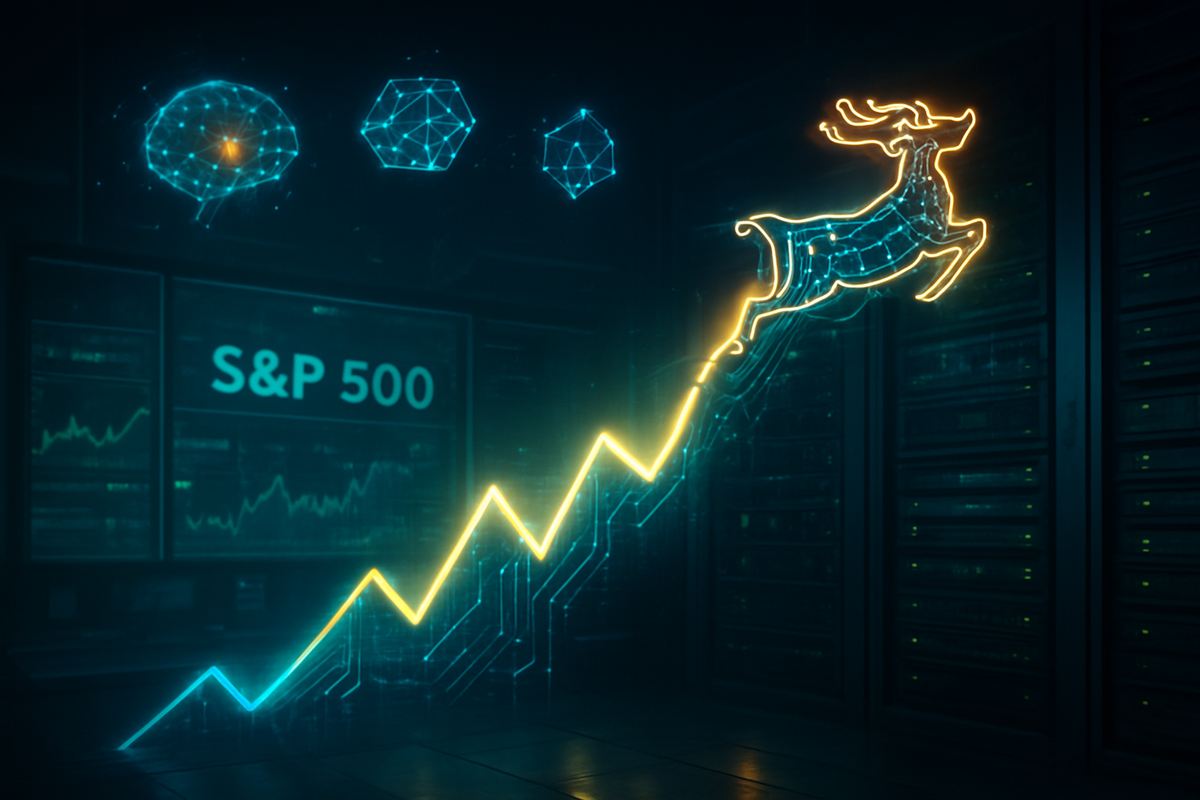
As the final trading days of 2025 unfold, the traditional "Santa Claus Rally" has returned to Wall Street with a vengeance, but the playbook has been fundamentally rewritten. On Christmas Eve, the S&P 500 (NYSE: SPY) surged to a historic close of 6,909.79, marking its 38th record high of the year and bringing the index within striking distance of the psychological 7,000 barrier. This year-end surge is not merely a product of seasonal optimism; it is the culmination of a "Great Bifurcation" in the technology sector, where the focus has shifted from the mere generation of text to the autonomous execution of complex tasks—a phenomenon known as "Agentic AI."
The rally is being underpinned by a rare alignment of monetary policy and industrial strategy. The Federal Reserve, having successfully navigated a "soft landing," executed its third 25-basis-point rate cut of the year in December, bringing the federal funds rate down to a range of 3.5%–3.75%. Simultaneously, the federal government’s "Genesis Mission"—a late-year initiative to centralize massive datasets for sovereign AI development—has signaled to investors that the AI revolution is transitioning from a commercial trend into a permanent pillar of national infrastructure.
The Year of the Agent: How 2025 Redefined the Market Landscape
The 2025 rally represents a departure from the speculative fever of 2023 and 2024. Throughout this year, the narrative matured from "Generative AI" (tools like ChatGPT that create content) to "Agentic AI" (autonomous systems that can plan, reason, and execute workflows). By late December, data from Google Cloud (NASDAQ: GOOGL) indicated that over 52% of major enterprises had deployed AI agents into production. These agents are no longer just chatbots; they are autonomous entities managing high-frequency trading, self-healing IT networks, and end-to-end supply chain logistics without human intervention. This shift has driven productivity gains of 25% to 40% in early-adopter firms, providing the fundamental earnings growth needed to justify record-high valuations.
The timeline leading to this moment was marked by several critical milestones. In November 2025, the release of GPT-5 by OpenAI and Gemini 2.0 by Alphabet (NASDAQ: GOOGL) introduced "reasoning cores" that allowed AI to handle multi-step planning. This was followed by the December 11 signing of the "National Policy Framework" Executive Order, which aimed to preempt restrictive state-level AI regulations and establish a pro-growth federal standard. Initial market reactions were electric, as the certainty of a deregulatory environment combined with falling interest rates created a "Goldilocks" scenario for tech-heavy portfolios.
The Federal Reserve's role cannot be overstated. After a period of internal dissent, the FOMC’s December cut signaled that the central bank is willing to tolerate inflation slightly above its 2% target (currently hovering around 2.6%) in exchange for sustained economic expansion. This "neutral" stance has provided the necessary liquidity for the Santa Claus Rally to take flight, even as some hawks warn that the market may be pricing in too much perfection for 2026.
Winners and Losers: The Great AI Bifurcation
The 2025 rally has not been a "rising tide lifts all boats" event. Instead, it has rewarded the "picks and shovels" of the infrastructure layer and the "Agentic-first" software leaders, while punishing legacy firms that failed to adapt. Among the clear winners is NVIDIA (NASDAQ: NVDA), which gained approximately 36% in 2025 as its Blackwell and H200 chip cycles continued to dominate the data center market. However, the real surprises came from the storage and networking sectors. Seagate (NASDAQ: STX) and Western Digital (NASDAQ: WDC) saw triple-digit gains this year, driven by the "historic demand" for high-capacity storage required to house the massive datasets utilized by agentic models.
Palantir Technologies (NYSE: PLTR) emerged as a standout winner in the software space, rising over 150% as its AI Platform (AIP) became the foundational operating system for autonomous enterprise decision-making. Similarly, specialized hardware players like Lumentum (NASDAQ: LITE) saw explosive growth due to the demand for optical components in hyper-scale GPU clusters. These companies have successfully transitioned from the "hype" phase to the "monetization" phase, proving to investors that their AI-driven revenue streams are both durable and scalable.
Conversely, the 2025 rally has left several former darlings in its wake. Salesforce (NYSE: CRM) and ServiceNow (NYSE: NOW) faced significant valuation pressure as investors questioned whether their traditional seat-based licensing models could survive in a world where AI agents replace human workers. Adobe (NASDAQ: ADBE) also struggled, with shares down 15% year-to-date as generative AI tools began to disintermediate professional creative suites. Perhaps the most dramatic fall was Oracle (NYSE: ORCL), which saw a 42% slump from its peak after a massive $10 billion data center financing deal collapsed in late 2025, highlighting the "AI debt" risks facing companies that overextended their capital expenditures.
Historical Precedents and the Regulatory Frontier
To understand the 2025 rally, analysts are looking back to the 1999 dot-com boom and the 2021 post-pandemic surge. Unlike 1999, where many "market darlings" lacked earnings, the leaders of 2025 are generating over $2 trillion in combined annual profits. However, the concentration of the market has reached extreme levels, with the top ten names in the S&P 500 now accounting for over 40% of the index's total value. This concentration mirrors the fragility seen in previous eras, though the underlying cash flows are significantly more robust today.
The regulatory landscape is also undergoing a tectonic shift. While the federal government is pushing for deregulation through the "National Policy Framework," states like New York and California are pushing back with their own safety acts. The New York RAISE Act, signed in late 2025, mandates strict governance for "frontier" models, creating a complex patchwork of compliance that global firms must navigate. Internationally, the full implementation of the EU AI Act in 2025 has forced a "risk-based" approach to development, which some fear could slow the pace of innovation in Europe compared to the more aggressive "America-first" stance adopted in Washington.
This event fits into a broader industry trend where AI is no longer a "feature" but the core architecture of the global economy. The ripple effects are being felt in the labor market, where sectors like media and communications saw a 15.8% drop in job postings in 2025 as agents began automating routine editorial and content tasks. This "productivity paradox"—where corporate profits soar while certain labor segments contract—is likely to be a central political and economic theme as we head into 2026.
Looking Ahead: ROI Anxiety and the 2026 Outlook
As we move toward the new year, the primary challenge for the market will be "ROI Anxiety." After two years of massive capital expenditure on AI infrastructure, investors are beginning to demand clear evidence of return on investment. The short-term outlook remains bullish, as the Santa Claus Rally typically provides a tailwind for the first two trading days of January. However, the strategic pivot required for 2026 will involve moving beyond "agentic pilots" to full-scale autonomous operations that can demonstrably lower operating expenses.
Potential scenarios for 2026 range from a continued "AI Supercycle" to a significant correction if enterprise adoption slows. One emerging challenge is the "AI debt" associated with the rapid build-out of data centers. As seen with Oracle’s recent struggles, the cost of financing and powering the AI revolution is becoming a significant headwind. Companies that can find energy-efficient ways to run inference—or those that can leverage "small language models" for specific tasks—may find themselves the new leaders of the next phase of the rally.
A New Era for the S&P 500
The 2025 Santa Claus Rally is a testament to the transformative power of Agentic AI and the resilience of a market supported by a pragmatic Federal Reserve. The key takeaway for investors is that the "AI trade" has matured; it is no longer enough for a company to simply mention AI in an earnings call. The market is now ruthlessly separating the "enablers" and "executors" from the "laggards" and "legacy" firms.
Moving forward, the S&P 500's trajectory will likely be dictated by the speed at which autonomous systems can be integrated into the broader economy without triggering severe regulatory or social backlash. While the current rally has pushed valuations to historic levels, the massive cash flows of the tech giants provide a safety net that was absent in 1999. Investors should watch closely for the Fed’s first meeting in 2026 and the Q4 earnings reports in late January, which will serve as the first real test of whether the "Agentic" promises of 2025 can be converted into the hard profits of 2026.
This content is intended for informational purposes only and is not financial advice.