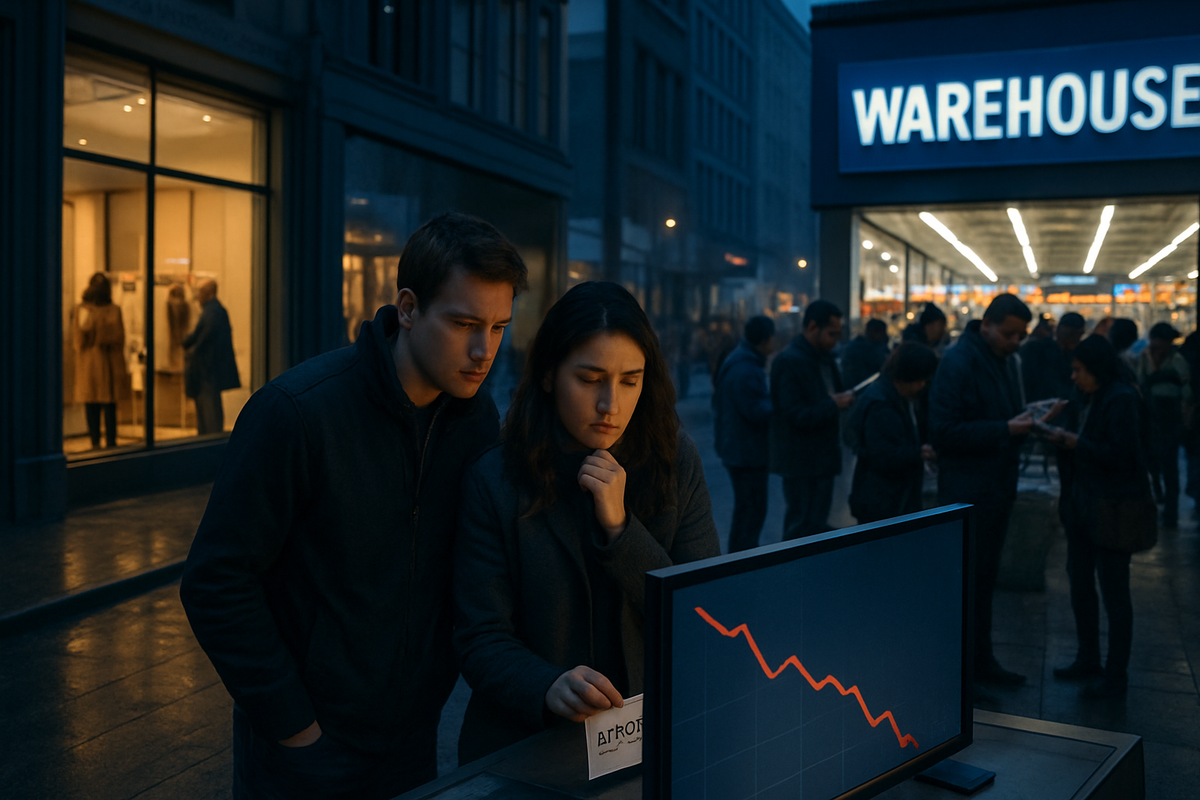
As the 2025 holiday season draws to a close, the American consumer appears to be ending the year in a state of "selective resilience." While nominal holiday spending officially crossed the historic $1 trillion milestone for the first time this December, a deeper dive into the data reveals an economy at a precarious crossroads. Beneath the surface of record-breaking dollar figures lies a significant slowdown in unit volume and a sharp contraction in discretionary demand, driven by a "double squeeze" of persistent inflation and the most aggressive trade tariff regime in nearly a century.
This deceleration is casting a long shadow over the "soft landing" narrative that dominated Wall Street throughout the summer. With the Federal Reserve’s preferred inflation gauge, the Personal Consumption Expenditures (PCE) index, remaining "sticky" at 2.9% and consumer confidence hovering at recessionary levels, the margin for error for the U.S. economy in 2026 has narrowed to its thinnest point in years. Investors are now grappling with a "K-shaped" spending environment where high-income resilience masks a deepening "vibecession" among middle- and low-income households.
The path to this late-year slowdown was paved by a series of unprecedented disruptions. The most significant was a 43-day federal government shutdown that lasted from October 1 to November 12, 2025. This "data blackout" forced the Federal Reserve and market participants to fly blind during the critical early weeks of the holiday shopping season, relying on high-frequency alternative data that often provided conflicting signals. When official reports finally resumed in mid-December, they painted a picture of a consumer who was "tired but standing."
Total holiday retail sales for November and December 2025 are projected to hit approximately $1.02 trillion, a 4.2% nominal increase over 2024. However, when adjusted for the "Liberation Day" tariffs implemented earlier in the year, real inflation-adjusted growth was a much more modest 2.2%. The cracks were most visible during Cyber Week, where dollar sales actually declined by 1.3% and unit volume fell by 4.4% compared to the previous year. This suggests that the traditional "deal-hunting" peak failed to ignite the usual frenzy, as shoppers faced price hikes of up to 20% in electronics and toys—sectors most heavily impacted by the 100% tariffs on Chinese imports.
The initial market reaction has been one of cautious repricing. Equity indices, which hit record highs in early Q4, have seen a rotation out of high-beta discretionary stocks and into defensive "value" plays. The "Expectations Index" from the Conference Board has now remained below the critical recession-warning threshold of 80 for 11 consecutive months, a streak that historically precedes a technical recession within six to twelve months. As of December 25, 2025, the consensus among analysts is that while a total collapse has been avoided, the "Goldilocks" era of high growth and low inflation is firmly in the rearview mirror.
The shift toward value-oriented shopping has created a stark divide among large-cap retail and discretionary stocks. Walmart Inc. (NYSE: WMT) has emerged as the undisputed leader of the "trade-down" effect, with its stock hitting all-time highs of $117 in late December. As middle-income families look to stretch their budgets, Walmart’s dominance in the grocery sector and its revamped e-commerce platform have allowed it to capture market share from more specialized retailers. Similarly, Costco Wholesale Corp. (NASDAQ: COST) has seen its membership model act as a fortress, with a $17 billion cash pile providing a safety net that investors find increasingly attractive.
In the off-price sector, The TJX Companies, Inc. (NYSE: TJX) and Ross Stores, Inc. (NASDAQ: ROST) have both seen significant gains, rising 6.8% and 12.5% respectively in the final quarter of the year. Burlington Stores, Inc. (NYSE: BURL) also capitalized on the trend, ending December on a winning streak as shoppers prioritized brand-name apparel at steep discounts. Even Amazon.com, Inc. (NASDAQ: AMZN) managed to maintain its footing, as its massive logistics network and AWS cloud revenue provided a cushion against the softening of its retail unit margins.
Conversely, the "losers" of this environment are companies tied to big-ticket discretionary spending and high tariff exposure. Nike, Inc. (NYSE: NKE) has struggled with the dual burden of slowing consumer demand and rising input costs from trade disputes. In the automotive and tech sectors, Tesla, Inc. (NASDAQ: TSLA) faced a downgrade from major analysts as the "shrinking ranks" of EV bulls grappled with weakening demand for premium vehicles. The Home Depot, Inc. (NYSE: HD) and Best Buy Co., Inc. (NYSE: BBY) have also felt the pinch, with analysts cutting price targets as consumers delay home renovations and gadget upgrades in favor of essential spending. Even the high-end EV maker Lucid Group, Inc. (NASDAQ: LCID) saw a sharp 5.4% sell-off in late December as cash burn concerns intensified.
The current economic landscape draws chilling parallels to the "Nixon Shock" of 1971, when a 10% universal import surcharge was used to combat trade imbalances, eventually leading to the stagflationary cycles of the 1970s. The 2025 "Liberation Day" Executive Order 14257, which imposed a 10% baseline tariff and much higher reciprocal rates, has functioned as a de facto consumption tax, draining an estimated $1,300 to $2,500 from the average household's annual purchasing power.
This policy-driven squeeze is occurring alongside a monetary environment reminiscent of the Volcker era of the early 1980s. While interest rates are not at 20% levels, the cumulative effect of the Fed's "higher for longer" stance has led to a "wait-and-see" attitude among consumers for durable goods. The historical precedent of 1930 and the Smoot-Hawley Tariff Act also looms large; while 2025 has not seen the same collapse in trade volume, the 20% price increases in targeted sectors have mirrored the supply shocks that can turn a slowdown into something more systemic.
Furthermore, the legislative tug-of-war over the Trade Review Act of 2025 has created what some call "economic purgatory." With Congress attempting to reassert authority over executive tariffs, businesses have been hesitant to invest in inventory or hiring, further cooling the labor market. While November saw a surprise addition of 64,000 jobs, the underlying trend in consumer sentiment suggests that the "vibecession"—where the public feels the economy is worse than the headline GDP suggests—is now a structural reality.
In the short term, the market will be hyper-focused on whether the Federal Reserve initiates a "dovish pivot" in the first quarter of 2026. If consumer spending continues to stall, the Fed may be forced to cut rates even if inflation remains above its 2% target, a move that would prioritize growth over price stability. For retailers, the strategic pivot is already underway: expect a massive shift toward "private label" generic brands and an intensification of loyalty programs as companies fight for a shrinking pool of discretionary dollars.
The long-term challenge will be the "tariff sunset" debates in Congress. If the Trade Review Act gains traction, we could see a period of market volatility as trade pacts are renegotiated. However, this could also provide a relief valve for consumer prices by mid-2026. Investors should watch for a "normalization" of spending patterns, where the extreme bifurcation between the wealthy and the working class begins to narrow—either through a cooling of the luxury market or a recovery in middle-class purchasing power.
As we wrap up 2025, the key takeaway is that the "soft landing" is no longer a guarantee; it is a moving target. The U.S. consumer is exhausted by years of price volatility and is now responding with a disciplined, value-first approach to spending. The market moving forward will likely reward companies with strong balance sheets and essential-service business models, while punishing those reliant on cheap credit or globalized supply chains vulnerable to trade wars.
The lasting impact of 2025 will be the realization that nominal growth can be a mirage. For investors, the months ahead require a focus on "real" metrics—unit volumes, foot traffic, and household debt-to-income ratios. While the $1 trillion holiday season is a headline-grabbing achievement, the true health of the market will be determined by whether the consumer can survive the "soft landing" squeeze without falling into a full-scale retrenchment.
This content is intended for informational purposes only and is not financial advice.