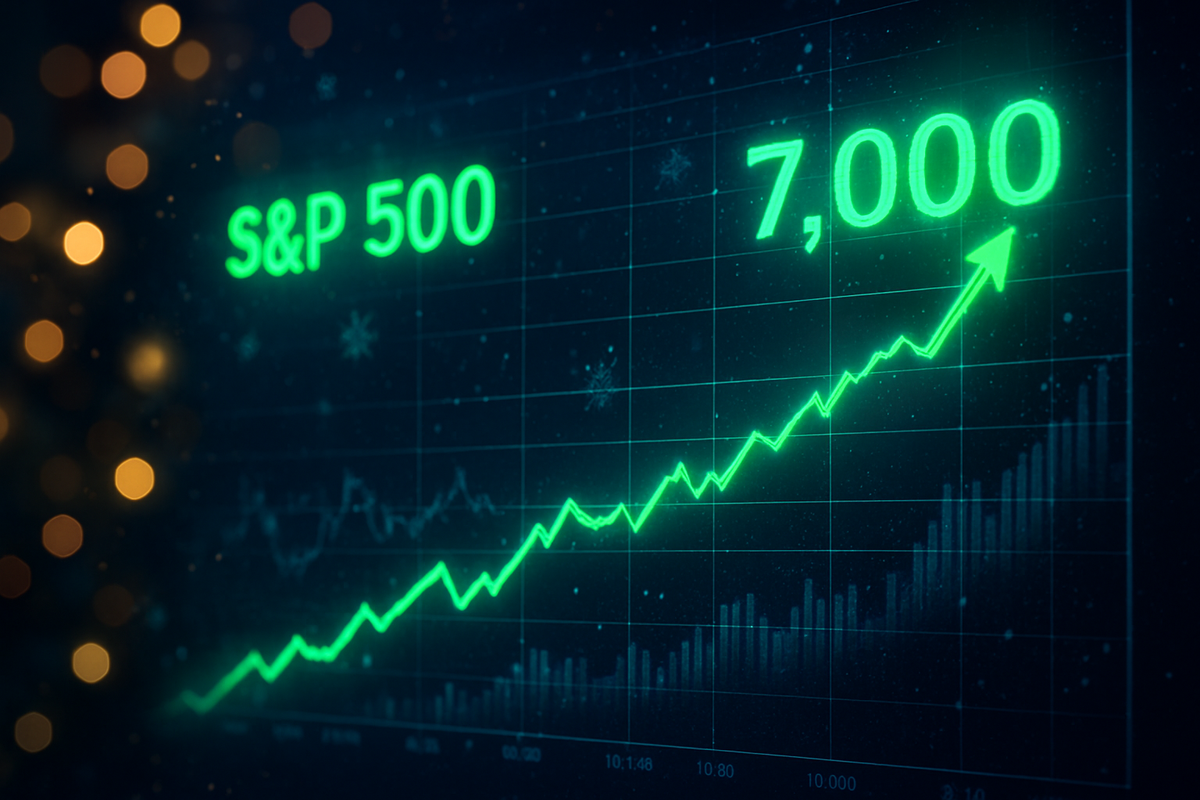
NEW YORK — As the final trading week of 2025 unfolds, the S&P 500 (NYSEARCA: SPY) has ascended to breathtaking new heights, fueled by a classic "Santa Claus Rally" that has pushed the benchmark index to a record close of 6,932.18 as of December 26, 2025. This year-end surge, characterized by light trading volumes and heavy seasonal optimism, has brought the psychological milestone of 7,000 within striking distance, capping off a year that defied early-year skepticism and recessionary fears.
The current rally is not merely a holiday fluke; it represents the culmination of a robust fourth-quarter expansion. Market participants are witnessing a convergence of favorable factors: a definitive pivot by the Federal Reserve, which delivered its third consecutive rate cut earlier this month, and the continued legislative tailwinds from the "One Big Beautiful Bill Act" (OBBBA). For investors, the immediate implication is a market that appears nearly unstoppable, though technical analysts are beginning to flag signs of exhaustion as the index enters overbought territory.
A Season of Record-Breaking Momentum
The 2025 Santa Claus Rally officially commenced on December 19, following a brief period of mid-month consolidation. Since then, the S&P 500 has climbed steadily, gaining nearly 2.4% in just five trading sessions. Historically, the seven-day window spanning the last five days of December and the first two of January yields an average return of 1.3%. The 2025 iteration is already tracking well ahead of this historical norm, driven by a rare combination of retail enthusiasm and institutional "window dressing," where fund managers add winning stocks to their portfolios to improve the appearance of their year-end holdings.
The timeline leading to this moment was defined by a series of pivotal economic shifts. Throughout the summer of 2025, the market grappled with "sticky" inflation, but a sharp cooling in labor costs by October allowed the Federal Reserve to shift from a restrictive stance to a supportive one. The central bank’s decision to cut the federal funds rate by 25 basis points in November and again in December acted as high-octane fuel for the equities market. By the time the holiday season arrived, the "soft landing" narrative had been replaced by a "no landing" scenario of continued growth and easing credit conditions.
Key stakeholders, including major institutional players like BlackRock (NYSE: BLK) and Goldman Sachs (NYSE: GS), have noted that the current rally is broader than the tech-heavy surges of 2023 and 2024. While the "Magnificent Seven" continue to lead, there has been a noticeable rotation into mid-cap stocks and cyclical sectors. Initial market reactions to the 6,900 breakthrough on December 23 were overwhelmingly positive, with the CBOE Volatility Index (VIX) dropping to multi-year lows, signaling a period of extreme complacency—or confidence—among traders.
Winners and Losers in the Year-End Push
The primary beneficiaries of this late-year surge are the titans of the AI infrastructure boom. NVIDIA (NASDAQ: NVDA) has once again emerged as the rally's standard-bearer, with its stock price hitting new all-time highs as data center demand shows no signs of peaking. Similarly, Microsoft (NASDAQ: MSFT) has seen a significant boost, as its integrated AI services began contributing meaningfully to bottom-line earnings in the second half of 2025. These companies have become the "safe havens" of the growth world, attracting capital from both domestic and international investors.
Consumer discretionary stocks are also seeing a significant "Santa" lift. Amazon (NASDAQ: AMZN) reported record-breaking holiday sales figures, benefiting from a consumer base emboldened by lower interest rates and a strong labor market. Meanwhile, the financial sector, led by JPMorgan Chase & Co. (NYSE: JPM), has rallied as the Fed’s rate cuts stabilized the yield curve, improving net interest margins and reviving the dormant IPO and M&A markets.
However, the rally has not been kind to everyone. Defensive sectors, such as Utilities and Consumer Staples, have largely been left behind as investors chase growth. Companies like Duke Energy (NYSE: DUK) and The Procter & Gamble Company (NYSE: PG) have seen their relative valuations compress as the "risk-on" sentiment dominates the floor. Additionally, firms heavily reliant on high-cost legacy debt that have failed to transition to the new AI-driven economy are finding themselves sidelined, despite the overall market's upward trajectory.
Technical Significance and Historical Precedents
From a technical perspective, the S&P 500’s ascent to 6,932 is highly significant. The index has successfully breached the 6,900 "battleground" level, which had served as a ceiling for much of November. The next major resistance is the 6,950–6,960 zone, followed by the formidable 7,000 psychological barrier. Currently, the index is trading well above its 50-day and 200-day moving averages, which stand at 6,780 and 6,115, respectively. This gap indicates strong momentum but also suggests that the market is "stretched" and could be due for a mean-reversion event in early 2026.
The 2025 rally draws comparisons to the historic year-end surges of 1999 and 2021. Like those periods, the current market is characterized by high valuations and a "fear of missing out" (FOMO) among retail investors. However, unlike the dot-com bubble, the 2025 rally is backed by substantial corporate earnings and a tangible technological shift in productivity. The historical precedent established by Yale Hirsch in the 1970s suggests that a strong Santa Claus Rally often bodes well for the first quarter; conversely, a "no-show" rally is often a harbinger of a bear market. With Santa clearly present this year, the historical odds favor a positive start to 2026.
Broadly, this event fits into the trend of "market broadening." While the S&P 500 is market-cap weighted, the equal-weighted version of the index is also hitting records, suggesting that the rally is healthy and not just a product of a few mega-cap stocks. Regulatory implications also loom; the success of the OBBBA has provided a stable fiscal environment, but any shifts in trade policy or antitrust enforcement in the coming year could quickly dampen the current euphoria.
The Road to 7,000 and Beyond
As we look toward the first week of January 2026, the primary question is whether the S&P 500 can maintain its velocity to hit the 7,000 mark. Short-term, a "January hangover" is a distinct possibility. Historically, the first few days of the new year often see profit-taking as investors lock in gains from the previous year’s rally, particularly for tax purposes. If the index fails to hold the 6,800 support level during a pullback, it could signal a deeper correction.
In the long term, the market's trajectory will depend on the Federal Reserve’s path. If the Fed continues to cut rates into a strong economy, there is a risk of reigniting inflation, which would force a strategic pivot back to a hawkish stance. Investors should also watch for the "January Effect," where small-cap stocks often outperform large-caps in the first month of the year. A rotation into the Russell 2000 (NYSEARCA: IWM) could be the next phase of this bull market cycle.
Strategic adaptations will be required for those who have been "underweight" equities during this run. The challenge now is entering the market at record highs without overextending. We may see a rise in defensive hedging strategies or a shift toward "value" names that have yet to participate fully in the 2025 surge.
Final Thoughts for the 2026 Outlook
The 2025 Santa Claus Rally has been a masterclass in market resilience. The S&P 500's climb to 6,932 reflects a world that has largely moved past the post-pandemic inflationary shocks and embraced a new era of technological efficiency and fiscal support. The key takeaway for investors is that while the trend is undeniably bullish, the "easy money" of the 2025 rally may be nearing its end as technical indicators reach extreme levels.
Moving forward, the market's health will be judged by its ability to digest these gains without a chaotic sell-off. The psychological 7,000 level will be the ultimate test of investor conviction in the coming weeks. As the calendar turns, the focus will shift from seasonal cheer to the hard reality of Q4 earnings reports and the sustainability of the AI-driven growth model.
Investors should remain vigilant, watching for any signs of a "failed" rally in the first two trading days of January. While Santa has delivered a historic gift this year, the market's lasting impact will be determined by how it handles the inevitable transition from holiday exuberance to the disciplined reality of a new trading year.
This content is intended for informational purposes only and is not financial advice.