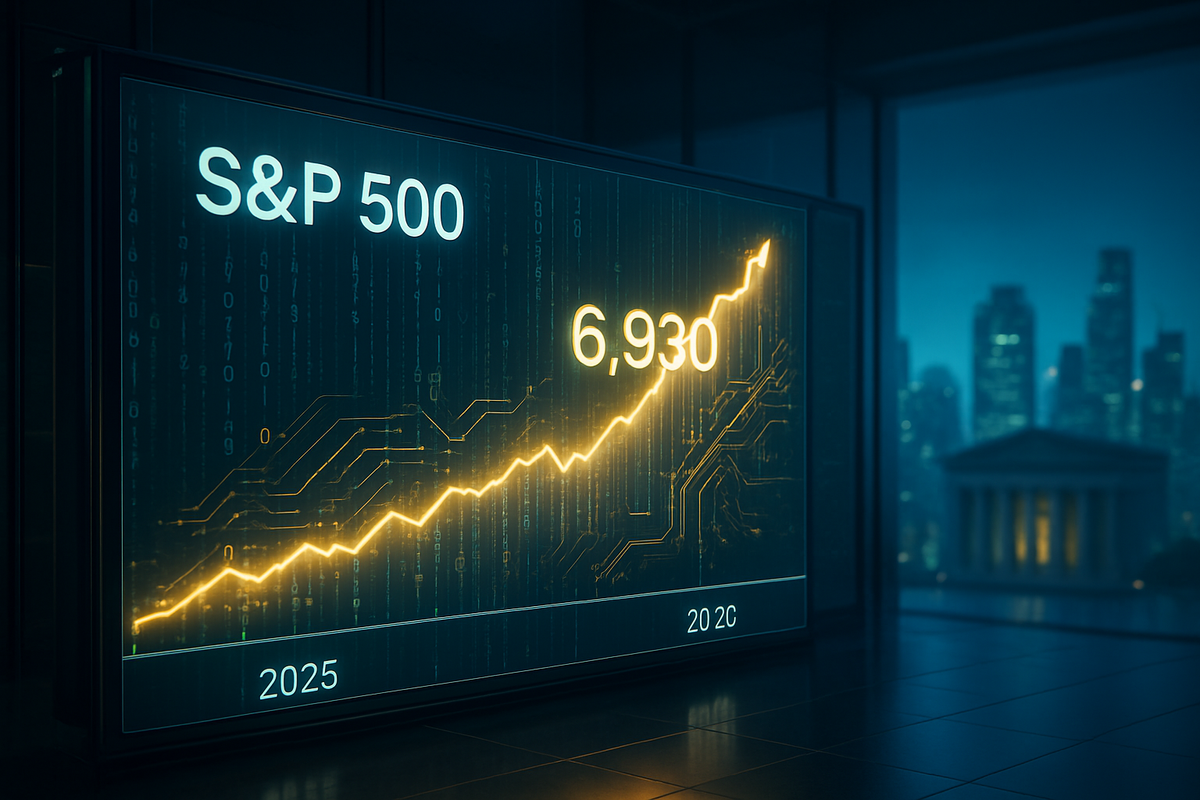
The S&P 500 has officially crossed the threshold into 2026, carrying the momentum of a historic 2025 that saw the index defy skeptics and reach unprecedented heights. Ending the year at a record 6,930, the benchmark index posted a total return of approximately 17.8%, marking its third consecutive year of double-digit gains. This rally was fueled by a unique cocktail of "Goldilocks" economic data, a pivotal shift in Federal Reserve policy, and an insatiable appetite for artificial intelligence infrastructure that has fundamentally reshaped the corporate landscape.
As investors flip their calendars, the immediate implications are clear: the market is transitioning from a period of speculative hype to a "show-me" phase. While the "soft landing" narrative largely played out in 2025, the new year brings a fresh set of challenges, including the need for companies to prove that their massive AI investments can translate into bottom-line profits. With the Federal Reserve signaling a more cautious easing path and global trade dynamics remaining fluid, the 2026 outlook is one of measured optimism tempered by the reality of high valuations and extreme market concentration.
A Year of Resilience: Recapping the 2025 Bull Run
The story of 2025 was one of remarkable economic endurance. The year began under a cloud of "higher for longer" interest rate fears, but the narrative shifted dramatically as inflation began a slow, albeit sticky, descent toward the 2.7% mark. This allowed the Federal Reserve to execute a long-awaited pivot, delivering three 25-basis-point rate cuts starting in September. This easing of monetary policy provided a critical tailwind for equities, particularly in the fourth quarter, as the benchmark rate was lowered to support a cooling labor market without triggering a full-scale recession.
Central to the 2025 rally was the "AI Supercycle." Capital expenditure from the world's largest technology firms—the "hyperscalers"—surged by nearly 70% as they raced to build out the data centers and hardware required for the next generation of computing. This massive spending spree insulated the broader market from pockets of weakness in the consumer discretionary and housing sectors. However, the year was not without its turbulence; an "April Slump" triggered by uncertainty over new trade tariffs saw the index retreat briefly before staging a powerful V-shaped recovery as investors bet on domestic manufacturing incentives.
Corporate earnings were the bedrock of this growth, with S&P 500 companies reporting an aggregate earnings increase of 13.2% for the year. Profit margins remained near historic highs of 13%, driven by aggressive cost-cutting measures and early-stage productivity gains from AI integration. By the time the closing bell rang on December 31, the S&P 500 had added trillions of dollars in market capitalization, cementing 2025 as one of the most profitable years for passive investors in recent memory.
The 2025 Honor Roll: Winners, Losers, and the AI Divide
The performance of 2025 was decidedly "K-shaped," creating a clear divide between the technological vanguard and legacy industries. The Information Technology and Communication Services sectors were the undisputed champions. Nvidia (NASDAQ: NVDA) continued its reign as the market's bellwether, but the spotlight expanded to include "back-end" infrastructure plays. Western Digital (NASDAQ: WDC) emerged as a surprise superstar, returning over 290% as the demand for AI-optimized storage solutions exploded. Similarly, Micron Technology (NASDAQ: MU) saw its stock soar as its entire 2025 supply of High-Bandwidth Memory (HBM) was sold out before the year even began.
Beyond the chipmakers, the "Magnificent Seven" evolved into a more nuanced group. Meta Platforms (NASDAQ: META) and Alphabet (NASDAQ: GOOGL) leveraged their AI-driven advertising tools to capture record-breaking revenue, while Microsoft (NASDAQ: MSFT) solidified its lead in the enterprise software space. On the industrial side, firms like GE Aerospace (NYSE: GE) and Caterpillar (NYSE: CAT) benefited from a resurgence in domestic infrastructure spending, proving that the rally had legs beyond just the Silicon Valley tech giants.
However, not every sector shared in the bounty. Interest-rate-sensitive areas, particularly regional banks and traditional real estate, struggled for much of the year until the Fed's September pivot. Legacy automotive manufacturers also faced headwinds as the transition to electric vehicles slowed and competition from overseas intensified. Companies that failed to articulate a clear AI or automation strategy found themselves increasingly sidelined by institutional investors who prioritized efficiency and future-proofing over traditional value metrics.
The Broader Significance: AI Maturity and Geopolitical Realities
The market's performance in 2025 signifies a major shift in the global economic order. We have moved past the "discovery" phase of generative AI and into the "deployment" phase. This transition is reminiscent of the late 1990s internet boom, but with a critical difference: today's market leaders are generating massive cash flows and possess fortress balance sheets. The significance of 2025 lies in the realization that AI is no longer a niche tech trend but a general-purpose technology that is beginning to influence every sector from healthcare to logistics.
Furthermore, the "April Slump" and subsequent recovery highlighted the market's increasing sensitivity to trade policy. The introduction of new tariffs and the "One Big Beautiful Bill Act" (OBBBA) stimulus have signaled a more protectionist and domestically focused economic policy. This has forced multinational corporations to rethink their supply chains, prioritizing "friend-shoring" and domestic production over global efficiency. This shift has profound implications for long-term inflation and the competitive positioning of U.S. firms versus their international peers.
Historically, 2025 will likely be viewed as the year the "soft landing" was achieved, but it also highlighted the risks of extreme market concentration. With the top 10 companies in the S&P 500 now representing nearly 38% of the index's total value, the broader market is more vulnerable than ever to the fortunes of a handful of tech titans. This concentration risk remains a primary concern for regulators and institutional allocators heading into 2026, as any stumble from the leaders could have an outsized impact on the entire financial system.
Looking Ahead to 2026: The "Show-Me" Year
As we look toward the remainder of 2026, the primary question for investors is whether corporate earnings can justify current valuations. Wall Street analysts have set ambitious targets, with Goldman Sachs (NYSE: GS) and Morgan Stanley (NYSE: MS) projecting the S&P 500 could reach between 7,600 and 7,800 by year-end. However, achieving these targets will require a successful handoff from "Capex-led" growth to "ROI-led" growth. Investors will be looking for concrete evidence that the billions spent on AI in 2025 are resulting in higher revenues or significantly lower operating costs.
The macroeconomic environment is expected to remain supportive but less explosive. Real GDP growth is projected to settle into a range of 1.8% to 2.1%, while the Federal Reserve is anticipated to follow a "shallow easing path" with one or two additional rate cuts in the first half of the year. This should bring the benchmark rate to a terminal range of 3.25% to 3.50%, a level that many economists believe is the "neutral" rate for a post-pandemic economy. Strategic pivots will be required for companies in the mid-cap space, which may finally see an opportunity to outperform as borrowing costs stabilize.
Wrap-Up: A Roadmap for the 2026 Investor
The S&P 500 enters 2026 in a position of strength, but the easy gains of the early recovery may be behind us. The key takeaways from 2025—the power of the AI supercycle, the resilience of the American consumer, and the importance of Fed policy—will continue to be the dominant themes. However, the margin for error has narrowed. Investors should watch closely for signs of "AI fatigue" in earnings reports and stay alert to the 35% probability of a recession that some analysts, including those at J.P. Morgan (NYSE: JPM), still maintain if the labor market cools too rapidly.
Moving forward, the market's health will depend on a broadening of the rally. For the bull market to sustain its pace, we need to see participation from the "other 493" companies in the S&P 500. In the coming months, keep a close eye on inflation data—specifically if it can reach the 2.4% forecast—and the impact of ongoing trade tensions on corporate margins. While the path to 8,000 is visible, it is paved with the requirement for disciplined execution and continued technological innovation.
This content is intended for informational purposes only and is not financial advice.