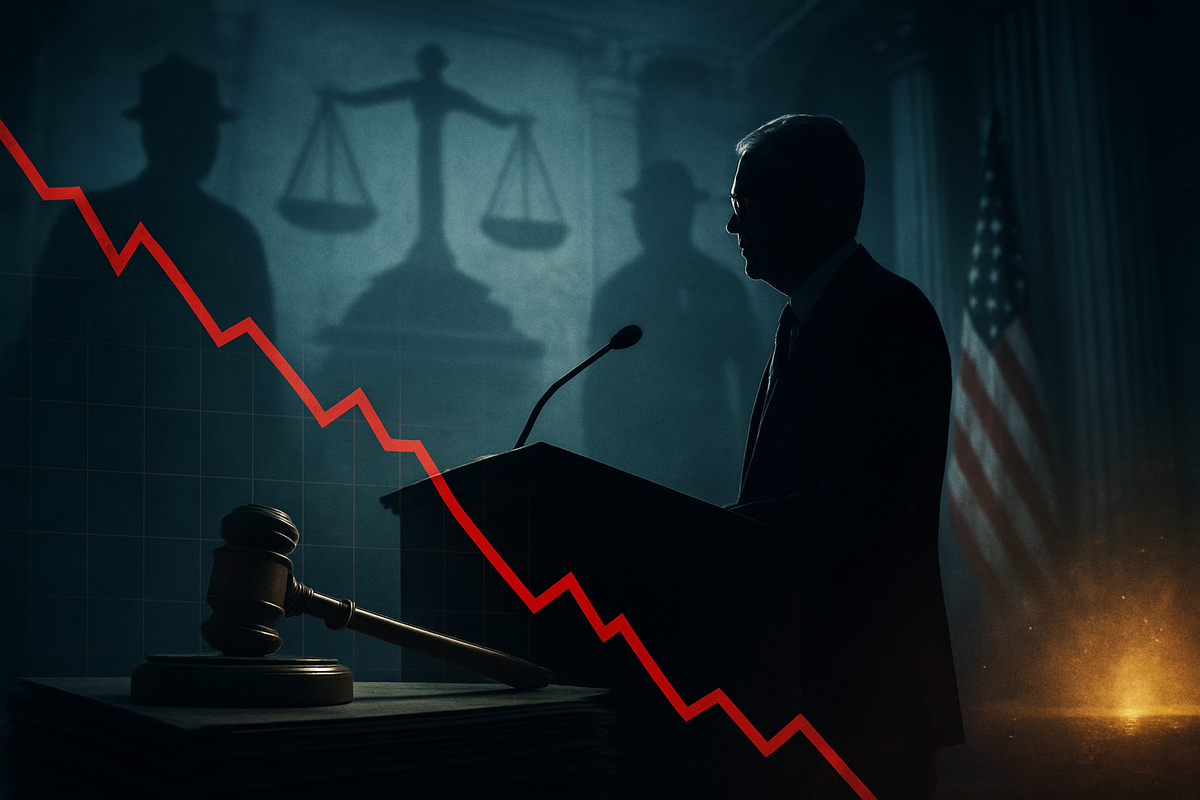
In a move that has sent shockwaves through global financial centers and ignited a constitutional firestorm, the Department of Justice (DOJ) has officially opened a criminal investigation into Federal Reserve Chair Jerome Powell. The probe, which centers on allegations of "lying to Congress" regarding a multibillion-dollar renovation of the Federal Reserve’s headquarters, marks an unprecedented escalation in the ongoing tension between the central bank and the executive branch. As news of the investigation broke, U.S. markets reacted with immediate volatility, with major indices struggling to find a floor as investors grappled with the implications of a potentially compromised or decapitated Federal Reserve.
The immediate implications are profound, as the investigation threatens to dismantle the long-standing tradition of Federal Reserve independence. Chair Powell, in a defiant video statement released on Sunday, January 11, 2026, characterized the investigation as a "pretext" designed to intimidate the Fed into implementing aggressive interest rate cuts. With the U.S. dollar dipping and safe-haven assets like gold and silver hitting all-time highs, the financial world is now forced to price in a "political risk premium" for U.S. institutions that was previously reserved for emerging markets.
A Targeted Strike on the Eccles Building
The investigation, led by U.S. Attorney Jeanine Pirro of the District of Columbia, focuses specifically on Powell’s June 2025 testimony before the Senate Banking Committee. At the heart of the matter is the $2.5 billion renovation of the Marriner S. Eccles Building and the adjacent Federal Reserve structure on Constitution Avenue. While the project was initially budgeted at $1.9 billion, costs ballooned by over $600 million—a discrepancy that Office of Management and Budget (OMB) Chair Russell Vought and other administration officials claim was intentionally obscured from congressional oversight. Allegations include the installation of "ostentatious" features and "special elevators," which the DOJ suggests may constitute a misuse of public funds and a failure of transparency.
The timeline of the escalation was rapid. On Friday, January 9, 2026, the DOJ served the Federal Reserve with grand jury subpoenas, demanding internal communications and accounting records related to the renovation project. By Sunday, the threat of a formal indictment was made public, prompting Powell to break the Fed’s traditional silence on political matters. In his address, Powell argued that the probe is a direct retaliation for the Fed’s refusal to meet the President’s demands for 2% interest rate cuts in 2025, during which the Fed only authorized 75 basis points of easing due to lingering inflation concerns.
Key players in this drama include not only Powell and Pirro but also prominent voices in Congress. Senator Elizabeth Warren and Senator Thom Tillis have both expressed alarm, though for different reasons; Warren warned against the "weaponization" of the DOJ, while Tillis suggested he would block any future Fed nominees until the legal matter is resolved. This political stalemate has created a vacuum of leadership at a time when the market is desperate for stability. Initial market reactions saw Dow Jones futures drop 230 points, while the U.S. Dollar Index (DXY) slipped to 98.89 as the international community questioned the stability of the American monetary system.
Financial Giants Retreat as "Hard Assets" Surge
The fallout on Wall Street has been stark, with the financial sector bearing the brunt of the "regime uncertainty." Major commercial banks and credit card issuers saw their share prices plummet as investors feared a politically compromised Fed would be unable to maintain its dual mandate of price stability and maximum employment. Synchrony Financial (NYSE: SYF) was among the hardest hit, dropping 8.5%, while Capital One Financial (NYSE: COF) and American Express (NYSE: AXP) saw declines of 6% and 4%, respectively. The sell-off in these stocks was exacerbated by fears that a weakened Fed would be unable to push back against proposed executive caps on credit card interest rates.
The "Big Four" banks were not spared either. JPMorgan Chase & Co. (NYSE: JPM) and Citigroup Inc. (NYSE: C) both saw significant retreats, with Citigroup falling nearly 4% as the "institutional risk premium" began to weigh on their valuations. Payment networks like Visa Inc. (NYSE: V) and Mastercard Incorporated (NYSE: MA) also traded lower, losing roughly 3% each. Analysts from Goldman Sachs Group Inc. (NYSE: GS) warned that the "weaponization" of oversight could lead to a long-term erosion of the "Fed Put," the long-held belief that the central bank would always step in to support markets during a crisis.
Conversely, the investigation has been a massive boon for the precious metals sector and "safe-haven" equities. As gold prices shattered records to cross $4,600 an ounce, Newmont Corporation (NYSE: NEM) and Barrick Gold Corporation (NYSE: GOLD) surged to all-time highs. Investors fleeing the dollar also sought refuge in high-cash-flow technology giants. Alphabet Inc. (NASDAQ: GOOGL) managed to hit a $4 trillion market cap on the same day, as its massive cash reserves and recent AI partnerships made it appear more like a sovereign entity than a vulnerable corporation. Meanwhile, Bitcoin (BTC) acted as a digital safe haven, trading above $91,000 as crypto-enthusiasts pointed to the chaos as proof of the need for decentralized finance.
The Erosion of the 112-Year Precedent
This event represents a seismic shift in the relationship between the U.S. government and its central bank, fitting into a broader trend of institutional erosion. Historically, the Federal Reserve has operated as an independent agency, with the Chair only removable "for cause"—typically interpreted as legal or ethical malpractice rather than policy disagreement. By framing the investigation around administrative mismanagement of building costs, the administration appears to be creating a legal "cause" to force Powell out before his term as Chair expires in May 2026. This tactic mirrors historical attempts by past presidents to influence the Fed, but with a degree of legal aggression that has no modern precedent.
The ripple effects are expected to be felt globally. If the DOJ succeeds in pressuring Powell to resign, it could trigger a massive capital flight from U.S. Treasury markets as foreign investors lose confidence in the independence of American monetary policy. This "regime uncertainty" is already causing firms like Evercore ISI to advise clients to hedge against higher long-term inflation. The regulatory implications are equally daunting; a Fed that is subservient to the executive branch could lead to a permanent shift toward populist monetary policy, potentially unanchoring inflation expectations that have been stable for decades.
The Path Forward: Stalemate or Resignation?
In the short term, the market is bracing for a protracted legal battle. Powell has signaled he will not resign, setting the stage for a Supreme Court showdown over the limits of executive power over the Fed. If Powell remains in office under indictment, the Fed’s ability to communicate with markets will be severely hampered, likely leading to increased volatility during every scheduled FOMC meeting. Investors should watch for a potential "strategic pivot" from the Fed Board of Governors, who may attempt to close ranks around Powell to maintain a semblance of institutional continuity.
Long-term, the search for a successor has already begun in earnest, with names like Kevin Hassett being floated by the administration. However, any nominee will face a grueling and likely partisan confirmation process in a Senate that is increasingly divided over the DOJ’s tactics. The most likely scenario is a period of "policy paralysis," where the Fed remains hesitant to make bold moves while under the shadow of a criminal probe. This could create opportunities for international markets and alternative assets to outperform U.S. equities for the first time in years.
A New Era of Institutional Risk
The DOJ’s investigation into Jerome Powell marks the end of an era for the Federal Reserve. The key takeaway for investors is that the "independence" of the central bank can no longer be taken for granted. The market is now entering a phase where political headlines may carry as much weight as inflation data or employment reports. Moving forward, the stability of the U.S. dollar and the 10-year Treasury yield will be the primary barometers of how much damage this investigation is doing to the underlying fabric of the American economy.
As we look toward the coming months, the focus will remain on the grand jury proceedings and Powell’s next moves. If an indictment is officially handed down, the market reaction could dwarf the initial 230-point drop in the Dow. Investors should remain cautious, diversifying into hard assets and resilient, high-cash-flow corporations while keeping a close eye on the bond market for signs of a deeper institutional crisis. The "Fed Put" may not be dead, but it is certainly under indictment.
This content is intended for informational purposes only and is not financial advice.