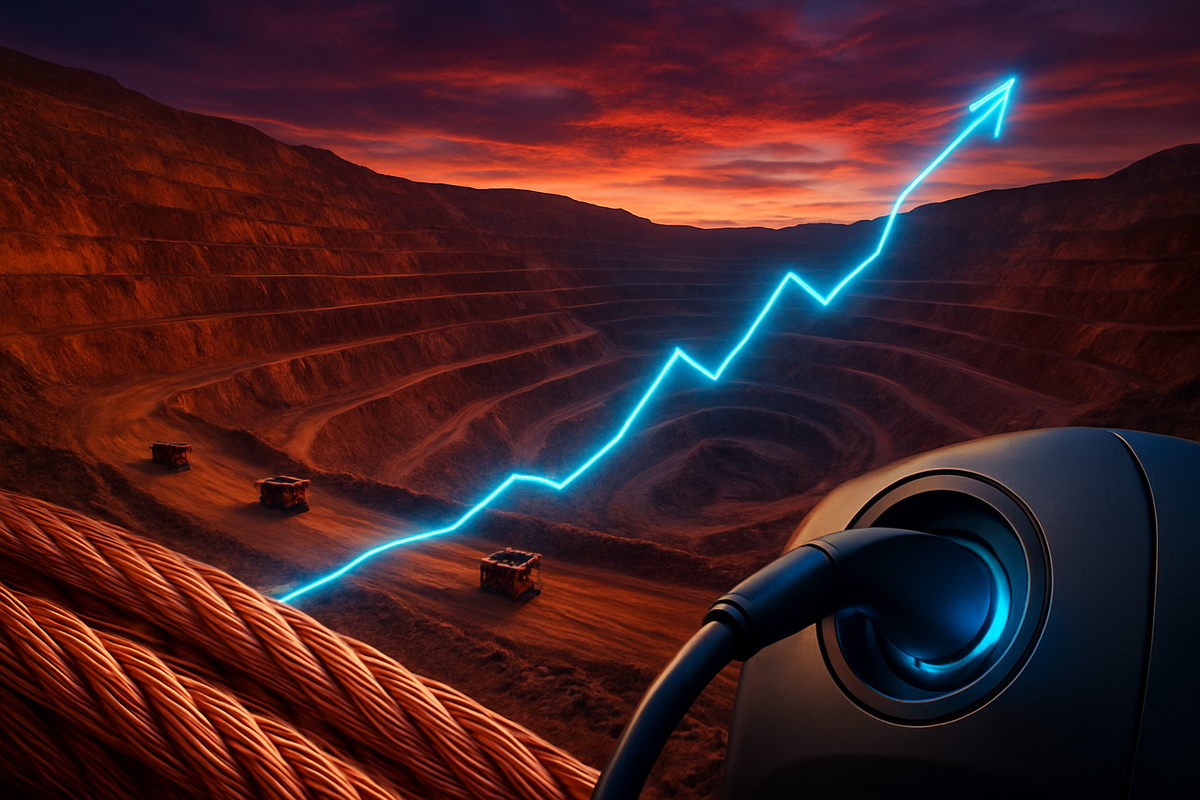
As of mid-January 2026, the global commodities market is grappling with a stark reality that researchers warned of years ago: the world is running out of the "red metal" just as it needs it most. Copper prices, which famously breached the $11,000 per tonne mark in a chaotic 2024 short squeeze, have continued their upward trajectory, recently touching all-time highs of over $13,200 per tonne ($6.00/lb). This price action reflects a structural deficit that is no longer a theoretical projection but a present-day crisis, fueled by an insatiable demand for artificial intelligence infrastructure and a slowing global transition to electric vehicles (EVs).
The implications for the broader economy are profound. As copper is the primary conductor for the modern world—found in everything from iPhones to power grids—the current price surge is acting as a massive inflationary weight on the tech and automotive sectors. While mining giants are reaping windfall profits, the "impossible" math of the global energy transition is forcing policymakers to reconsider whether a 100% battery-electric future is even geologically possible.
The Perfect Storm: From the 2024 Squeeze to the 2026 Deficit
The roots of the current crisis trace back to May 2024, when copper prices first hit record territory near $11,000/t. That event was characterized by a historic "short squeeze" on the COMEX exchange, where a lack of physical inventory forced traders to scramble for supply. Since then, the market has transitioned from a temporary liquidity crisis into a deep structural shortage. Throughout 2025, the industry saw a convergence of factors: a 300,000-tonne global supply deficit, the massive scaling of AI data centers requiring specialized copper-heavy cooling systems, and persistent labor unrest at key Latin American mines.
A critical turning point occurred in late 2025 when a series of operational setbacks at major production hubs curtailed supply. Freeport-McMoRan (NYSE: FCX) saw a significant reduction in its 2026 sales guidance following a major "mud rush" accident at its Grasberg mine in Indonesia. Simultaneously, the global appetite for copper grew by 4% year-over-year, driven by the expansion of the U.S. and European power grids. This mismatch has left inventories at London Metal Exchange (LME) warehouses at decade-long lows, providing the fundamental backdrop for the record-breaking prices seen this month.
Industry Titans and the Struggle to Scale
In this high-price environment, the world’s largest miners are walking a tightrope between record revenues and operational exhaustion. BHP (NYSE: BHP), the world’s largest mining company, has seen its stock price swell as its Escondida mine in Chile maintains high production grades. However, even BHP has warned that the "easy" copper has been found, and future production will require deeper, more expensive underground mining. Rio Tinto (NYSE: RIO) is currently betting its future on the Oyu Tolgoi project in Mongolia, which is finally ramping up to full capacity, but analysts note that even this massive project only fills a fraction of the projected global demand gap.
Conversely, the automotive industry and renewable energy sectors are the clear losers in this environment. Companies like Tesla (NASDAQ: TSLA) and Rivian (NASDAQ: RIVN) are facing surging bill-of-materials costs. Because a standard EV requires nearly 2.5 times more copper than a traditional internal combustion engine vehicle, these manufacturers are being forced to choose between raising vehicle prices—risking consumer demand—or absorbing the costs and watching their margins erode. Small-cap junior miners have also struggled; while copper prices are high, the cost of capital and the 20-plus-year lead time to open a new mine make it difficult for new players to enter the market quickly.
The Michigan Study: A Geological Reality Check
At the heart of the current debate is a landmark study from the University of Michigan, led by researchers Adam Simon and Lawrence Cathles. The study, which gained significant traction in late 2024 and 2025, posits that the global transition to 100% EVs by 2050 is "essentially impossible" for current mining companies to achieve. According to the research, the world would need to mine 115% more copper than has been extracted in all of human history to meet current electrification goals. To put that in perspective, the industry would need to bring roughly six new world-class copper mines online every single year for the next three decades.
The study highlights a grim historical precedent: it takes an average of 23 years from the discovery of a copper deposit to the first production of metal. This lag time makes the 2030 and 2035 "zero-emission" targets set by many governments appear mathematically detached from geological reality. The ripple effect of this study has already reached the regulatory level, with several European nations and U.S. states beginning to pivot their subsidies away from pure battery EVs (BEVs) toward Hybrid Electric Vehicles (HEVs), which require significantly less copper but still offer immediate carbon reduction.
Navigating a Scarcity-Driven Future
Looking ahead to the remainder of 2026 and beyond, the market is likely to see a strategic pivot toward copper thrifting and recycling. Large-scale tech firms and automakers are already investing in R&D to find alternatives to copper, such as aluminum, though aluminum's lower conductivity makes it an imperfect substitute for high-efficiency applications. Short-term, the focus will remain on "Resolution Copper," a joint venture in Arizona between Rio Tinto and BHP. While the project could supply 25% of U.S. demand, it remains mired in legal battles with tribal groups and environmentalists, illustrating the paradox of the green transition: the minerals needed to save the climate are often located in environmentally sensitive areas.
Strategic stockpiling will also become a permanent feature of the market. We expect to see more "direct-to-miner" deals, where automotive and tech companies bypass traditional exchanges to secure supply directly from the source. This "mineral nationalism" could lead to increased volatility and a fragmented global market, as nations compete for the limited refined copper available.
Final Assessment: A Metal-Constrained World
The copper market of 2026 is a vivid illustration of the friction between climate ambition and physical reality. The record prices near $13,000/t are a signal from the market that the current path of rapid, total electrification is hitting a wall. Investors should closely monitor the quarterly production reports from majors like Southern Copper (NYSE: SCCO) and Antofagasta (LSE: ANTO), as any further operational hiccups could send prices into an even more parabolic trajectory.
For the public, the "Copper Crunch" means that the era of cheap electronics and affordable EVs may be on a temporary—or perhaps permanent—hiatus. The key takeaway for the coming months will be the speed of permitting reform; unless the 23-year lead time for new mines can be drastically reduced, the supply-demand gap will continue to widen, making copper not just an industrial metal, but a strategic asset as precious as oil once was in the 20th century.
This content is intended for informational purposes only and is not financial advice